anecdote

The story behind a picture #2

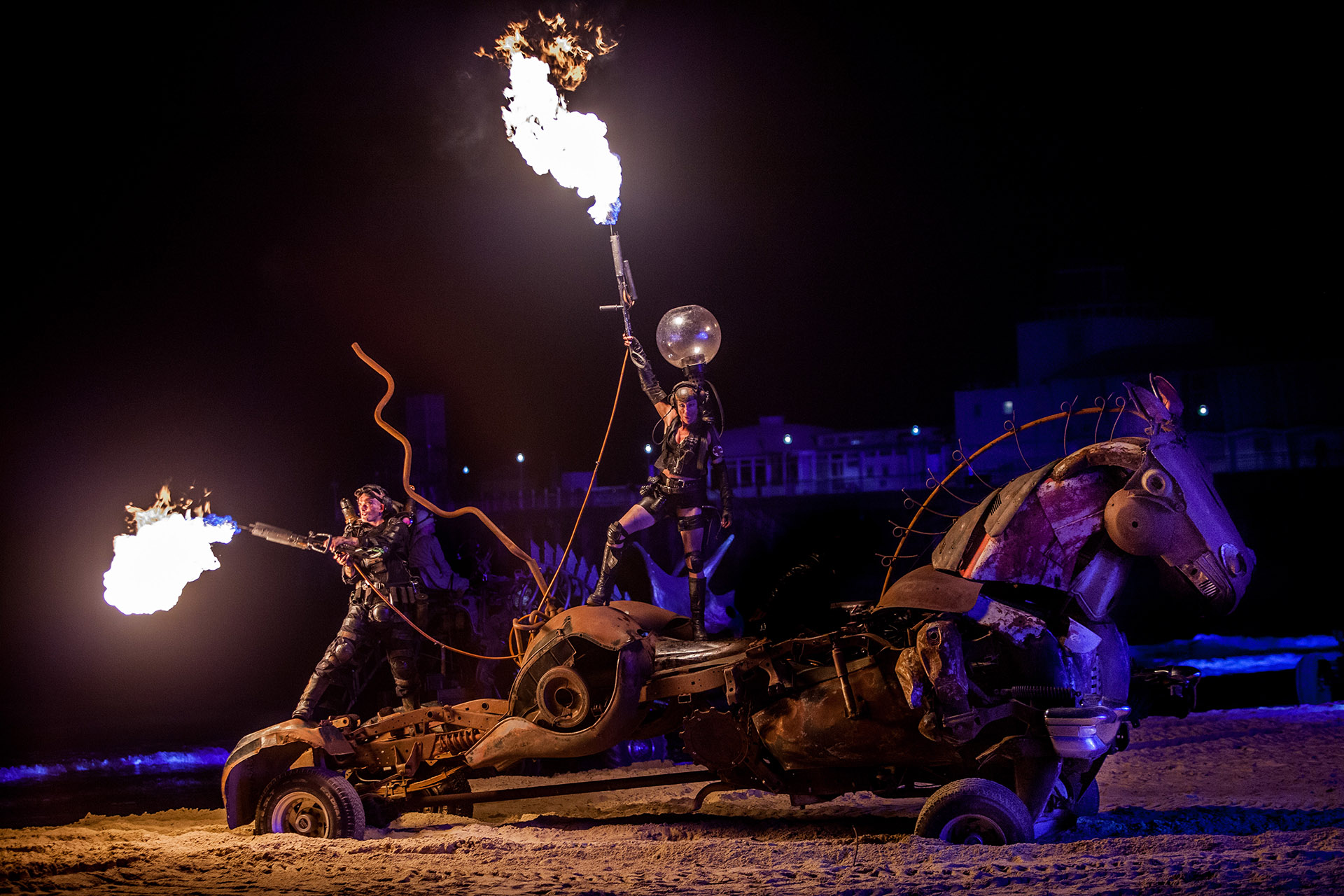
© Neil Turner. Joe Rush and the Mutoid Waste Company stage a spectacular demonstration of their vehicles on the beach next to Bournemouth Pier.

© Neil Turner. Joe Rush and the Mutoid Waste Company stage a spectacular demonstration of their vehicles on the beach next to Bournemouth Pier.

Back in 2013 the Bournemouth Arts By The Sea Festival was getting bigger and better and I was asked to come along and shoot some of the events. The climax of day two was to be a spectacular show on the beach next to Bournemouth Pier by Joe Rush and The Mutoid Waste Company who build and drive fantastic vehicles made from scrap. The organisers had penned off a large area of beach, put up a large public address system and once night had fallen the vehicles and their crews came onto the beach.

I had been there earlier in the festival when some of the vehicles had driven through the town and so I knew roughly what to expect. I got there reasonably early and staked out what I thought would be a good position with the sea and the pier in the background. I had two cameras with me – one with a 70-200 f2.8 and the other with a 24-70 f2.8 zoom lens. I had a couple of Canon speed lights and a high-voltage battery pack, plenty of memory cards and then waited for darkness and the start of the show.

Half a dozen vehicles sped onto the sand and I started shooting away without flash. It was pretty dark, despite the arc lights that had been positioned at various points around the perimeter. These vehicles weigh several tons and one or two of them got caught in the soft sand but that made for great pictures because the people who ‘crew’ them are artists and showmen and they gave the most amazing static display whilst waiting to be hauled free.
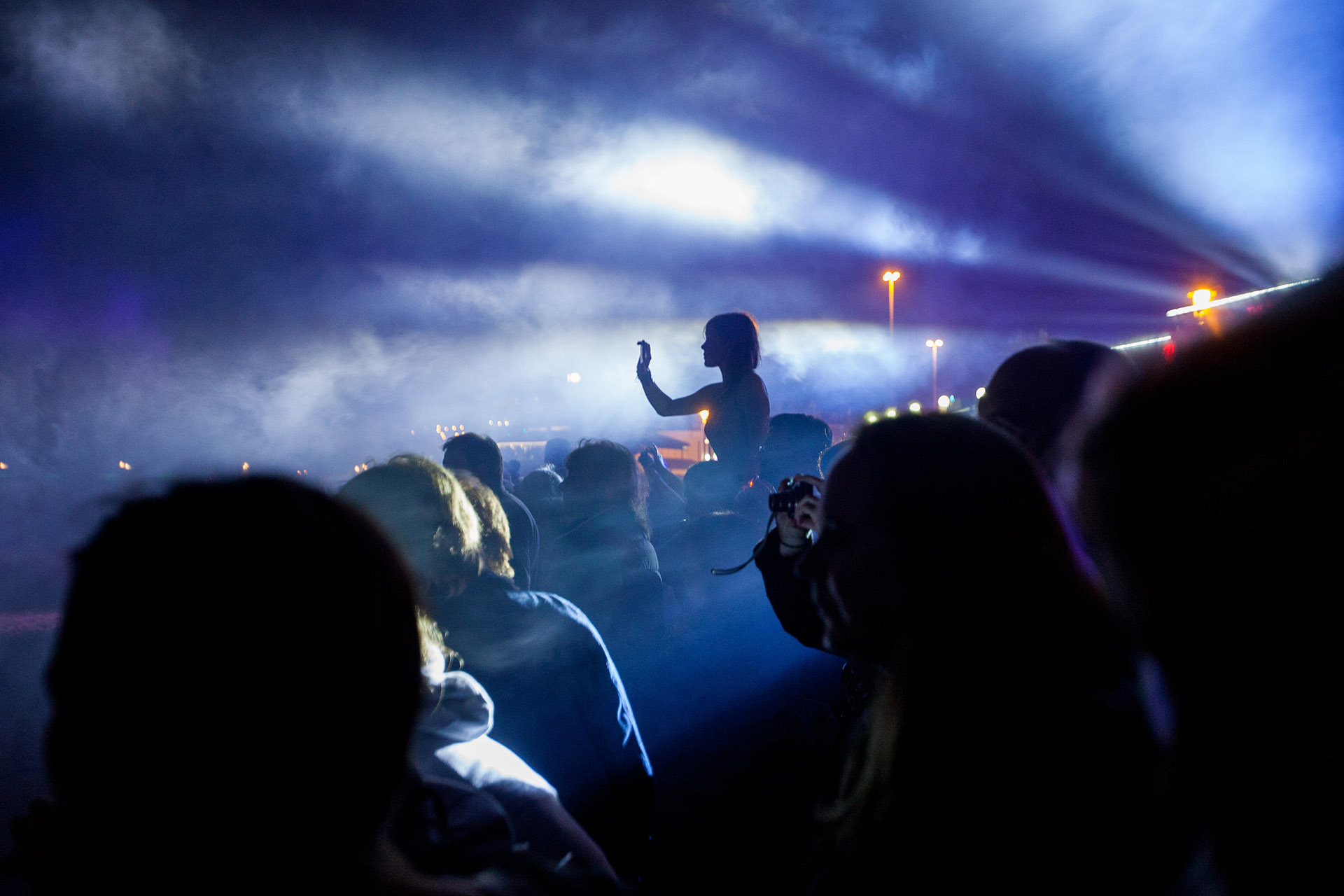
© Neil Turner. Audiences watching Joe Rush and the Mutoid Waste Company  on the beach next to Bournemouth Pier to close day two of the third annual festival.  Photo: © Neil Turner

© Neil Turner. Audiences watching Joe Rush and the Mutoid Waste Company on the beach next to Bournemouth Pier to close day two of the third annual festival.

The edit of the pictures was done in rapid time and sent to the client ready for the next day’s papers and any number of websites and social media platforms and accounts.

The 2015 festival takes place in October and I’m looking forward to seeing some of it up close.

Technical stuff: Canon EOS5D MkII cameras with Canon EF 70-200 f2.8L IS and 24-70 f2.8L lenses. Top picture 1/100th of a second at f2.8 on 2000 ISO with white balance corrected in Adobe Camera RAW. Bottom picture 1/25th of a second at f3.2 on 2000 ISO.

The story behind a picture #1

Young England cross-country runners posing for a photograph in Winchester. © Neil Turner/TSL

Young England cross-country runners posing for a photograph in Winchester. © Neil Turner/TSL

Even after nearly thirty years shooting photographs I can almost always remember something about ‘being there’ on the job when I look back at the pictures. There’s also a story to be told about why a particular picture was shot, lit or composed in a certain way.

A while ago I was posting a “photography word of the day” on Twitter and one of the first was compromise. This photograph of two rising stars of cross country running is a classic example of compromising to get a decent shot.

When I arrived at the college where they were both studying neither of them had their kit with them to do an action shot. Luckily their England team tracksuits had arrived and so I had to manufacture an action portrait of them that left one important part out of the frame – their feet. Neither of them had suitable footwear to be photographed in action and so I had to find a way to shoot them without drawing attention to their lack of running shoes.

In front of the college was a large banked area of grass and playing fields. I realised quite quickly that I could get the best of the light (dusk was fast approaching), lose most of the buildings and hide their feet by getting down low and using one of the banked grass areas to fill the foreground as they ran towards the low angled sun whilst shooting on a long (ish) lens.

So that’s what I did. The two runners were amused by the lengths to which I was determined to go to get a decent shot. They had been photographed two days before but just wearing their street clothes and standing by the college sign and they had assumed that I’d do the same. They did about ten lots of the ten yard run that had them in the right place and I shot some of them horizontally and the others vertically to cover the possible shapes that the newspaper might use. I also shot it using a range of aperture and shutter speed combinations to get the depth of field right.

I did some static upper-body photographs as well as having them pose with their trophies (feet hidden) on the grass.

Technical stuff: Canon EOS1D MkII with a 70-200 f2.8L IS lens. ISO 320, 1/1000th of a second at f6.7

Three weeks in a bunker

Court 14 - above the Photographers Workroom. ©Neil Turner, June 2015

Court 14 – above the Photographers Workroom. ©Neil Turner, June 2015

There aren’t too many offices with a cooler roof than the one I’ve spent the last three and a bit weeks working in. The brilliant new Photographers’ Workroom at the All England Lawn Tennis Club is directly under courts 14 and 15 and having world class tennis being played on the office roof isn’t an every day boast!

For the second year running I have had a contract to work as a Picture Editor for the AELTC and I can honestly say that it is an exciting, exhausting, fulfilling, frustrating, full-time and full-on twenty three days.

I get to work early in the morning just as the Ground Staff are starting to get the courts ready for action and I leave as they are putting most of them back to bed for the night. In that time thousands of top class photographs cross my screen and I have hundreds of conversations with our photographers and the dozens of other professionals with whom we work.

What I don’t get to do much of is take pictures. A few snatched frames on my Fujifilm X100S on my way in and my way home and some candid shots of the team in the office are my only chances to use a camera. (more…)

Zooming with your…

©Neil Turner/Bupa 10,000. May 2015. A Police rider accompanies a detachments of Guards as they march back their barracks.

©Neil Turner/Bupa 10,000. May 2015.
A Police rider accompanies a detachments of Guards as they march back their barracks.

I was on a job the other day, standing next to a very young photographer in a ‘press pen’. He glanced over at the gear I was using and mentioned how much he would love to own the 135mm f2L lens that I had on one of my cameras. He said that he had never really got the hang of “zooming with his feet” in the way that so many of the photographers he admired had advised. He had also had it drummed into him by one of his tutors at college and it had left him wondering if he was doing something wrong.

Zooming with your feet is a great concept and it is one of the catchphrases in contemporary photography that appears to be beyond question. But is it? Is it actually as much a cliche as a universal truth?

There we were on a job where we couldn’t have zoomed with our feet even if either of us had the skills to do so. We couldn’t go forward – there was a metal barrier in the way. We couldn’t go backwards because there were other photographers and a couple of TV crews behind us – and behind them was another barrier. We had a tiny amount of sideways movement if we could change places with each other but, apart from that, we were in a very fixed position. (more…)

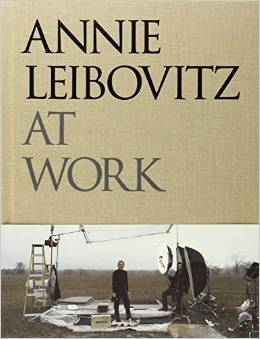
Having read “Annie Leibovitz At Work”

liebovitz_coverI doubt that you’ll be surprised to hear that the vast majority of the books sitting on my shelves at home are collections of photographs. I have books by most of the greatest photographers who ever lived and I find them to be a constant source of inspiration as well as a great help in keeping my feet on the ground. Every time that I need ideas I see what they did and every time I think I’ve done something great I realise that many other people did it before me and often better than me.

One of the biggest sections is the one devoted to Annie Leibovitz. I admire her and I admire her work. I don’t necessarily want to be the kind of photographer that she has become and I definitely don’t want to do the kind of work that she is most famous for but there is a great deal of inspiration there.

For my birthday a few months ago I was given a 2011 copy of her 2008 book “Annie Leibovitz At Work”. It is partly a biography, partly a summary of her professional life and an interesting insight into how she feels about the job that she has done since leaving college. There are also copies of many of her greatest pictures in it – although it’s the words that I want to talk about here.

When I read it a month or so ago I did so immediately after reading Roger Allen’s excellent “The Darkroom Boy 40 Years on Fleet Street” which is a funny and honest look at the life and career of one of the greatest exponents of the newspaper photographer’s craft. (more…)

Reliance on the internet

As photographers we have got used to using a range of web-based technologies to deliver our work to our clients. Most of the time it works and nobody notices how amazing these technologies are. Over the years we have come to expect more and more in terms of bandwidth and speed and we have come to rely on getting good connections to easily accomplish what would have been regarded as time-sensitive alchemy only a few years ago.

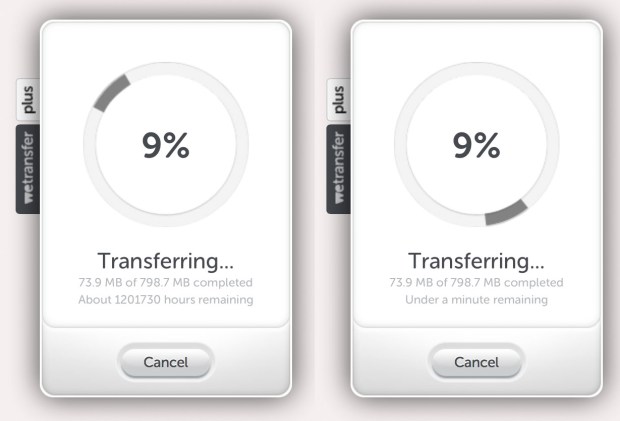
On an overseas job last week the client wanted a lot of high resolution Jpegs delivered to them very quickly and their chosen method was WeTransfer. It’s a very good and reliable system in itself but it depends on a half decent internet connection. Sadly we didn’t get that connection and out of sheer frustration I did these screen grabs:

wetransfer

Yes that’s right: one million, two hundred and one thousand, seven hundred and thirty hours to complete a transfer that should have taken about half an hour on a half decent network. In case you are interested that is fifty thousand and seventy-two days or one hundred and thirty-seven years and sixty-five days. A bit slow. The second screen grab says less than a minute but that was also wildly inaccurate as no further data moved.

In the end I had to abandon the ethernet and wifi networks that the client had arranged for us to use and head outside where I could pick up a great 4G mobile signal by tethering to my iPhone and use my roaming package to send the pictures – which took about 44 minutes (by then I had 1.2Gb of pictures). The point here is that now we have come to reply on the internet for almost all of our image delivery it has become crucial that we have multiple ways of connecting to the internet.

Twenty-five years ago today

©Neil Turner, 13th February 1990. Whitecross Street Market, London EC1.

©Neil Turner, 13th February 1990. Whitecross Street Market, London EC1.

Over the last few years I’ve posted a few pictures from my own filing cabinet when they have had some relevance or when there is a specific anniversary. This picture was taken twenty-five years ago today as I went for one of my regular wanders around bits of London that were near Metro – the 24 hour laboratory where we all got our E6 transparency film processed. It was about a mile and a half from our Hoxton office (before it was trendy) and it took about twenty minutes to walk there or five minutes to drive. Sometimes there would be other photographers around and we would adjourn to a local cafe for a cup of something and a sandwich and at other times I’d take myself off for a walk around one of the many fascinating side roads and markets that made up the Clerkenwell/Farringdon/Smithfield area and take a few personal and/or stock pictures whilst the film made its hour and three quarter journey through the system and the ‘soup’ at Metro.

On this particular day I went to Whitecross Street with a couple of cameras and a couple of rolls of Kodak Tri-X film. It is amazing what you remember when you start to think about a day and a place and my memory of this day is that I was half an hour into the walk when I bumped into another photographer (there were three or four agencies close by) and we had a coffee anyway!

The man in the photograph (who said his name was Frank but I’m not sure he was being 100% honest judging by the cheeky look in his eye) had been a stall holder at the market selling books and a few magazines for many years. Trade was brisk as the workers from the many offices on the edge of the City of London were having their lunch hours and I didn’t really finish my conversation with him.

Anyway, another ‘archive’ picture that brings back happy memories and brings a smile to my face. This was, quite literally, half of my lifetime ago and I still love the photograph.

Techie stuff: Nikon FM2 camera with a 135mm f2 Nikkor, Kodak Tri-x film.

Electronic viewfinders and me

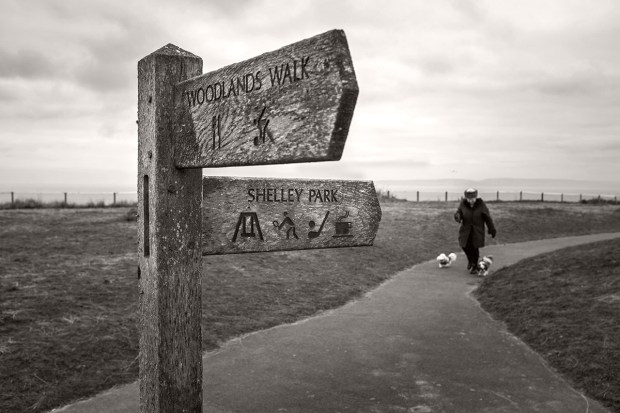
©Neil Turner, February 2015. The cliff tops at Boscombe on a dull winter's day.

©Neil Turner, February 2015. The cliff tops at Boscombe on a dull winter’s day.

A few months ago a colleague whose work I know and love said that it took him a little while to get used to electronic viewfinders and now that he has been using them for a while he cannot remember why he had been so resistant to them in the first place. Resistant to electronic viewfinders? That summed up my attitude until a couple of weeks ago too. After carrying my beloved Fujifilm X20 around with me I decided that it was time to give an X100S a run out. The lack of a zoom lens and the small jump in size and weight is compensated for by a big increase in the higher ISO quality (which isn’t to be sniffed at during the winter time) and a few more megapixels (allowing a bit of judicious cropping here and there) and so for the last few weeks I have been shooting my personal work with the X100S. The idea hit me that now I had the option of using the electronic viewfinder (to be known as the EVF from here on in) instead of the optical viewfinder (known from here as the OVF) and that’s what I started to do.

For the first few days I was getting annoyed by the EVF to the extent that I had to have a few days off from it. During that time I shot some photographs that I really liked and I had to force myself back to using the EVF with something of a heavy heart. That was just over a week ago and I am now really pleased to announce that I have got the hang of shooting using an EVF. Welcome to the twenty-teens, welcome to the world of the EVF enthusiast and welcome to a wide world of possibilities I hear some of you saying. Not quite.

The current situation is that I am perfectly capable of shooting with an EVF and that I can see why some photographers have made the switch but not me. I still prefer the OVF to the extent that I don’t want to use the electronic version and to the extent that the kind of work that I have been doing with my Fujifilm cameras isn’t as fulfilling without the old-school optical set up. If I were tempted to buy a Fujifilm XE-2 or an XT-1 I’d have to forego one of the main pleasures that I derive from using kit that, despite some huge flaws, makes me want to go and just shoot pictures.

I’m not going to tell all of the EVF enthusiasts I know that they are wrong but I am now in a position where my choice to carry on using OVFs and DSLRs is made from knowledge and not from ignorance. There, I’ve said it.