Dorset

Every picture teaches a lesson

©Neil Turner. Poole, Dorset. September 2008

We all know that “every picture tells a story” but how many people think that, as photographers, every picture teaches us a lesson. Grab a picture – any picture – and really look at it. What’s good about it? What could you improve if you went back and re-shot it? If it’s perfect, why is it perfect?

I spent a lot of time yesterday shooting on mixed light with no real option of lighting the scene (a busy retail mall with dozens of shops and lots of people). Looking back at the best of the shoot this morning I could see that every frame had one major feature: one thing that was the single most important part of the composition and it was obvious that I should always get the white balance right there and let the rest of the scene do what it will. I already knew this but it doesn’t hurt to look and re-affirm what you already know.

Every time you shoot pictures and every time you look at other people’s work you can learn lessons. If you don’t know how something was shot – see if the photographer will tell you.

Look for the big four factors: subject matter, composition, light and technical quality. Work out how those factors come together to create the whole. Work out if the picture still works if one or more of those factors is deficient. It’s amazing how often the most eye-catching images are not perfect in every way and it is equally interesting that some pictures that score full marks in all categories just seem boring and “too good to be true”.

Analysing your own work on a regular basis is a great way to get better. Getting together with others and discussing each others work is great too but, for my money, going over your own work on your own is a fabulous way to find your style and motivate yourself to do better and better.

Observational, interactional and ‘dictational’ photojournalism

If you believe the old saying, “there is more than one way to skin a cat” and if you want to carry that thought over into photographic journalism there is definitely more than one way to shoot a story. If you listen to some debates about photojournalism you would find that hard to believe but regular readers of my opinion pieces about photography will know that I am a big fan of the ‘black to white, left to right theory of just about everything’.

©Neil Turner. Bournemouth, Dorset. 11 minutes past 11 on the 11th of the 11th 2011

The idea goes like this: imagine a line from one side of a page to the other and that one extreme of something is placed at the left hand end of that line. Now imagine that the opposite extreme is placed at the right hand end of that line. For illustrative purposes, let’s make those two extremes black on the left and whit on the right. What have you got in between? Every tone of grey that you could imagine. You can have one smooth gradient or you can have it in steps – it really doesn’t matter but what you will have is a smooth transition from one extreme to the other. Salt to sweet. Short to tall. Narrow to wide. It really doesn’t matter.

So how does this translate to different ways of shooting photographs? We are talking about photojournalism here and so I’d like to place “observational” at the left hand end of our imaginary line and “interactional” in the middle with dictational at the other end. That’s the easy bit. What exactly are these three approaches and what else sits along our line?

Observational photography can be defined as a ‘fly-on-the-wall’ approach where the photographer is an almost ghost like figure who tries to have little or no impact on the situation and their subject matter. Some types of street photography where the photographer tries their best to remain unseen and unnoticed are classic examples of observational photography. Some would argue that a lot of sports photography fits these criteria too – after all, the cameras are there but nobody is changing their behaviour for them for 90% of the event. By definition observational photojournalists don’t seek any meaningful contact with their subjects whilst they are shooting and most would eschew contact once they have finished taking the pictures either.

Good photojournalism is nearly always accompanied by good and accurate captioning – which is easy if you are photographing a Manchester United game or the Olympic 100 metres final because the participants have names and/or numbers on their kit and they are all famous athletes. If you are taking pictures of people running from an approaching storm then you would like to know who they are and where they are heading but the only way to find that out is to ask. I can remember a number of occasions where I’ve shot lovely street photos whose value as works of curiosity is pretty high but whose value as a piece of photojournalism is a lot lower because I didn’t have the details of the people in the pictures. When I was young and keen I regularly followed people and plucked up the courage to get their name. These days I tend not to shoot the picture if having no details for the caption devalues the image.

So that’s observational photojournalism dealt with. What about it’s interactional cousin? This is where I’m happiest. Shooting pictures with the full knowledge and either permission or acquiesence of my subjects in ways that allow me to interact with them whilst maintaining the integrity of the pictures is, for me, the gold standard. You can tell stories, relay passions and miseries and generally get under the skin of people. Interesting people. By interacting with your subject the nature of your pictures changes and they will have a lot more of you and a lot more of your subjects soul in them.

Back to that pesky scale… you have observation at one end and interaction in the middle and dozens of shades of whatever you would call it in between. Then there’s the final form of getting the pictures: dictational – where you tell your subjects what you want them to do and then shoot it but I’d find it hard to label that as photojournalism at all. I’ve put it there on our scale miles away from observation and a fair distance from interaction too.

Let’s say that observation is the black on our scale and ‘dictatorial’ is white. What colour is interaction? 18% grey of course! (photographer joke – if you don’t get it, I apologise)

The anguish of editing your own pictures

©Neil Turner. London, January 2011

I’ve written about this kind of thing many times but it seems to come to the forefront of my photographic consciousness over and over again so I hope that you will forgive me if none of this is new.

There are a lot of great reasons why photographers have to edit their own work. They are the only ones who truly know what was shot, why it was shot that way and how well the pictures reflect the situation. For news photographers the idea of someone else doing their edits is, largely, a far-fetched and even unwelcome notion. It is happening more and more though.

Some of the big wire agencies and more progressive newspapers are using direct wireless transmission from cameras to editors on big sports and news jobs where the time between shooting the pictures and getting them to market is absolutely critical.

If, however, time is not quite so much of an issue photographers like to sit down and go through their own pictures, make their own selections, add their own captions and prepare the files for delivery. That’s how I’ve worked for the last fifteen years or so and even before then I was often in charge of my own edits because that was how things were done.

Every once in a while (mostly on commercial shoots) someone else edits my pictures. I find it both liberating and scary in equal measure. The liberation is that I get to concentrate on shooting pictures and the scary bit is that someone else gets to see everything – the good, the bad and the downright indifferent. What if they miss the subtlety of that amazingly constructed picture on the second memory card? What if they don’t appreciate the ultra-shallow depth of field that I grafted so long and hard to realise?

There’s a good counter-argument to that of course: If a professional editor doesn’t get what I was trying to do, neither will the client, neither will the designer and neither will the viewer. There are some pictures that you take on almost every shoot that are there for you and for you alone. That is true but every once-in-a-while those pictures do get used. Every once-in-a-while somebody else gets your vision and loves the ‘weird one’ as much as you hoped that they would.

Editing your own work is a tough thing to do. Try editing a full set of someone else’s pictures and you will realise just how easy it is to be dispassionate and just how readily you are able to discard pictures that don’t work. Editing your own work can be a minefield. Every step can bring a very tricky decision. What about the pictures that you have a personal emotional connection with? What about the pictures that you have overcome huge technical challenges to secure? What about the pictures that don’t actually add to the edit or make sense as part of a set?

Taking a shoot and making sense of the pictures from that shoot is a skill that very few photographers ever truly get right. Those that do are blessed and really lucky because they avoid the regular pain and anguish of having to ignore their own ‘babies’.

I have four things that come into my mind every time I am struggling to decide about a single frame: light, composition, subject matter and technical quality. If all four are right the picture goes in. If three out of four are right it will probably make it too. Less than three and that’s where the anguish begins…

Think Tank Hydrophobia

Ever since I managed to soak one of my Canon EOS5D MkII cameras at an outdoor event last summer where it rained hard and non-stop I have been meaning to get my hands on a Think Tank Hydrophobia rain cover. I finally managed to get around to it just as one of the longest dry spells (work and weather) hit but I have finally given it a run out. The job actually meant using a tripod quite a lot and, whilst the Hydrophobia wasn’t actually designed for this, it all worked out well.

As predicted, I got a proper soaking (cold, wet rain) and I got very cold but my camera stayed dry and kept on working. The version that I have is designed to be used with a 70-200 f2.8 sized lens and it has small sleeves for your hands to fit inside the cover. There’s an option to have a flash unit attached too on the version that I have and so this is a very well designed piece of kit.

A word of caution

Even the best designed kit has a few features that you need to be aware of. The Hydrophobia does a great job and it worked flawlessly but I’d love to see a big sign included in the package telling you to have a few practice goes at fitting the cover before trying to use it on a job in front of clients and/or other photographers. Fitting it for the first time was a fairly frustrating process. Happily I had the sense (too many bad days with soft boxes and tents) to try it first in the warm and dry confines of my kitchen. The second time was in the car and it was actually my third go at fitting the cover when I had to do it in the dark and the rain in front of others. I was still a little ham-fisted but fitting it for the fourth time today so that I had a few pictures to accompany this piece was a (relative) breeze. Practice does indeed make perfect.

What else you can actually say about a piece of kit that is essentially designed to keep your gear dry than “it kept my gear dry” is beyond me. If it came in a tin, it would do exactly what it said on that tin!

So… marks out of ten? For doing its job it gets 10 but for ease of use I’d give it a 5 out of the packaging rising to 7 after four uses and an even higher mark with lots of practice.

Training on Weymouth beach – an unusual portrait

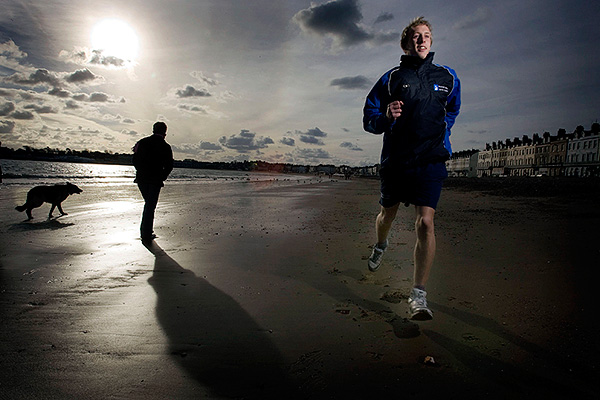
Sometimes pictures come together without much effort and sometimes you almost kill yourself trying to get something just that little bit special. This portrait of a young athlete who was competing in the sport of Biathle for Great Britain at a junior level whilst studying at a college in Weymouth, Dorset definitely came along after a not insignificant struggle. Nothing to do with the subject – he was cooperative, willing and full of energy – I just tried to get pictures that didn’t seem to want to come off.

©Neil Turner/TSL. Weymouth Dorset, December 2007.

This frame was shot on a 16-35 f2.8L lens at its widest focal length on a Canon EOS1D MkII at 1/250th of a second at f22 and 200 ISO. I was using every joule of power from a Lumedyne Signature Series flash kit with no umbrella or soft box and I just had the power to get this. I have always liked the photo and I was always sad that the paper didn’t use this frame.

I guess that this picture is further proof that I love shooting beaches – especially Dorset beaches!

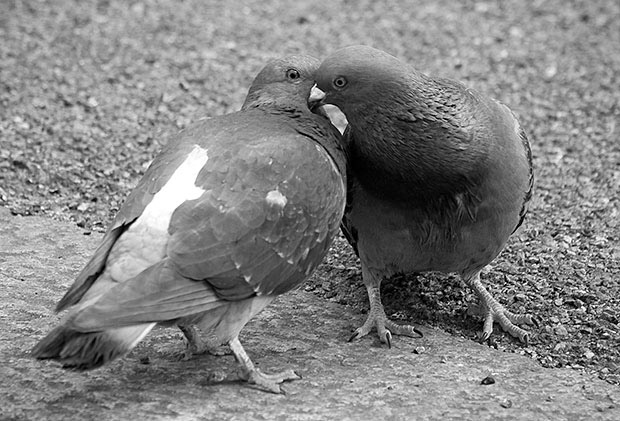
Fun picture – pigeons checking each other out, Bournemouth

©Neil Turner. February 2012. Bournemouth

I don’t know if spring is in the air but these two pigeons outside a supermarket in Dorset this morning look as if they were rehearsing for Valentines Day next week.

Canon announces a new 24-70 f2.8L lens

New objects of desire on the equipment front will probably start to appear with monotonous regularity between now and The London 2012 Olympic games. Overnight Canon have announced a new version of the 24-70 f2.8L lens – the mark II.

The older version has been my workhorse for so many years now that I would find it hard to do my job without one and the appearance of a new (and improved?) version makes get my abacus out and start to apply the cost/benefit calculations that professionals need to make every time we consider a new piece of kit.

If I decide that I cannot justify buying it, then it still remains an object of desire! Apparently another major camera manufacturer has also been busy on the launch pad overnight. Nikon have announced the D800 with more megapixels in a 35mm style DSLR body than anyone thought possible/desirable/necessary. Given Nikon’s recent track record of getting things right I would not bet against this being a great piece of kit and a runaway success. For my part, I hope that the next full-frame Canon doesn’t follow suit and re-ignite the megapixel race. A 5D MkIII with decent AF and a chip at around 24-25 megapixels with decent options to shoot smaller (and maybe custom sized?) RAW files would suit my needs rather well.

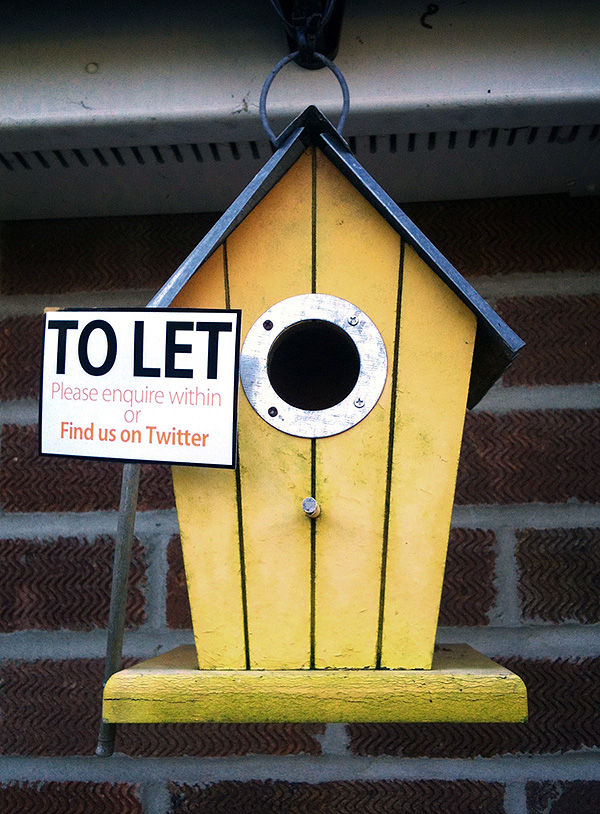
Fun picture: bird house to let

©Neil Turner. February 2012, Bournemouth

Completely staged photo opportunity this morning in Bournemouth…