education

Poor old Photographer B

There is a heated discussion about the winner of this year’s Taylor Wessing Portrait prize on a photographers’ forum at the moment. Some people love Spencer Murphy’s picture and other’s don’t get it – which makes it a perfect demonstration that personal taste is a major factor in “liking” an image. One thread of the debate is the winning photographer’s use of large format film and The Guardian having quoted him as saying “I chose to shoot the series on a large format film, to give the images a depth and timelessness that I think would have been hard to achieve on a digital camera.” Hard to achieve? Hard for whom?

All of this prompted me to expand a little on something that is happening in photography right now that frustrates me: To make myself clear – I applaud photographers who find ways to make an overcrowded and homogenised market work for them and I applaud the way that they are using different methods to enable them to “see” better.

The idea is gaining momentum that just because something is shot on film it somehow has greater validity and greater truth. This really angers me.

If Photographer A likes the way that they work with film and that there is a market for that work then Photographer A has found a niche and I’m happy for them. Photographer B on the other hand creates great work without resorting to film but potential clients who have bought into the myth about the validity of film are already starting to question why Photographer B isn’t going with the fashion and using Photographer C who is happy to take the money but doesn’t work better on film. Basically, we are in a situation where the means of production could overtake the end result as the goal of the commission. Nobody wins – especially photographers D-Z.

The place where this is most frightening is in our colleges and universities where the small resurgence of film is being leapt upon by lecturers who are miles out of their depth in the digital world supported by managers who are desperate to validate their investments in silver based facilities and avoid having to spend on up-to-date digital ones. We have a generation of students being equipped for professional life in the 1980s based on the achievements of a tiny number of photographers achieving critical acclaim by “seeing differently” and then talking nonsense about it to a small clique of art lovers who lap up all of this stuff so that they can repeat it at Islington dinner parties and sound as if they know what they are talking about.

I come from a newspaper background where there is a good deal of nostalgia for shooting film. Happily most of us who wish to can indulge in this kind of work as part hobby and part self-expression. Each to their own and vive la difference and so on. We owe it to ourselves and each other to take the utmost care that our professional lives are not going to get hijacked by a notion that film – or “heritage media” as I quite mischievously like to call it – is better. After all, there’s a lot of truth in the old saying “be careful what you wish for.”

For the record I like Spencer Murphy’s work and I don’t blame him for mining the niche that he has helped to create. Portraiture should be about telling the subject’s story and not about how we shot the picture. I’ve been guilty on many occasions of shooting pictures where you notice the “how” before the “who” and the “why”. Photographic portraiture is as difficult as you want to make it. Spencer Murphy suggests that he has made a virtue out of simple by shooting with what is in truth a complex medium. My head hurts…
Charity PR portrait

©Neil Turner, July 2013. The Victoria Education Centre & Sports College

©Neil Turner, July 2013. The Victoria Education Centre & Sports College

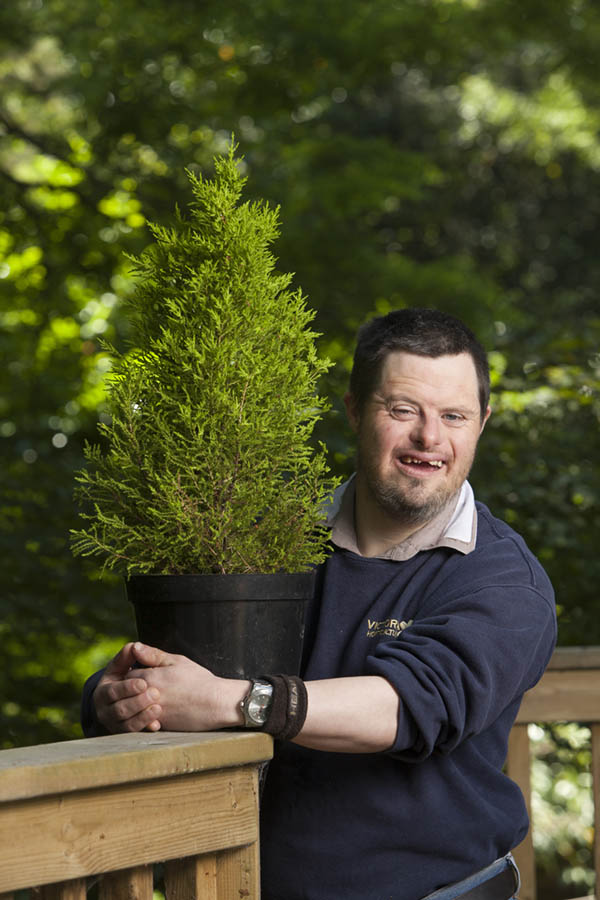
Back in July I was commissioned by Livability to go to the Victoria Education Centre & Sports College to shoot a range of pictures for their in-house publications, websites and PR work. I’d worked on news events a couple of times with the charity before but this was the first time I was shooting this kind of job for them. The afternoon started in the horticulture department where a team of professionals and volunteers works with students and clients growing a range of plants for use around the college and for sale to visitors and the public.

The young man in this picture volunteered himself for this picture and he chose which of the several hundred plants he wanted to be photographed with which made my job rather easy. I found this railing in the woods behind the greenhouses and poly-tunnels (where the work gets done) for the portrait. I chose it because I liked the way that the light was coming through the mass of green foliage, because the rail was sturdy and a great height and because I could see the scope for lighting the foreground in balance with the lovely ambient light in the background.

The photograph that you see here is completely ‘as shot’ with no cropping, no white balance adjustments and only a very simple tweak of the shadows in Adobe Camera RAW from the Canon CR2 files from an EOS5D MkII.

I knew that I wanted to shoot with a relatively shallow depth of field so that the background was sufficiently blurred. I was able to get back a decent distance and so I decided to shoot on my 70-200 f2.8L IS Canon lens and to light the subject with my Elinchrom Ranger Quadra with a shoot-through white 100cm umbrella. Once I had everything set up:

  • The flash was just under two metres away from the subject
  • About 30 degrees from the axis of the lens and ten degrees above his eye-line
  • A quick Custom white balance using the Lastolite EzyBalance grey card
  • It quickly became obvious that shooting at f2.8 or even f4 wasn’t really going to work – I wanted to have the whole plant in focus as well as my subject and then have the whole background as far out of focus as possible.
  • I shot a few test frames and looked at them on the LCD screen before opting for a third of a stop wider than f8 (f7.1 according to the EXIF data) and a balancing shutter speed of 1/80th on 200 ISO.

This gave me the lighting balance that I wanted and the depth of field was as good a compromise as I could get. These shoots are always a mass of compromises and that’s one of the biggest lessons that I try to teach when doing seminars and workshops.

I often get asked about the time it takes to shoot these kinds of pictures and the answer in this case was from the moment I unzipped the bag with the light stands in to shooting the first meaningful frame was just over four minutes. I then had another three minutes before other people were demanding the subject’s attention and it took a final three minutes to pack the kit away again – a nice round ten minutes from start to finish. That’s nowhere near being a record but it was comfortable for me and the subject and it really helps that the client liked the results.

Back when I first started to use portable lighting in this way I used to have a Lumedyne head already on a stand in a sling bag with a pack already connected and used a simple umbrella with Pocket Wizard triggers. I used to boast that my kit was not only lightweight but well planned and that I could be ready to shoot in under forty-five seconds from the time I touched the zip on the bag. When I did seminars and talks I’d even get people to time me getting the kit out and regularly beat forty-seconds. These days I’m a bit slower and I carry a bit more kit (I’m also a fair bit older by the way) and so a three minute set-up and break-down time is pretty good (three and a half minutes if there’s a softbox involved). It means that even if your subject is watching you, they don’t really get the chance to get bored waiting.

The rest of the day was fun and the other highlights were the students playing Boccia (a sport that I hadn’t encountered before last year’s Paralympics), one young woman showing off her excellent art and spending time with younger students and their rather docile rabbits.

Anniversaries

©TSL. July 2004. Nine years ago this week Canon delivered my first EOS1D MkII. I shot for the first time with it on a job where staff were using acupuncture in a Sussex school to help boys with their behaviour.

©TSL. July 2004. Nine years ago this week Canon delivered my first EOS1D MkII. I shot for the first time with it on a job where staff were using acupuncture in a Sussex school to help boys with their behaviour.

I woke up this morning to the headline news that it was Nelson Mandela’s 95th birthday. It is also my next-door-neighbour’s 50th birthday and my nephew’s partner is having her birthday celebration this evening as well. I started to think about things that had happened on (or near) this day over time in my life and I came up with a few:

  • 18th July 2012: I was working as a member of the Photo Operations team at the London 2012 Olympic and Paralympic games. I have written before about just how exciting, tiring, inspiring and memorable it was but with the first anniversary athletics event about to happen those memories are coming back as strongly as ever.
  • 18th July 2011: I was coming to the end of the very first cycle of the NCTJ Photojournalism course that I help to teach at Up To Speed in Bournemouth whilst shooting a wide range of both editorial and corporate commissions. That was also an exciting time but for very different reasons.
  • 18th July 2010: I was shooting mostly corporate photography and things were starting to go quiet for the summer months. Really quiet as it turned out.
  • 18th July 2008: I was still employed as a staff photographer at TSL and I spent the day shooting a lovely set of pictures at a school in Hertfordshire that had spent a small fortune making their new building and the grounds as environmentally friendly as possible. I was still unaware that two weeks later I’d be called into a meeting with the Editor and the HR Director to be told that they were making me redundant.
  • 18th July 2003: I had been using my Canon ESO1D cameras for over a year and I was in love. The CRW file format was something of a revaluation and I really enjoyed using it.
  • 18th July 1999: http://www.dg28.com had just been born – I started to publish samples of my work and a few bits of technique advice on my own website for the first time.
  • 18th July 1997: I was starting to experiment with borrowed and rented digital cameras before getting my own DCS520 in late October 1998.
  • 18th July 1995: A month previously I got my own scanner (Kodak RFS2035) and Mac laptop (Powerbook 160c) with Photoshop (v2.5) and began the long journey to digitisation
  • 18th July 1994: Having become a staff photographer at The Times Supplements in January 1994 I had just swapped from shooting with Nikon F4s to Canon EOS1n cameras.
  • 18th July 1993: Life was fun, fast and decidedly unpredictable. One day I would be shooting for a newspaper and the next it was a glossy magazine. On the third day it might be a PR job and you could lay money down that every week would be different from the last. I was shooting with a mixture of Nikon F4, F801 and FM2 cameras as well as having Leica M6s. Some days it would be black and white and some days it would be colour transparency. Some days I’d be using lights and others required nothing more than a fast lens.
  • 18th July 1983: I was working for Jessops when they only had five shops, offered great deals and great service and everyone knew the Jessop family. I was using Olympus OM1n cameras at the time and had acquired an awesome 35mm f2 Zuiko lens.

My career has (so far) failed to stand still for more than a couple of years. Technology changes, my employment status changes and I change. All of that adds up to excitement and that triggers a feeling of keeping it fresh. My style constantly evolves and the client base also evolves. A lot of my colleagues spend a lot of time bemoaning the disappearance of the ‘good old days’ and I am also prone to a bit of nostalgia but we are where we are and just under five years ago I wrote this line:

“It’s an exciting time to be a photographer with new challenges being presented every month and I am on record as saying that I am a very lucky man to be doing what I do.”

Today I’m shooting a nice mixture of editorial and corporate work as well as doing some teaching, writing and consultancy. I spend a lot more time on the beach and I’m constantly looking forward to the next exciting development… whatever that turns out to be!

No such thing as professional?

yahoo_screen

Yahoo’s CEO Marissa Meyer made a stupid remark yesterday whilst announcing a complete overhaul of their Flickr photo-sharing website service. She actually said was that “…there’s really no such thing as professional photographers anymore”. Like many people who used to think that they were professional photographers I became very angry.

What I’d love to happen next is to get commissioned to shoot her portrait for a major newspaper or magazine and to prove her wrong. That’s unlikely to happen, which is a shame. Within a few hours of hearing what she had said I had deleted my Flickr account and let my Twitter followers know that I had done it and why I had done it.

Did Ms Meyer really mean to upset hundreds of thousands of hard-working professionals? Does she really think that our profession has ceased to exist? I suspect that what actually happened is that she made her remark with the subtlest of hints of humour in her voice in order to promote her company’s new-look product. I doubt that it has done too much harm but why do corporates continually keep doing this kind of thing? Gerald Ratner famously compared his company’s gold jewellery to  a prawn sandwich wiping millions of pounds off of its share value and ultimately leading to his downfall. Time after time people at the top who believe their own hype and who think that they can be funny in order to sell their products make this same mistake.

Flickr’s owners won’t apologise. They have sought to make light of her remark because it was ‘light-hearted’ – or at least it was light-hearted in her mind. At a time when the value of photography is, in many ways, at an all-time low the owner of one of the biggest sites based on photography has unwittingly reinforced that perception. Stupid and un-thinking throw-away remarks do damage in ways that only become apparent over time

My business model isn’t based on Flickr. I had about thirty folio images up there simply because it probably pays to have a presence on all of the social media sites. I have probably shot myself in the foot by deleting my account but anger leads to gesture and the biggest gesture that I could make was to leave Flickr.

The point that I really want to make here is that photography does have value. Good photography is, in fact, invaluable. Maybe if the Board of Yahoo realised that they’d actually get their CEO to apologise.

Location flash workshop – June 22nd

for_the_blog

For anyone who remembers that far back, my dg28.com website started out as a vehicle for me to post updates about the work that I was doing along with some technique examples that I rather pompously called “photographer education”. Well, that was in 1999 and a couple of years later I started doing occasional workshops and lectures about my use of portable flash on location. I have done a lot of talks over the years but, because of my commitments at the London Olympic and Paralympic Games I didn’t take part in any workshops last summer. That is about to change.

In conjunction with the team at Up To Speed we are going to be running a lecture and workshop on Saturday 22nd of June right here in my hometown of Bournemouth. There are two options for anyone wanting to come along: there’s a half day morning session which will be classroom based where we will explore some theory, go through some of the basic techniques and generally talk the talk. For anyone wanting to make it a full day (smaller number of places) we then go off to a nearby park for the afternoon and put some of what we have discussed into practice with a model and some of my gear. You can bring your own kit as well if you want to get better acquainted with what you use – your choice.

  • Morning only  £80.00 inc VAT
  • Full day  £120.00 inc VAT
  • Some group discounts are available
  • Discounts for members of The BPPA and NUJ

I’m happy to answer any questions that you might have or you can get in touch with Up To Speed on 0800 121 6818 or by email rcarr@uptospeedjournalism.co.uk

No two workshops are alike because we can never know what the British weather is going to give us; the good news is that cloudy days are just as much fun as shooting against the sun. The workshop is aimed at three groups:

  • Professionals wanting to develop their skills
  • Serious amateurs who want to get more from their passion
  • Photography students wanting to supplement their knowledge

I hope that this will be the first of many that we run in Bournemouth. Remember that you can always dump the rest of the family off on one of our rather good beaches and join them for the last swim of the day…

Headteachers or whatever you want to call them…

Almost everyone remembers their head teacher. If they don’t then they will probably remember the Principal, Headmistress, Headmaster, High Master, High Mistress, Direktor or whatever other title the person who led their schools went by. Since 1986 I have photographed hundreds of these people and I have made the journey from being a little bit scared of them through accepting them to being impressed by the work that they do and the huge difference that their being good at their job makes to children and young adults.

I decided to put together a slideshow of some of the headteacher portraits that I have done. Most of the portraits date back to my time at The Times Educational Supplement. I also made the decision to keep them anonymous – I just wanted to show how different they are yet how much they have in common. Some of the Heads featured in this selection are famous in the world of education and one or two have been made Knights or Dames for their services to education. A few have since retired but that doesn’t matter. I don’t want to suggest that the person in charge is the only reason that some schools are better than others but I have yet to visit a successful school that doesn’t have first rate leadership.


Capture One Pro and other workflows…

One of the subjects that I teach is workflow. I know that I’ve mentioned that before but I thought that I’d remind you of that when I explain why and how I have been learning all about Capture One Pro – the professional RAW conversion, tethered shooting and image enhancement tool from Phase One. I am on version 6.3.5 (the latest available) and this is the first time that I have seen it since version 4 a few years ago.

Principally designed to make the most of Phase One’s own imaging systems, it also works rather well with the whole gamut of professional file formats. I have been using it for quite a few days now and I thought that I’d post some thoughts on here.

Before I get down to my opinions on Capture One Pro I need to say that every piece of software that I’ve used has needed quite a long time to get used to and anyone who does “full reviews” based on a few hours of use is kidding both themselves and their readers. I also need to make it clear that I paid for this software and that I have absolutely no ties to Phase One.

I have now used Aperture, Lightroom, Photoshop, Photoshop Elements, Canon DPP, Graphics Converter and a few others and Capture One Pro is probably the easiest of the lot to get to like. My knowledge of Adobe Camera RAW in Photoshop has been gained over many years and many thousands of edits and it has only taken me a few days to feel almost as comfortable with Capture One. I’m still learning more and the more that I learn the more I like it. That isn’t always true of new software packages – even if you really want to like them…

The workspace that I'm currently using on a 15" MacBook Pro

I like lots of things about the way it works, about the interface and about how good the customer support and instruction manual are. Every time I think that I’ve found a flaw in the feature set of this software I search the knowledge bank or put a note on Twitter and there it is – the answer that tells me that everything I wanted was there all along. That is great but there seems to be one feature from Adobe Camera RAW that I use all of the time that isn’t there with Capture One Pro – good and accurate profiles of all of my Canon lenses ready to apply corrections.

My first impressions of the user interface centred around my inability to find the tools that I actually wanted. I knew that most were there because the literature told me they were and a very brief exchange on Twitter with the workflow genius that is Nick Wilcox-Brown let me know how to find them and add them to my custom user interface or “workspace” as the application calls it. Better still, you can create a range of custom workspaces and save them alongside the suggested ones for dual monitors, simple workflow, black & white or even a replica of the previous version (5) of the software. Being able to customise the workspace is not unique to this application but I believe that they have implemented it really well.

All of the adjustments and all of the options have easily controlled and finely adjustable controls (mostly sliders) and I found myself easing very quickly into the Phase One way of doing things.

Time for a short list of likes:

  • Customisable user interface
  • Easy to learn how to use
  • Extraordinary range of functions
  • Tethered shooting
  • Fantastic image quality
  • Value for money
  • Web contact sheets
  • Output of files to specific sizes

… and dislikes

  • Cannot find profiles for my Canon lenses
  • The sessions menus
  • Applying adjustment “recipes” seems hit and miss
  • The way that it handles IPTC metadata (I know that the sister app Media Pro does that better)
  • Speed of processing batches of files
  • Not recognising the simple tags that I can apply in camera or by using the ‘tag’ function in Photo Mechanic

That is a short list of dislikes and you have to actually use it to decide if you agree about the sessions menus – the way that Capture One likes to create a virtual time bubble for each job in much the same way that Aperture does by default. I may be doing something wrong when I’m trying to create, save and apply “recipes” which are a great idea (again shared with Aperture and others) that allow you to copy all of the adjustments that you have applied to one image to one or more others as well as keeping that set of adjustments for future use/adaptation. Sometimes the recipes worked and other times they didn’t.

My background is in news and editorial photography and IPTC metadata is a fundamental requirement for me and it forms a big part of my own workflow and the personal workflows of people that I work with when I’m doing coaching. Capture One Pro handles IPTC and is compliant with all of the IPTC fundamentals – it just doesn’t do it very well. The same can be said for quite a few image processing applications and I still love good old Photo Mechanic for the speed, accuracy and flexible way that it handles everything except RAW conversions and long term storage.

My final dislike is the speed when processing batches of files. On a two year old Apple MacBook Pro with an i5 2.4Ghz processor, 8GB or RAM it takes 50-60% longer to process a batch of 36 CR2 images from a Canon EOS5D MkII than Adobe Camera RAW inside Photoshop CS5 does. Individual files are shot through in almost the same time but batches are slower. I tried very hard to be scientific when comparing like with like but I am prepared to be proved wrong on this.

This isn’t really a full review – just some thoughts on an application that I am sure to have to teach very soon. Several people have already asked what advantages Capture One would give them over Lightroom or Adobe Camera RAW in Photoshop and, to be honest, I couldn’t really name any. If you already use and are happy with either Adobe product for processing RAW files then it doesn’t really make sense to spend more money and get Capture One Pro. BUT (and it is a but worthy of being in upper case) if you are looking at designing a new workflow for news and editorial work from the ground up and you don’t already have licenses for anything else I would strongly recommend getting Capture One Pro and using it in tandem with Photo Mechanic. Between the two you have a solid, reliable and well priced set of options that will, without doubt, deliver the goods. That would leave you in need of an archiving option and for that Phase One’s Media Pro might be a good solution. There are those who’d argue that between the two Phase One applications you have everything you’d need and they would be right but there is no getting away from the fact that Photo Mechanic does what it does so well that it is worth the money and then some. The same goes for Capture One Pro too.

Get yourself some defaults

©Neil Turner/TSL. London, May 2005.

Surprise, surprise – yet another blog post in response to a question! I was asked “what one single piece of advice could I give to someone who had already read the previous “one piece of advice” blog post on here?”

That’s a really cheeky and rather good question and, having shot myself in both feet by saying that I was a sucker for people who used please and thank you I felt duty bound to answer.

In three words I’d say “default staring point”. What’s that? you ask… “Good question” I respond. It is the notion that every time you go to do something you have two choices: you can mess about working out where to start and what to do first OR you can go to your default starting point and get stuck in straight away.

In photography this takes a wide variety of forms. For example, when I’m shooting a lot portrait my default position for placing a light is parallel to my subject’s torso – imaging that their chest is one line and the front of my light source is another, those two line would be parallel. Another example is “what gear shall I use today” the answer (if you are lucky enough to have sufficient kit that you need to choose) is my default kit: two 5D MkII bodies with 24-70 and 70-200 f2.8L lenses and a couple of 580exII flashes in the bag with a 16-35 “just in case”.

Every part of the job has a default setting. From the preferences locked into Photo Mechanic and Adobe Camera RAW to leaving my cameras on daylight white balance and 200 ISO. Default starting positions. I know that if I start there I can move away as soon as my imagination starts to flow and as soon as I start to get a feel for the situation. Sometimes the defaults get changed with seconds but it is amazing how often they stay a lot longer.

One photographer I explained this concept to a few years ago compared it to putting his left sock on first, followed by his right sock and then his trousers. No real reason why, it just means that you can concentrate on the interesting stuff safe in the knowledge that you have the basics covered.

When you really start to think about it we all have defaults in every area of our lives. Toothpaste onto wet brush, small amount of cold water onto that and away I go. Why would I do it any other way? Off to shoot a portrait, tightish head shots on a long lens first to avoid spooking the subject and then gradually get closer and wider. It makes sense to me and that’s my default.

I could go on with the list but I’m guessing that you have the idea by now. A default starting position for everything just helps you to organise your thoughts and get stuff done. Good advice?