London

Do you do corporate head shots?

headshots_header

I had a phone call call this morning from a potential client who had found me via a web search. That doesn’t happen very often and when it does the calls are normally from people trying to sell me something rather than commission me to do some work for them. The very pleasant lady who had called asked me if I did ‘corporate head shots’ and when I replied that I do and that I have done lots of them over the years she asked why there were none on my website. Wow… she’s correct. There are no easy to find samples of one of the most basic and important parts of my professional work on any of my folio sites.

During the call I promised to stick fifty varied images into a gallery and send her the link. I also explained that head shots weren’t the sole preserve of the corporate world and that some other sectors used them well and that the gallery that I’d prepare would have teachers and actors and other professionals too. (more…)

The story behind a picture #3

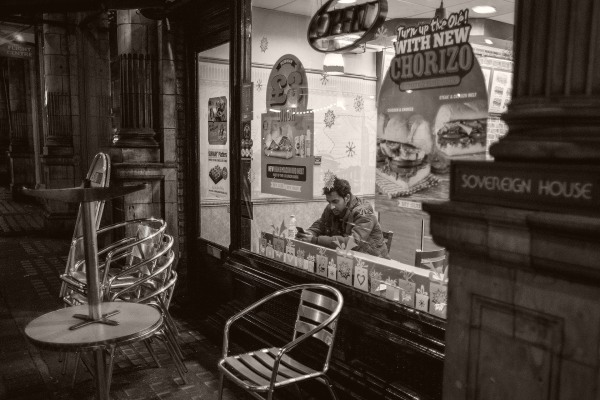
Sitting in the window seat at Subway on Shaftesbury Avenue Photo: Neil Turner Photo: Neil Turner

Sitting in the window seat at Subway on Shaftesbury Avenue
© Neil Turner, November 2014.

This photograph falls into the ‘personal work’ category. I had been to a meeting in central London during the evening and had arrived fashionably on-time having failed to park in my favourite evening parking space near the location of the meeting. That had forced me to park a bit further away. As a result my walk back to my car at around 10.30pm was both longer and much more interesting than usual.

I nearly always have a camera with me and it is nearly always either my Fujifilm X100S or it’s little brother the X20 but on this evening I had a Canon EOS6D with a couple of fast prime lenses and so I shot some photographs of things that interested me as I walked. This shop window – a branch of Subway that stays open until the early hours was the very first thing that caught my eye and I was very interested to see just how good the EOS6D is at higher ISOs. This was shot at 3200 ISO with a shutter speed of 1/250th of a second at f1.8 using a Canon EF 28mm f1.8 lens. For a DSLR this is about as unobtrusive as you can get – the quiet shutter mode is really good and the speed and accuracy of the auto focus on the centre focusing point means that you can ‘snatch’ a frame in really low light with quite a high degree of certainty.

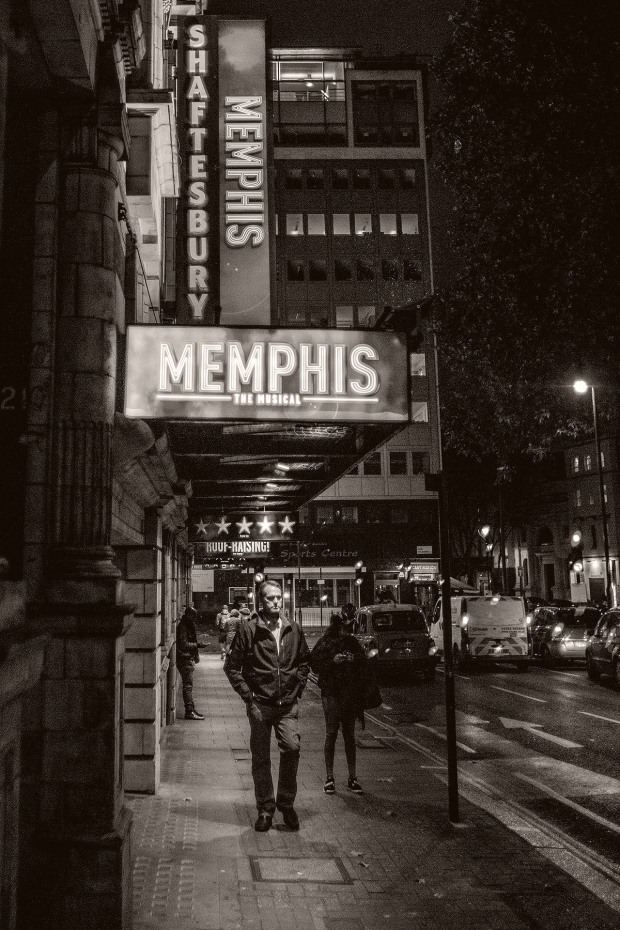
Just around the corner I saw the potential for another nice image with the frontage of a theatre after the last member of the public had left the building. I composed, waited and finally got this frame as a solo pedestrian passed through the frame.

Pedestrian passes under the "Memphis" banner outside a west end theatre at night. © Neil Turner November 2014.

Pedestrian passes under the “Memphis” banner outside a west end theatre at night. © Neil Turner November 2014.

This photograph was also shot at 3200 ISO but was better lit at 1/640th of a second at f1.8. I was actually quite disappointed when I got back to my car and realised that I had a two and a half hour drive home. I knew that I had half a dozen good photographs and I sat in the car and transferred a couple of them to my phone using the camera’s built-in wifi before uploading them to EyeEm and Twitter. Then I drove home…

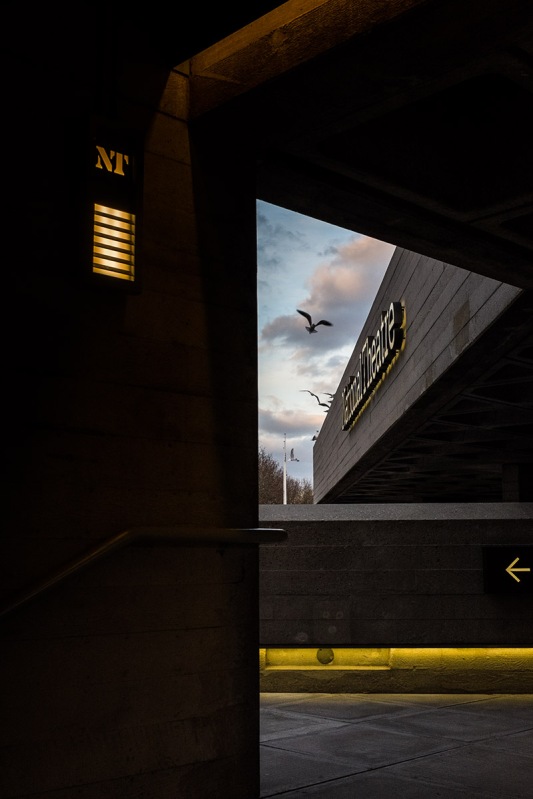
Dusk at the National Theatre

Dusk approaching at the National Theatre on London's South Bank. ©Neil Turner, March 2015.

Dusk approaching at the National Theatre on London’s South Bank. ©Neil Turner, March 2015.

Interesting evening light plus some fabulously brutal architecture makes for some interesting photos. Whilst walking to meet up with a friend and colleague at the National Theatre yesterday evening I was drawn to this section of concrete staircase and shot a few frames in one of those “just because…” moments.

Fujifilm X100S 800 ISO 1/250th of a second at f8.

Twenty-five years ago today

©Neil Turner, 13th February 1990. Whitecross Street Market, London EC1.

©Neil Turner, 13th February 1990. Whitecross Street Market, London EC1.

Over the last few years I’ve posted a few pictures from my own filing cabinet when they have had some relevance or when there is a specific anniversary. This picture was taken twenty-five years ago today as I went for one of my regular wanders around bits of London that were near Metro – the 24 hour laboratory where we all got our E6 transparency film processed. It was about a mile and a half from our Hoxton office (before it was trendy) and it took about twenty minutes to walk there or five minutes to drive. Sometimes there would be other photographers around and we would adjourn to a local cafe for a cup of something and a sandwich and at other times I’d take myself off for a walk around one of the many fascinating side roads and markets that made up the Clerkenwell/Farringdon/Smithfield area and take a few personal and/or stock pictures whilst the film made its hour and three quarter journey through the system and the ‘soup’ at Metro.

On this particular day I went to Whitecross Street with a couple of cameras and a couple of rolls of Kodak Tri-X film. It is amazing what you remember when you start to think about a day and a place and my memory of this day is that I was half an hour into the walk when I bumped into another photographer (there were three or four agencies close by) and we had a coffee anyway!

The man in the photograph (who said his name was Frank but I’m not sure he was being 100% honest judging by the cheeky look in his eye) had been a stall holder at the market selling books and a few magazines for many years. Trade was brisk as the workers from the many offices on the edge of the City of London were having their lunch hours and I didn’t really finish my conversation with him.

Anyway, another ‘archive’ picture that brings back happy memories and brings a smile to my face. This was, quite literally, half of my lifetime ago and I still love the photograph.

Techie stuff: Nikon FM2 camera with a 135mm f2 Nikkor, Kodak Tri-x film.

Another photo worthy of an obituary

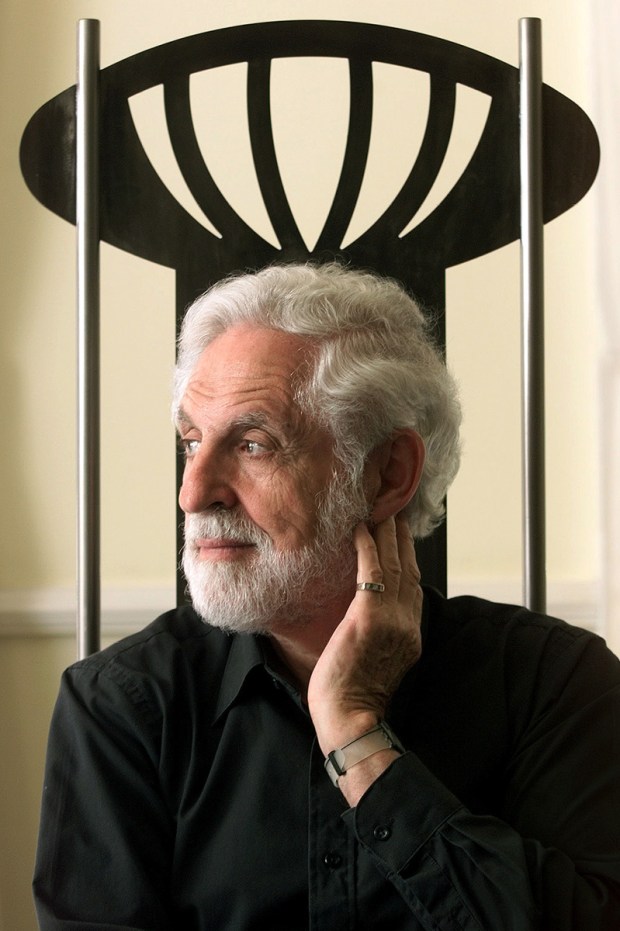
©Neil Turner/TSL. Carl Djerassi, June 1999, London.

©Neil Turner/TSL. Carl Djerassi, June 1999, London.

Carl Djerassi, the chemist widely considered the father of the birth control pill, has died aged 91. I photographed him back in 1999 sitting in what I thought was a very ‘egg-shaped’ chair in his London apartment. If you want to know more about him, The Guardian’s obituary is worth reading but my very clear memory of being there was that he was one of the calmest people that I had ever met. He was confident without being arrogant and his understanding of my job and the job of the reporter who went with me was absolute. He had, obviously, been interviewed and photographed hundreds of times before but I still believe it to be true that most people who have had that kind of media exposure still don’t ‘get it’ in the same way that he did.

It seems that almost every week now I see an obituary in the press of someone that I photographed earlier in my career and it has two distinct effects on me. The first is quite predictable – I feel that bit older each time it happens. The second effect is to make me realise how amazingly lucky I have been in meeting the people that I have met and having been able to make what I hope are portrait and feature images that will stand the test of time.

This particular photograph lived in my folio for many years. It was unusual for me to have shot quite such a reflective portrait at that time. I was busy trying to make a reputation for myself as ‘the guy’ who used strong lighting and strong compositions to compliment that lighting. Like most phases of a career, it passed. I can still shoot the strong pictures when the situation calls for it but this portrait is far closer to my current favoured style than almost anything that I shot in those early days of digital. When I look back at the more memorable images that I shot through the late 1990s – the period of transition from scanned negative film to 1.9 megapixel digital cameras – a lot of them have this kind of feel and that surprises me because my memory is of lighting everything in slightly over-the-top ways.

Technical stuff: Kodak DCS520 camera with a Canon 28-70 f2.8L lens. Ambient light, 1/160th of a second at f4 on 400 ISO.

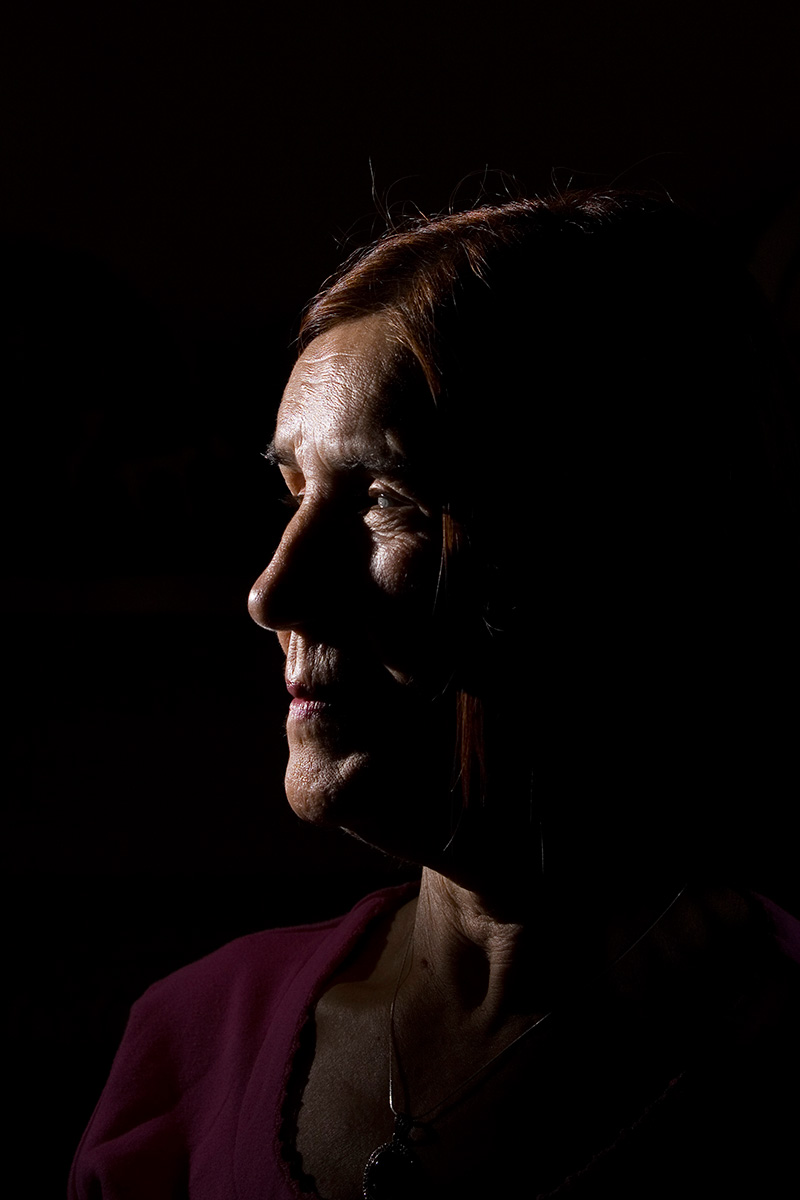
Hard light portrait

©Neil Turner/TSL, September 2007.

©Neil Turner/TSL, September 2007.

Not long after I took redundancy from my staff job at The Times Educational Supplement I spent several days putting together a collection of possible portfolio pictures. I was a long task as I’d been there for over fourteen years and when I eventually published my folio on line I had cut a couple of hundred photographs down to thirty. Whilst I was looking for something else today I came across that folder of 223 pictures and had a good root through.

Like most adventures down memory lane it reminded me of things that I’d forgotten and the story behind this picture immediately jumped into my mind. The lady in the portrait is a blind sculptor originally from Iran who was by this time married to a British teacher and living in south-west London. I have posted a portrait of her on this blog before when I discussed two surprisingly similar portraits that I’d made. This frame from the set has some of the harshest lighting that I’d ever used and it jumped out at me when I was looking today because I rarely use that kind of light any more. I guess that’s partly due to the nature of the clients I work for now – PR and corporates who don’t want anything as edgy as this was – and partly because my first instinct isn’t always to get the lights out any more. Even when I do light portraits I don’t mess around with the light as much as I once did. This goes with my Twitter #PWOTD which is TESTING

Techie stuff: Canon EOS1D MkII with a 70-200 f2.8 L IS lens at 70mm. 200 ISO 1/250th of a second at f8. Lumedyne flash.

What’s your favourite lens?

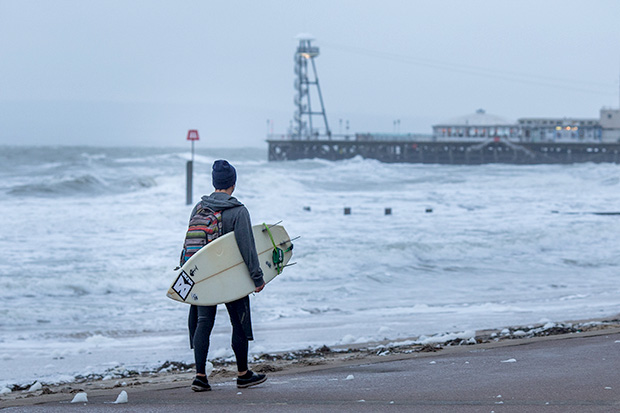
©Neil Turner, November 2014. Surfer heads towards Bournemouth Pier as the waves get bigger during a storm.

©Neil Turner, November 2014. Surfer heads towards Bournemouth Pier as the waves get bigger during a storm.

It’s been a while since I’ve directly answered a question from a reader on this blog. I haven’t been ignoring people – it’s just that the questions best suited to an answer on here haven’t been coming my way. A fellow news photographer causing mischief asked this one last week:

“What’s your favourite lens?”

It’s tough to answer because one of the things I love doing in my work is to use as wide a variety of focal lengths as possible and to use the right lens for the situation (if I own it and/or have it with me of course). I’ve written before about the best lens for portraits and I’ve written about zooms versus primes quite recently and so I thought that I’d give a couple of different answers to the question.

Most used lens

There is one lens that I use more than any other, one that I’d find it hardest to live and work without and which has given amazing service over many years. That lens is my Canon 70-200 f2.8L IS. (more…)

Card readers are the new camera bags…

©Neil Turner, December 2014. A small selection of the CF card readers that I own

©Neil Turner, December 2014. A small selection of the CF card readers that I own

As I sit here about to hit “buy” on yet another new reader for compact flash cards I am feeling more than a little bit of deja vu. And when I say “deja vu” I mean multiple layers of it. Sure I’ve bought plenty of CF, SD and even PCMCIA card readers in my time and of course none of them has been perfect but that feeling is an identical replica of the feeling I get when I buy a new camera bag – it’s a complex emotion; optimism meets resignation as I want to think that “the one” that I am buying is as perfect as I long for it to be whilst knowing full-well that it is going to be just as disappointing and just as deeply flawed as the last one, the one before that and the twenty or more before that.

It appears to be part of the psyche of professional photographers that we have to seek perfection in the equipment that we buy and use without acknowledging that such a thing doesn’t exist and that it probably never will. In just the same way that there is a colossal amount of choice in the camera bag market, there are lots of different CF card readers out there. Where the two markets diverge is in the quality of the construction and the longevity of the products. I have camera bags that have lapped the world and lived in more car boots than I can remember and that are still perfectly serviceable whereas CF card readers are cheap, poorly made and don’t appear to be of professional quality at all.

It isn’t completely the fault of the manufacturers: the pin design on compact flash cards isn’t as tough as you’d like and the way that the current crop of USB3 readers with separate cables  experience problems with the cable to reader connection would imply that it may be the USB3 standard that is at fault rather than the manufacturers quality control or design. This is backed up by the number of portable USB3 hard drives that are being reported as failing due to that same connection. It wasn’t always this way. I still have a couple of Sandisk Firewire 800 card readers that are as good as new despite having a hard life and being pretty much obsolete and the ancient PCMCIA reader that lives in a box in the loft was a proper professional bit of kit.

The accepted wisdom was that readers with removable cables were a good idea because the cables were the part of the kit that was prone to damage but that’s no longer the case. In an almost heretical move I am leaning towards the idea that built-in cables, avoiding the car crash that is the USB3 standard, are once again a good idea – and that is why my finger is hovering over the “buy” button because Delkin Devices have produced a reasonably solid looking USB3 reader with a built-in, chunky cable. Of course I’m resigned to the idea that there will be issues – this is one of those moments where optimism is high and the deja vu is strong.

Here goes…