neil turner

What kind of photographer are you?

© Neil Turner, August 2013. Evening light from London's Tower Bridge. From my EyeEm feed.

© Neil Turner, August 2013. Evening light from London’s Tower Bridge. From my EyeEm feed.

When you are introduced in a social situation as a ‘photographer’ there is almost always a follow up which will vary from “do you do weddings?” via “what kind of photographer are you?” to “I take a lot of pictures myself”. How you respond to these various questions and comments says a lot about you.

There was a time when I got quite annoyed that so many people automatically equated professional photography with wedding photography and it didn’t help that I wasn’t a huge fan of the work most wedding photographers were doing.

That has literally all changed. Fewer people automatically assume that I must shoot weddings at the same time as the quality of the best wedding photography has gone from quite good to extraordinarily good. It is inexcusable, not to mention counter-productive, to get worked up about people not understanding a job market as complex as photography when the only professionals that the majority have met are high street portrait photographers and wedding photographers.

My annoyance has gone away (that could of course be my age showing through) and been replaced with a desire to educate as many people as I can about what makes a professional photographer different from a person with a nice camera. I’ve had a go at defining professionalism on this blog before so I want to visit my notions of myself as a photographer:

What kind of photographer AM I?

This is an exercise that we should all do no matter what we do for a living and no matter how we have described ourselves in the past. Every website, social media platform and discussion forum that I appear in has some form of description of me but they vary subtly from one to another. For example, on the EyeEm photo sharing site I have been using this;

Middle-aged editorial photographer still obsessed with taking pictures for fun, for a living and for posterity

Whereas on my AboutMe page I use the following;

Middle-aged editorial & corporate photographer, still crazy about pictures after all of these years

And then on LinkedIn – which I regard as the most important and most serious of the social media platforms for work I use a much longer description;

Freelance photographer based in the south of England providing editorial and editorial style photography to the media industries. Features, portraits, case studies and documentary style work for newspaper, magazine, commercial, PR and NGO clients

On the one that matters, I don’t mention my age and I don’t try to be even remotely witty or self-depricating. Horses for courses. Encapsulating who you are and what you do in one line is a lot easier when you have time to think about and when it is written down. I have lost count of the number of people that I’ve met in situations not directly connected to finding work as a photographer who have gone on to provide me with work. Your social media presence, your website or your blog are important shop windows and it is very important to have good and concise biographies available for those who want to know more. It’s important to keep them up-to-date and professional and that is something we all need to work hard on. Responding in person in a social or business setting is a lot tougher unless you give it a great deal of thought and have a few reasonably well rehearsed (without sounding glib or insincere) answers up your sleeve. I say this because it does matter.

So what are the options?

  • You can come up with one or two simple descriptions of what you do that rolls off of the tongue and says exactly what kind of professional you are.
  • There is an option to have a slightly less perfect description that invites further questions to which you have good answers that will lead into a proper conversation rather than you just giving a straight answer to a straight question.
  • It’s very easy to have some rather more enigmatic answers that give hints to what you do for a living but that have the goal of really dragging the other person/people into a detailed analysis of you and your work.
  • Finally you might want to deflect the question altogether – sometimes you meet people who aren’t interested in you and just want to talk about themselves and it is often easier to give them permission to indulge in that. Similarly there are occasions where you meet people who have a camera around their neck and who want to bore you rigid with their questions about the minutiae of photography.

Once you have been in this business for enough years you tend to make snap judgements and use an answer from any one of the four bullet pointed categories above as the situation demands. That isn’t always easy and so my default position is the second option – the imperfect description that invites conversation. The question can be phrased in far too many ways to work out an exact response for each one but my stock response would be something like;

“I make 90% of my living as an editorial and corporate photographer”

That gives them a chance to ask for definitions of editorial and corporate, to ask who my clients are and to ask how I make the other 10% of my income. I guess that there is a hint of ‘enigmatic’ in that answer but it mainly gives me a chance to assess their response and to line up some good descriptions and the odd anecdote. This is basic conversation and we all have conversations all of the time but I’m a very strong believer in responding professionally to enquiries about my profession.

To me, editorial photography is anything used in a newspaper or magazine, on a website or in a video to help to tell or illustrate a story. The pictures should have been shot as a third party where the person paying you doesn’t have a direct relationship with who or what is in the photographs. I also shoot a lot of PR and commercial pictures in an ‘editorial style’ where I use the same styles and techniques of lighting and composition but where I am being paid by someone who have a personal or business relationship with my subject. My corporate work is very similar but isn’t intended for use in an editorial context. The corporate stuff might be for a brochure or an annual report – a blatantly non-editorial context.

You can see that I have spent quite a bit of time thinking about this stuff. It’s important. At a time when the amount of work out there hasn’t increased with the number of people chasing it and when prices are under constant pressure because of supply and demand you have to have some clear ideas and visions about where you want to be, where you are perceived to be and how to marry those two often conflicting views. As time moves on, your own attitudes and positions change as well and you need to be able to give articulate responses to questions because more than ever before everyone you meet is a potential client or knows someone who is.

Because I make 10% of my income without a camera in my hands – something that has come into being in the last five years – I also have to have simple descriptions of what that entails. That, weirdly, is a lot tougher than describing how I make the 90%. Simply put – I teach, write about and consult on editorial and corporate photography. I am at pains to stress that whilst I love having the variety my heart remains with taking pictures and that my value to clients as a teacher, writer and consultant is vastly increased because I’m still a practitioner.

Quite how many social situations allow you to get through the whole script is a whole other blog post. You have to obey the social conventions and be interested in other people too. How easy that is depends on who they are and how engaging they are – exactly what they were thinking about you.


Customers Vs Clients

© Neil Turner, July 2013. Fisherman's Walk, Bournemouth.

© Neil Turner, July 2013. Fisherman’s Walk, Bournemouth.

Today is my first proper day back at work since a long overdue holiday. I will write a little more about our time away when I do a further Fujifilm x20 update but in the mean time I am writing a few new lesson plans for my next bout of teaching. The first one that I decided to tackle was about business or, more specifically, the business of editorial and corporate photography. Every single colleague who works in these areas handles their business lives differently but there are a few basic truths that are there for everyone.

What is the difference between a customer and a client?

It’s subtle but it’s important to be able to differentiate between the two, no matter what business you are in. A customer is someone who buys your wares or services. When you go into Tescos or Wal Mart (depending where in the world you are) you pick up a few items, stick them into a basket and pay for them before leaving. You are one of a few thousand people who will do much the same thing in that store on that day. You are, or were, a customer. As a professional photographer I might pick up the odd customer but I don’t have a shop and I don’t get much “passing traffic”.

What I need is clients. A client works with you on a regular basis and there is a definable business relationship between you. They do far more than dropping a print or a JPEG file into a basket. There are, obviously, business models in the photography industry that work exactly that way but it would be tough and rather less than fulfilling if I were to think of the people who pay me merely as ‘customers’. A client needs to nurtured, convinced that they are buying the right services and looked after. I might have twenty clients at any given time and everyone who I deal with is a potential client and not just a customer.

In the field of photography that I love working in long-term symbiotic relationships are what I need. I am happy to say that I first worked with one of my current clients in 1987 and that my next three assignments are all for clients I have had for at least four years. I have a few jobs booked between now and Christmas that have become annual fixtures in the diary and that is a great feeling: clients who come back time-after-time. It’s funny though because whilst shooting a job for a new client a couple of weeks ago I acquired a customer. A corporate executive that I was shooting a portrait of wants to buy a print from the session. I don’t think that he will ever become a client (although I’d love to have his company as one) but he makes a rather useful customer.

So, what is the difference between a customer and a client? Let’s try this;

A customer is someone with whom you trade whereas a client is someone with whom you work.

If you have a definition that would be better in the context of editorial and corporate photography, I’d be very happy to hear it

Big soft light on the cheap

This technique example was originally posted on the ‘pre-blog’ in January 2009

A lot of portrait photography is done with large soft boxes or large umbrellas. The point there being that large light sources give a certain type of soft light that is reasonably flattering, nicely even and pretty good to work with. Bouncing a flash off of a big white wall gives a very similar effect to a large soft box which makes a big pale wall on location a very useful thing.

eaton-054

©Neil Turner, November 2008. Bournemouth, Dorset.

Shooting this portrait of a couple who met and fell in love in later life gave me a few challenges. The picture editor wanted them to be photographed on the beach in my home town of Bournemouth but the weather forecast for the late November morning wasn’t too promising. Having spoken to the couple we decided to head for a location which offered us plenty of parking right near the beach front as well as wide open expanses of sand. The plan was to shoot on the beach and head for one of the local cafes if the rain came. The same stretch of beach also has some covered seating areas, which were to prove very useful.

We started off shooting on the sand but moved pretty quickly under the covered area that you can see to the left. It was out of the wind and out of the rain that was looking likely. The theme for the picture was to be mildly romantic and the strong arch was likely to be useful.

I was shooting with a Canon EOS 50D and 16-35, 24-70 and 70-200 f2.8 L lenses. The lighting was a Lumedyne 200 watt/second pack and Signature head triggered with a pair of Pocket Wizards. The back wall of the covered area was painted with a very pale cream/lemon colour so I decided to bounce the flash off of it.

I mentioned above that the effect is similar to a large soft box and the area of wall illuminated by the flash was about four square metres (a little over ten square feet) which is a big soft light by anyone’s standard.

Looking at the brilliant LCD on the back of the camera after a couple of test shots, it was obvious that the colour of the wall was a little more yellow than was apparent to the naked eye. I shot a frame with a piece of white paper in the man’s hand so that I could do a custom white balance. The net effect of this was to send the daylight behind them and any areas lit by the ambient a little blue – not an unpleasant effect.It was clear that they were enjoying being photographed and were happy to indulge my usual technique of playing around with lenses, compositions, exposures and lighting positions.

I was trying to shoot with a wide lens under the cover and the shot that you see above was taken with my 16-35 f2.8L right at the 16mm end. I usually try to shoot at 200 ISO and the meter reading for the sand and sea behind the couple was 1/125th of a second at f5.6. I altered the output on the flash to give me f5.6 on the couple and changed the shutter speed to 1/180th to marginally underexpose the background. The available light reading on the couple would have been 1/30th at f5.6 so they were lit exclusively by the flash. I shot a lot of different images with similar compositions before changing over to a 70-200 f2.8L IS lens.

I moved my subjects so that they were leaning in the entrance just as the light outside was getting a bit better. By the time I shot the image below the shutter speed was up to 1/250th of a second but not really underexposing at all.

©Neil Turner

©Neil Turner, November 2008. Bournemouth, Dorset.

The ambient light was starting to affect the man’s head and you can see that he has a gentle blue highlight on top of his head. The light balance was just right for about two or three minutes before the ambient became brighter and I had to increase the power on the flash to maintain the balance.

After a few dozen frames we moved back onto the beach where we shot several more ideas. The magazine eventually ran a picture shot on the beach as the day turned brighter and it came towards midday. In the two pictures shown above I am looking almost due south where the midday sun would be. The second picture was taken only 45 minutes before noon and so the reasonably heavy cloud was a real help to make this picture work.

The whole shoot took a little over an hour and the edit took about the same amount of time before I sent the magazine around forty pictures.

New work – an answer

A few weeks ago now I posted an open invitation for anyone to ask me a question. I received a few and saved some of them until I was ready to answer them. This one has been playing on my mind for quite a while:

“Why don’t you post new pictures on your blog in the way that you used to when dg28.com was the first website I looked at every week?”

That is what I call a question! There are so many parts to the answer that I have decided to list them as bullet-points:

  • I don’t shoot as much editorial work as I used to and a lot of corporate clients don’t want me to post the images shot for them.
  • I don’t have quite as much time to work on websites as I used to.
  • One of the main reasons that I stopped posting new work was that much of it stopped looking ‘new’ and I wrote about that on this blog.
  • Another reason that I stopped was the number of times people asked me to take pictures down.

Now that I am a freelance photographer I need to be very careful about what I post. Social media, blogs and websites are very public forums for thoughts and ideas and it is far too easy to do or say something that harms your business and freelancing as a photographer is very much a business. There’s also an element of protecting ideas. I published fifty technique examples in the period between 1999 and 2008 and I get emails from photographers all over the world saying that some of those lessons changed their practice. I still meet photographers who tell me that they read those pages over and over again when they were trying to develop their own techniques for using portable flash and that is gratifying but now I’m playing a few of my cards a bit closer to my chest because I have developed a few new ways of working that I’m not ready to share outside of my portfolio.

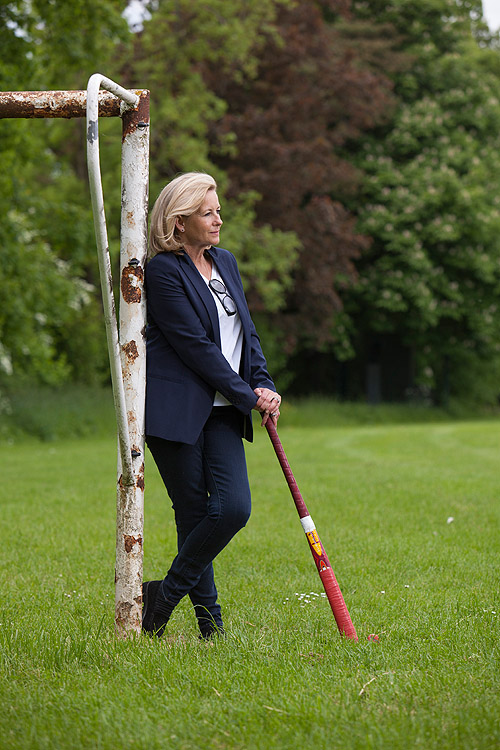
Like I said – there’s no single reason why I stopped posting and I certainly don’t rule out posting some more ‘new’ work over time. As a response to the question that was asked I have decided to post one new portrait that I made a couple of months ago for a women’s magazine. Te story was about three women who had written very personally about their time at school and how that had influenced their later lives. One of the women was journalist and author Gill Hornby and I was asked to photograph her with her dislike of school and team sports in mind. We had a few minutes at a playing field on a less than sunny day and this is the photograph that I liked most:

©Neil Turner. 07 June 2013. Gill Hornby is the author of The Hive (Little Brown).

©Neil Turner. June 2013. Gill Hornby is the author of The Hive (Little Brown).

Some answers to your questions

A couple of weeks ago I invited people to ask me questions about anything. The idea was to generate some ideas for blog posts because some of the best ones that I have written in the past have been initiated by good questions. I have kept a couple of the most inspiring back for longer answers (and let the questioners know) and I thought that I’d give some answers to some of the other questions now. So, in no particular order, here goes:

Q: Do you do one-to-one training with other photographers and would you be happy to do that in my hometown of Oxford?

A: Yes I do and yes I’d be happy travel if the travel costs were covered. It doesn’t come particularly cheaply but I hope that people who book training with me get an awful lot out of a session. Anyone who has read my blog lately will know that we did a new small group workshop at Up To Speed in Bournemouth a couple of weeks ago. It was a wonderful day with five great people attending the session. You can get in touch with me if you are interested in one-to-one or small group sessions and we can take it from there.

Q: How has you move from London affected your work? Have you tried to hide it from London clients? Do you get any sense that you are looked down upon at all by London-based clients, or have you found benefits in being an out of town photographer?

A: I have always had a home in Dorset, even when I was working as a staff photographer in London. In that respect nothing has changed – I still have bases in both London and Bournemouth. What is different is that I have tried very hard to change the balance of the work that I do so that I can spend a lot more time at home in Bournemouth. My clients all know that I have two bases and one or two have definitely chosen not to pick up the phone for simple jobs that they perceive would involve me popping up to London for a quick portrait or a one hour PR job. The truth is that the vast majority of my photographic work comes from London clients and a big percentage of that is still in London. That’s absolutely fine: I stay up in town as and when I need to. On balance the work that comes from London is better paid, more interesting and more plentiful. The photographic market down here is a lot smaller and there is a relatively large number of photographers chasing that small pool of work. There are one or two photographers down here that will work for stupidly low fees and I am not about to get into a race to the bottom with them. All of that adds-up to the status quo where I am working all over the country for mostly London or overseas clients and less than 5% of my work is locally sourced. The benefits of living down here are self-evident: it’s a lovely place, I was born here and have lots of family and friends here. When I’m not shooting I am able to do the other stuff (like blogging) at home. The drawbacks are all about perception and I spend a lot of time on the phone trying to change negative perceptions.

Q: Best portable light modifier for location work (for the Quadras)? I’m toying with the idea of getting a Rotalux Deep Octa (100cm I think it would be) as an upgrade to my current brolley, grid or small Easybox softbox, and wondered what you have found to be the ‘best’ portable light modifier for your Quadras?

A: Quantify best… For me, it’s all about the compromise between quality of light and ease/speed of use. I have a huge soft spot for the Chimera ProII soft box that I’ve owned for well over ten years. It’s a 32″ x 24″ rectangular box with an inner diffuser that fits onto the Quadra via the Elinchrom soft box adapter and a suitable speed ring. I can assemble and attach it in under a minute (30 seconds if I’m on form) and it rotates on the speed ring allowing either portrait or landscape orientation. I also use a shoot through translucent umbrella. Many years ago I acquired a Lastolite umbrella box which is as quick as an umbrella to put up, almost as cheap as an umbrella and yet give a really nice even efficient light in the way that a soft box does. It has been in and out of my bag over the years as I get bored with doing things the same old way but I recently started to use it again and it finally broke. I have ordered a new one and when it comes I expect to get back to using the umbrella box for a while. I think that the important thing here is to have options and to know when and where to use each of them. I never, for example, use the translucent umbrella outdoors – too much loss of light. The Rotalux deep boxes are great but they are expensive and relatively cumbersome. I have never owned one but I’d like to.

Q: Hello. I own a 5D mark1, 24-105, 430ex2. I work with ambient light & tripod mostly because I’m scared of flash. This is OK for landscapes/architecture etc but not for people shots in low light. I have tried E-TTL in P & Green mode but am always disappointed. Would you have safe manual settings you could share with me for low light people shots?

A: Shooting people in low light requires quite a lot of practice to get great results and shooting direct flash whilst keeping the flash unit in the hot shoe will make getting better results really hard. The ‘secret’ to great flash photography is how you modify the light – bouncing it off of walls, reflectors or almost any surface that will direct the light onto the subject from a pleasing angle is what makes the picture. Shooting modes are a secondary issue. I know people who use E-TTL and some of the auto modes who get great results because they know how to bounce or modify the light. You should experiment with bouncing and you shouldn’t be afraid to try a wide range of surfaces. I wrote about how to approach bouncing a few months ago and that is a good starting point. As far as settings go, you need to think about how much power you have in your flash (not that much) and so you need to use apertures like f4 or f5.6 to conserve the flash power. If you are new to shooting in manual modes you might consider using aperture priority and deliberately setting the ambient exposure at -1 or -2 stops. Alternatively you can set everything manually and use the screen on the back of the camera to judge whether the exposure is a good balance or not. Introducing flash as a secondary light source is scary and you need to take some baby steps. Changing absolutely everything at once is a tough call because you will probably take longer to work out what works for you. If you have some money I’d suggest that you get a small light stand, a white umbrella and a either a Canon ST-E2 remote trigger or a pair of off-camera radio triggers so that you can get the flash out of the hot shoe and open up a world of creative options. After that, many of my old technique samples will make a lot more sense.

Q: The Enterprise and Regulatory Reform Act… How do we fight against the potential legislation this has paved the way for?

A: There are lots of things that we can all do. The first is to get into a dialogue with your Member of Parliament. Ask them to oppose the orphan works proposals as they stand and point out that the work that the Intellectual Property Office has done so far has left photographers and other creators angry and feeling as if the IPO has an agenda which doesn’t include us or our livelihoods. Your MP will almost inevitably write back quoting a generic reply from Lord Younger pointing out that the stripping of metadata is illegal (which is circumvented by so many websites terms & conditions) and that the right to attribution of your work already exists. This is a red-herring of a response and needs to be challenged if you don’t want you MP to think that they have fulfilled their obligation to you. Next, you should keep the discussion up within your professional and social circles. Don’t let the subject drift into the background. The good news is that there are plenty of people working on this as we speak. Stop43, EPUK, the NUJ, the British Photographic Council, the major agencies and The BPPA amongst others are going to meetings with people that matter and keeping up the pressure on the IPO and the legislators. The Stop 43 website is a useful one to bookmark if you want to keep up to date. Finally it is important that we all try to influence those websites (Flickr, Instagram, Twitter, Facebook etc) whose websites strip metadata to change their ways. You can avoid adding images to them or actively use their competitors who don’t strip stuff and you can try to persuade your friends to follow suit. It’s going to be a tough battle and we need as many people to join-up as possible so your efforts in helping others to get involved will be vital.

Thanks to everyone who has sent me questions so far. Please keep them coming…

Ask me anything…

©Neil Turner, June 2012. Dorset.

©Neil Turner, June 2012. Dorset.

Whilst looking back through some of my most popular blog posts in the last few years a surprising number of them were written in response to questions that other photographers and students of photography have asked me. That got me thinking about posting this simple update with a very simple request/offer:

“ASK ME ANYTHING… WELL SOMETHING… ALMOST ANYTHING…”

So not exactly ANYTHING – I’m only going to answer interesting questions about photography and my own work! Please use the contact form or reply to this blog posting. You could tweet me but I might miss that given the avalanche of stuff that goes across my desk each day. I will then pick out a couple of questions and use them to write future blog posts. Great… get other people to come up with the ideas!!!

Go back

Your message has been sent

Warning
Warning
Warning
Warning

Warning.

Editorial portraits folio

Like most photographers I’m always looking at new ways of showing my portfolio. I’ve saved the presentation version of my editorial portraits folio as a QuickTime movie and posted it here. Please let me know what you think. If you look at it without going for the full-sized version the captions are a bit small but, apart from that, I quite like it!

Location flash workshop – June 22nd

for_the_blog

For anyone who remembers that far back, my dg28.com website started out as a vehicle for me to post updates about the work that I was doing along with some technique examples that I rather pompously called “photographer education”. Well, that was in 1999 and a couple of years later I started doing occasional workshops and lectures about my use of portable flash on location. I have done a lot of talks over the years but, because of my commitments at the London Olympic and Paralympic Games I didn’t take part in any workshops last summer. That is about to change.

In conjunction with the team at Up To Speed we are going to be running a lecture and workshop on Saturday 22nd of June right here in my hometown of Bournemouth. There are two options for anyone wanting to come along: there’s a half day morning session which will be classroom based where we will explore some theory, go through some of the basic techniques and generally talk the talk. For anyone wanting to make it a full day (smaller number of places) we then go off to a nearby park for the afternoon and put some of what we have discussed into practice with a model and some of my gear. You can bring your own kit as well if you want to get better acquainted with what you use – your choice.

  • Morning only  £80.00 inc VAT
  • Full day  £120.00 inc VAT
  • Some group discounts are available
  • Discounts for members of The BPPA and NUJ

I’m happy to answer any questions that you might have or you can get in touch with Up To Speed on 0800 121 6818 or by email rcarr@uptospeedjournalism.co.uk

No two workshops are alike because we can never know what the British weather is going to give us; the good news is that cloudy days are just as much fun as shooting against the sun. The workshop is aimed at three groups:

  • Professionals wanting to develop their skills
  • Serious amateurs who want to get more from their passion
  • Photography students wanting to supplement their knowledge

I hope that this will be the first of many that we run in Bournemouth. Remember that you can always dump the rest of the family off on one of our rather good beaches and join them for the last swim of the day…