news

Having an eye for detail

The choice between taking the same photograph as everyone else and standing back and getting something different becomes a matter of survival when you work on a weekly newspaper and the other five photographers around you will be publishing the next morning. Even if that weren’t the dilemma of every photo-call I go to, I like to think that as a photographer I am an individual. It’s a pretty useful mindset to sign up to, no matter how much or little photography you do.

Photo: NEIL TURNER. ©TSL. 04/09/2000. TES news.

This photograph of an elephant’s eye is a classic example of taking a mental step back from the herd and shooting something different. It is also an advertisement for having more than one camera with different lenses on. There were five other photographers at the job. The story was about this young Indian elephant who paints pictures, and about how he was being used to launch an environmental art competition for schoolchildren. We were all trying to make the same picture of the elephant, three kids, some paint and an easel. The composition was looking messy, and there were just too many elements in it. We all had 16-35 lenses on and were getting nowhere. I was getting nowhere faster than the other five who would all go to press that night leaving me with two more days during which the story could easily get scrapped without a strong image. My second camera had my 70-200 on it and I grabbed it, zoomed in and the picture almost took itself. Strong, arresting, different and wide open for headline writers to do their thing. Just about every base covered. I shot some of a paint brush in the elephant’s trunk too, but this was the picture chosen.

When an image is competing for space on a newspaper page it has to stand out. The enlightened editors at our papers allow images to arouse the reader’s interest and don’t insist that photographs tell the whole story all of the time. This approach works on every level, from the family album through e-mailed postcards to published images. Getting in close works.

See also: MINDSET FOR NEWS PHOTOGRAPHERS

Possibly the oddest picture I ever took…

©Neil Turner/TSL | London | January 2006

The story was simple: we were doing an anonymous interview with a man who needed to remain unidentifiable for legal reasons and we had to shoot a picture of him at a time and a place that wouldn’t give his identity away. It seemed to be important that it was actually him in the picture and that became obvious when I had to shoot a proper portrait at the same time just in case the court case was decided and we needed a proper picture of him to go with a future follow-up article. Still with me?

The reporter arranged that I meet the subject at a London tube station and to get around the problems of finding someone whose name you don’t know and who you don’t have a picture of I always describe myself and what I’m likely to be carrying and wearing because a) I’m probably going to be there first and b) I’m probably going to be easier to spot (being big and carrying a lot of kit).

The venue turned out to be quite close to where he works and we decided that if any of his colleagues happened to spot us the cover story was that we were doing a fashion vox-pop on what the well-dressed office worker was wearing that season. The cloak and dagger details just kept multiplying.

I decided to go with a silhouette (you can read my thoughts on them here) and just for good measure I added an extra twist with a bit of motion blur too. The result was quite striking if bafflingly anonymous!

The technique is pretty simple. It was a dull winter’s morning in the city and we found a under cover area. I used a Lumedyne flash kit to light the brick pillar and silhouetted the subject against it. Without the flash, he would still have been a shadowy outline but so would the pillar and the picture would have been pointless.

The light that was coming from either side of the pillar was OK but it wasn’t plentiful and so I decided to give it a bit of movement blur by zooming the lens whilst the shutter was open. I ended up with an exposure of 1/8th of a second at f13 on 200 ISO using a Canon EOS1D MkII with a Canon 16-35 f2.8L lens triggering the flash with a pair of Pocket Wizards. Zooming during an exposure as relatively short as 1/8th of a second means that you have to have quite a few attempts to get it right and it also pays to tell the subject what you are doing if you don’t want them to think that you are a lunatic!

In the end I was very happy with this genuinely odd picture. I had arrived at the assignment with almost no idea what I was going to do and pretty much made it up as I went along. That’s why I love my job…

Fun picture: stray apostrophes, London.

When the news broke that UK booksellers Waterstone’s were going to drop the apostrophe from their logo to “make things simpler” the story was greeted with a mix of horror, outrage and cynicism. I was part of the cynical camp: what better way to get your company on the news than to pull a stunt like that? Leak a story that you might be about to do something and then sit back and watch it go viral and, more importantly, go viral amongst the very people who would be your core market. It was either brilliant, fortunate or (the least likely in my view) a genuine story.

©Neil Turner/TSL | London | October 2003

I was reminded of the last time that I was involved in a “stray apostrophe” outrage story. Back in 2003, yet another report on the use of punctuation in grammar singled out signs and posters for special criticism and so I was asked to go and find some examples. For a city reputed to have “thousands” of examples I struggled and it wasn’t until I was in the second hour of driving around looking that I finally found this gem on a secondhand video, DVD and CD shop near King’s Cross. The shop was on a one way system with almost no chance of stopping and very little parking nearby but I was desperate and so I went around again, found a parking meter and shot some pictures of the sign. The cafe next door was also the perfect place to have a quick coffee and send my pictures. Job done.

The BPPA and The Leveson Inquiry

I have been involved in writing, amending and publishing a second submission on behalf of The British Press Photographers’ Association to the Leveson Inquiry into  the culture, practice & ethics of the press in the United Kingdom. It has been a huge task and the work of propagating it using social media has now begun.

Lord Justice Leveson’s inquiry was founded to look into the phone hacking scandal that brought about the closure of The News of The World and other unsavoury practices in play within the UK news media. In the first week of evidence it turned into a “photographer bashing” event and The BPPA had to respond on behalf of the thousands of perfectly well behaved and law abiding news photographers out there. Lots of countries have a problem with rogue paparazzi or “stalkerazzi” as they have been memorably named by one UK academic.

If you are a lover of great news photography, please follow @TheBPPA on Twitter like The BPPA on Facebook and read The BPPA blog here on WordPress. The industry is at a crossroads and we need our friends and colleagues to help us get where we need to go.

Folio photo #09: Bournemouth grave digger, October 2008

©Neil Turner. October 2008

Dave Miller has been working for the cemetries service in Bournemouth since leaving school. These days he even lives in a house inside one of the local graveyards. Photographed at dusk in Bournemouth’s North Cemetry for The Guardian. They were running a whole series of pictures of people who do slightly unusual jobs and they times this particular feature to run at halloween.

This frame features four separate flash units – one of which is down inside the grave (which was otherwise empty). Dusk is my favourite time of year for shooting pictures and this particular sunset was very colourful. If you’d like to know even more about this picture, go to this technique page

Mindset – small word, big concept for news photographers

©Neil Turner/TSL, March 2004

Written in 2002, this opinion piece still holds very true nearly ten years later…

What’s the difference between a photographer who takes pictures for fun, another who struggles as a professional and one who is on top of their game? The answer, well there are many but the top of my list is….mindset

It’s a pretty innocuous word, but it makes a massive difference. As I sit here writing this I’m trying to formulate some thoughts ahead of a talk to a group of postgraduate news photographers. Snappy titles are always a good start – according to the “Lecturing for Dummies” handbook so “Mindset” it is.

Next step – arresting opening sentence. That will have to wait until I have better formulated my ideas, but my handbook tells me that if you get people’s attention at the beginning you have won fifty percent of the battle and if you don’t you will waste a lot of time getting it back. Well, that’s a bit like writing and (spot the cheasy link) an awful lot like being a news photographer.

The narrative that runs through a well shot photo story or a well written essay is remarkably similar. I have been trying to find a way of telling eager “news photographers in the making” that the message is more important than the way it is delivered and I have decided that it’s worth keeping the writing analogy going.   Nobody denies that poetry is literature and everyone has respect for well written short stories. Good authors are comfortable with their medium, they structure their work and use words economically. Good photographers mirror this. The common thread is mindset; shaping what you have into what you want it to be. I’m not saying that you pre-judge an issue, but rather that you should edit before you shoot, as you shoot and after you shoot to tailor your pictures to a particular format.

If you are working towards an exhibition you work one way – adopting the right mindset, and if you are shooting a single image story you work a completely different way.  And then there are the differences between making and taking photographs, between being a welcome guest wherever you are or an unwanted intruder. News photography is a very broad church, with room for many ways of working and a lot of photographers find it very difficult to switch between the various sub-genres. It can be done.  The temptation for photographers new to journalism to assume that only great long complicated narratives qualify as news photography is understandable. It is also one hundred and eighty degrees out. The thought that it takes real skill to tell a story in a single picture is a difficult concept to master but the greatest story-tellers know that less can often be a whole lot more.

It’s all in the mind.  If you have a month to shoot a spread you can afford a few days (let’s say three to make the comparison easy) to acclimatise. If you have an hour to shoot a single image story and you take the same percentage of the job time to settle in, you’ve only got six minutes. You know what the score is, so you adopt the right approach before you start.  News photography, when it’s stripped down, is a really simple idea. You take pictures and you make pictures that tell stories. You can use photographs to spell out what you want to say, you can use them to intrigue the viewer or you can use them to infer things.

Good journalism often uses words, but it uses photographs just as often. If the photographer is thinking straight and can concentrate on the end product, good photography becomes great news photography.

Final step – the clever conclusion. I would advise anyone coming into the profession to read some good poetry and a few good novels, to work out how they were structured and to try adapting the simplicity of poetry to their photography. Why? The answer is all too simple, photography is all about creativity and it’s all about mastering the technical aspects but most of all it’s about a state of mind – a mental process – mindset.

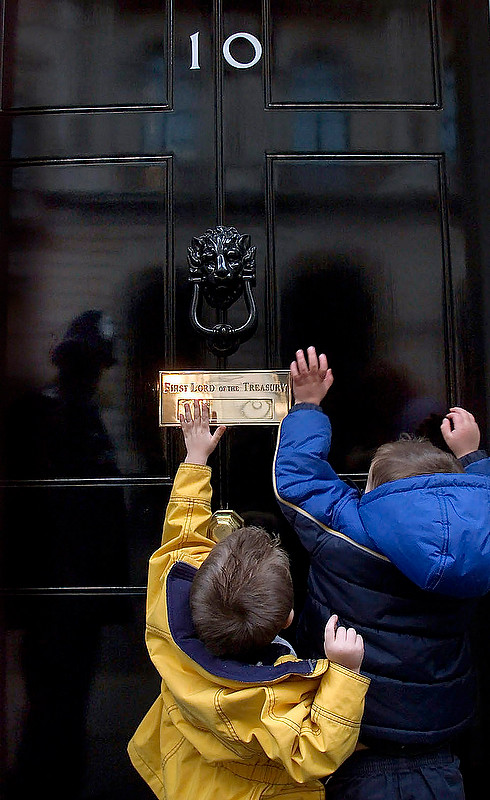
Folio photo #06: 10 Downing Street, November 2001.

©Neil Turner/TSL November 2001

Children from a Leicestershire nursery school try to hand in their petition against closure to No.10 Downing Street.

This was a very ordinary story about yet another petition being handed in at No.10 which became extraordinary when the Police Officer on duty allowed the two children to try to knock on the door and then stood back and laughed as they kept trying.

It was a very cute moment on a day where the world’s media were not watching and the reflection of the officer in the shiny black door makes this a favourite picture of mine. They never reached the door knocker and so the officer eventually helped them out by knocking it for them.

Table top still life and the news photographer

Most press photographers will have lost count of the number of times they have been called into the office of the newspaper they are working for to ‘do a quick still life’. These vary from the simplest product shot to some interesting concept ideas. I thought that I’d share a few with you here:

This slideshow requires JavaScript.

As you can see, I sometimes go to town with them and the stories you see illustrated here are about:

  • The risks of cloning and everyone looking and doing the same (rubber ducks)
  • Managing your credit (cutting up credit card)
  • Handling your savings (fist full of bank notes)
  • The aftermath of a school fire (melted clock)
  • A debate about healthy eating versus too many sweets (cauliflower and mars bar)
  • Reading the fine print in a new employment contract (magnifying glass)
  • Taking a chance with the school your child is going to (rolling the dice)
  • The high cost of housing in certain parts of the country (Monopoly houses on the map)

The main idea is to us decent light, keep the idea simple and not be tempted to try to do too large a picture in the cramped and messy confines of the office. I deliberately added the rolling dice idea because we had some giant dice available, I had an intern to help throw them and there was a nice piece of open ground nearby on a lovely sunny day.

Studio based still life photography is a tough discipline and we still get asked to do creative stuff that should be done “properly”. It has been said that press photographers make great all-rounders because we have to think on our feet and adapt all of the time: I won’t be arguing against that one!