press

F4 and be there…

06 August 2015. Bournemouth, Dorset. Close up of part of a Canon 70-200 F4L IS lens. Hillcrest Road

06 August 2015. Bournemouth, Dorset. Close up of part of a Canon 70-200 F4L IS lens.

I’ve discussed zooms versus primes far too many times in far too many blog posts to rehearse the old arguments again and at the end of my recent post about zooming with your feet I mentioned investing in some new gear with a promise to follow it up with a blog post – so here it is.

The great New York press photographer Weegee is supposed to have said “F8 and be there” when asked how he got such great pictures. I’m not remotely interested in the debate about whether or not he actually said it but I am interested in the idea of apertures and, more importantly, maximum apertures.

For as many years as I’ve been shooting with zooms I’ve owned and used lenses pretty much exclusively with f2.8 maximum apertures. (more…)

Zooming with your…

©Neil Turner/Bupa 10,000. May 2015. A Police rider accompanies a detachments of Guards as they march back their barracks.

©Neil Turner/Bupa 10,000. May 2015.
A Police rider accompanies a detachments of Guards as they march back their barracks.

I was on a job the other day, standing next to a very young photographer in a ‘press pen’. He glanced over at the gear I was using and mentioned how much he would love to own the 135mm f2L lens that I had on one of my cameras. He said that he had never really got the hang of “zooming with his feet” in the way that so many of the photographers he admired had advised. He had also had it drummed into him by one of his tutors at college and it had left him wondering if he was doing something wrong.

Zooming with your feet is a great concept and it is one of the catchphrases in contemporary photography that appears to be beyond question. But is it? Is it actually as much a cliche as a universal truth?

There we were on a job where we couldn’t have zoomed with our feet even if either of us had the skills to do so. We couldn’t go forward – there was a metal barrier in the way. We couldn’t go backwards because there were other photographers and a couple of TV crews behind us – and behind them was another barrier. We had a tiny amount of sideways movement if we could change places with each other but, apart from that, we were in a very fixed position. (more…)

Hard light portrait

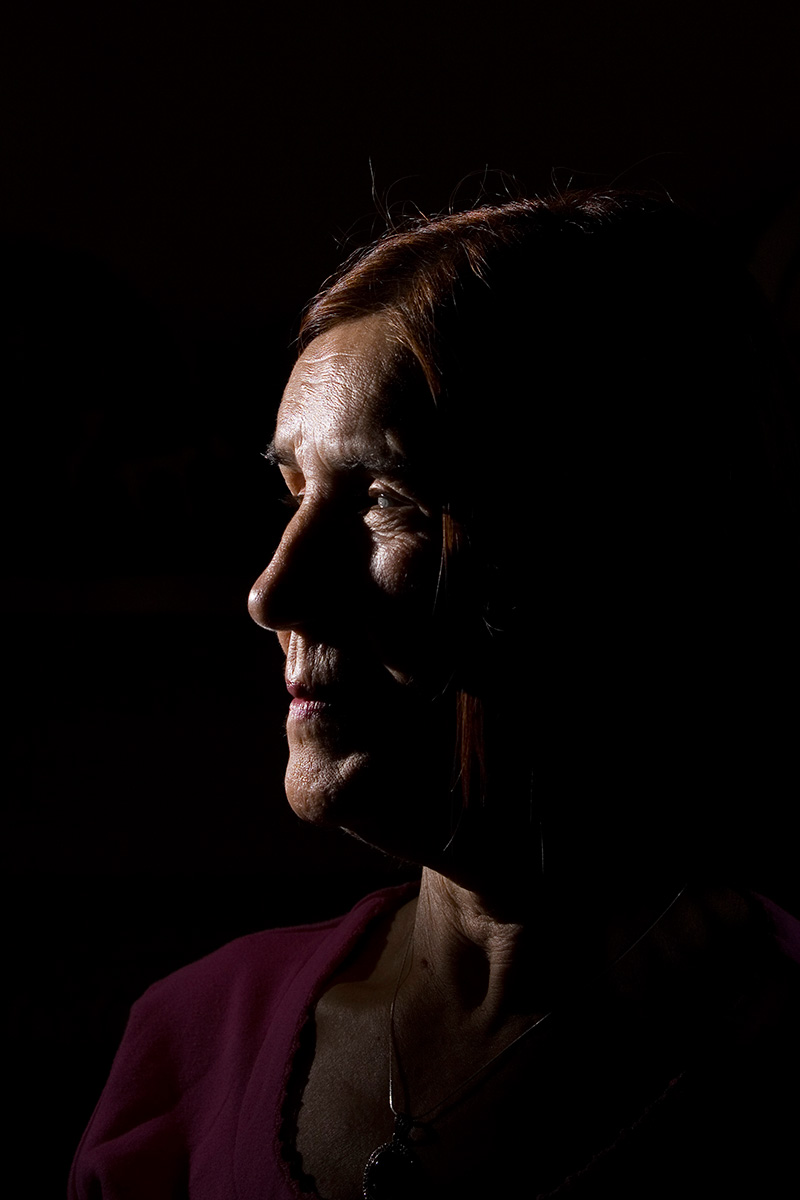
©Neil Turner/TSL, September 2007.

©Neil Turner/TSL, September 2007.

Not long after I took redundancy from my staff job at The Times Educational Supplement I spent several days putting together a collection of possible portfolio pictures. I was a long task as I’d been there for over fourteen years and when I eventually published my folio on line I had cut a couple of hundred photographs down to thirty. Whilst I was looking for something else today I came across that folder of 223 pictures and had a good root through.

Like most adventures down memory lane it reminded me of things that I’d forgotten and the story behind this picture immediately jumped into my mind. The lady in the portrait is a blind sculptor originally from Iran who was by this time married to a British teacher and living in south-west London. I have posted a portrait of her on this blog before when I discussed two surprisingly similar portraits that I’d made. This frame from the set has some of the harshest lighting that I’d ever used and it jumped out at me when I was looking today because I rarely use that kind of light any more. I guess that’s partly due to the nature of the clients I work for now – PR and corporates who don’t want anything as edgy as this was – and partly because my first instinct isn’t always to get the lights out any more. Even when I do light portraits I don’t mess around with the light as much as I once did. This goes with my Twitter #PWOTD which is TESTING

Techie stuff: Canon EOS1D MkII with a 70-200 f2.8 L IS lens at 70mm. 200 ISO 1/250th of a second at f8. Lumedyne flash.

What’s your favourite lens?

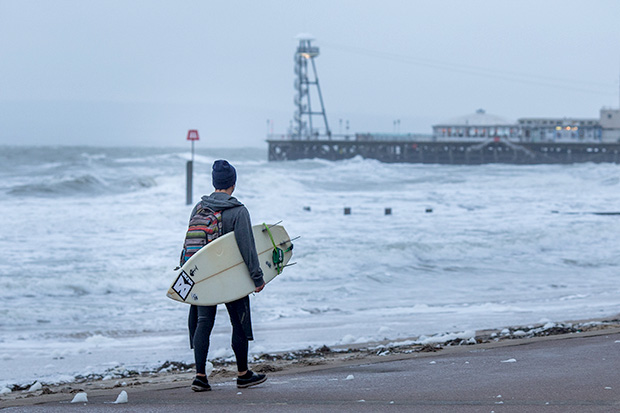
©Neil Turner, November 2014. Surfer heads towards Bournemouth Pier as the waves get bigger during a storm.

©Neil Turner, November 2014. Surfer heads towards Bournemouth Pier as the waves get bigger during a storm.

It’s been a while since I’ve directly answered a question from a reader on this blog. I haven’t been ignoring people – it’s just that the questions best suited to an answer on here haven’t been coming my way. A fellow news photographer causing mischief asked this one last week:

“What’s your favourite lens?”

It’s tough to answer because one of the things I love doing in my work is to use as wide a variety of focal lengths as possible and to use the right lens for the situation (if I own it and/or have it with me of course). I’ve written before about the best lens for portraits and I’ve written about zooms versus primes quite recently and so I thought that I’d give a couple of different answers to the question.

Most used lens

There is one lens that I use more than any other, one that I’d find it hardest to live and work without and which has given amazing service over many years. That lens is my Canon 70-200 f2.8L IS. (more…)

Card readers are the new camera bags…

©Neil Turner, December 2014. A small selection of the CF card readers that I own

©Neil Turner, December 2014. A small selection of the CF card readers that I own

As I sit here about to hit “buy” on yet another new reader for compact flash cards I am feeling more than a little bit of deja vu. And when I say “deja vu” I mean multiple layers of it. Sure I’ve bought plenty of CF, SD and even PCMCIA card readers in my time and of course none of them has been perfect but that feeling is an identical replica of the feeling I get when I buy a new camera bag – it’s a complex emotion; optimism meets resignation as I want to think that “the one” that I am buying is as perfect as I long for it to be whilst knowing full-well that it is going to be just as disappointing and just as deeply flawed as the last one, the one before that and the twenty or more before that.

It appears to be part of the psyche of professional photographers that we have to seek perfection in the equipment that we buy and use without acknowledging that such a thing doesn’t exist and that it probably never will. In just the same way that there is a colossal amount of choice in the camera bag market, there are lots of different CF card readers out there. Where the two markets diverge is in the quality of the construction and the longevity of the products. I have camera bags that have lapped the world and lived in more car boots than I can remember and that are still perfectly serviceable whereas CF card readers are cheap, poorly made and don’t appear to be of professional quality at all.

It isn’t completely the fault of the manufacturers: the pin design on compact flash cards isn’t as tough as you’d like and the way that the current crop of USB3 readers with separate cables  experience problems with the cable to reader connection would imply that it may be the USB3 standard that is at fault rather than the manufacturers quality control or design. This is backed up by the number of portable USB3 hard drives that are being reported as failing due to that same connection. It wasn’t always this way. I still have a couple of Sandisk Firewire 800 card readers that are as good as new despite having a hard life and being pretty much obsolete and the ancient PCMCIA reader that lives in a box in the loft was a proper professional bit of kit.

The accepted wisdom was that readers with removable cables were a good idea because the cables were the part of the kit that was prone to damage but that’s no longer the case. In an almost heretical move I am leaning towards the idea that built-in cables, avoiding the car crash that is the USB3 standard, are once again a good idea – and that is why my finger is hovering over the “buy” button because Delkin Devices have produced a reasonably solid looking USB3 reader with a built-in, chunky cable. Of course I’m resigned to the idea that there will be issues – this is one of those moments where optimism is high and the deja vu is strong.

Here goes…

Another ‘classic’ technique posting from the old site

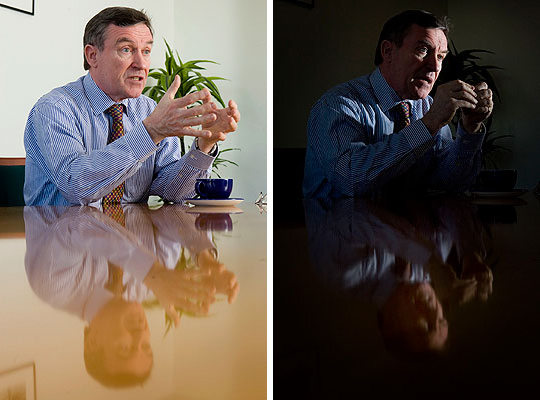
The idea here is to have two separate lighting set-ups for one interview portrait without having to constantly move around the room adjusting lights. This interview was with a senior businessman who chairs a body that decides how much teachers’ pay rises will be each year. The reporter wasn’t all that comfortable with me shooting through the interview but it was what the picture editor wanted, so that’s what I did. This job required a bit of quick thinking so that I could get two different set-ups in place.

©Neil Turner/TSL, April 2008.

©Neil Turner/TSL, April 2008.

The picture on the left was lit using a single Lumedyne head at 50 joules bounced off of a wall almost in front of the subject. The image on the right was lit by a single Canon 550ex flash gun with a Honl Photo snoot attached aimed directly at the subjects face and set further away from the camera.

Both flash units were fitted with Pocket Wizard receivers set on different channels from each other. The idea here is that by simply switching between channels on the transmitters I could switch between two very different lighting styles without moving.

The left hand image is far more evenly lit. The large expanse of off-white wall made a very good and large light source. The exposure here was 1/60th of a second at f5.6 on ISO200. There was some available light play – without flash the scene would have been two stops under exposed with that amount of flash. You can see from the diagram below how the room was laid out and the flash head was positioned at about 10 degrees above the subjects eyeline.

The right hand image is far more starkly lit. The exposure was 1/250th of a second at f13 on ISO 200. There is almost no available light in this picture and the lighting effect is dramatically different. The very narrow angle of the light offered by the Honl snoot makes it difficult to always get the subject right in the centre of the small pool of light and so you need to be careful when aiming it to centre it on where the subject is most likely to be.

The layout of small conference room where the interview took place.

The layout of small conference room where the interview took place.

The point of this technique is that you can arrange more than one style of lighting and then switch between them at will simply by selecting a different channel on the trigger. I find that I use the Honl snoot a lot more than I had imagined that I would. It fits into a bag very easily and it is simple to use. When you are in complete control of the lighting, it’s very easy to achieve dramatic results. This style of light might not be to every picture editor’s taste and so the evenly lit alternative is a very good idea.

A fourteen year old technique post

Between May 1999 and June 2008 I posted a large number of technique examples on the original http://www.dg28.com taken from my daily work to show how I used light in an era where digital cameras were pretty poor at ISOs over 800 or even 400 in the case of the venerable Kodak DCS520. These days flash is a creative choice rather than a technical necessity but the techniques still stand up. From time to time I re-post one of these old examples just to remind myself how life used to be. This one was first posted fourteen years ago and for a very long time it was amongst my favourite pictures that I had posted.
©Neil Turner/ TSL, November 2000.

©Neil Turner/ TSL, November 2000.

At the time it felt as if I spent every evening answering follow-up questions about the pictures and techniques that I’d described. These days there are thousands, if not tens of thousands, of people publishing ‘how-to-do-it’ photography blogs but back then there were only a small number of us. It was such an exciting time in our profession. Anyway, here’s the post as it appeared back in November 2000:

Arriving at the job is usually the best times to start having ideas about locations for a portrait. Buildings often have features that lend themselves to use in a photograph, and the grounds can be just as inspirational.

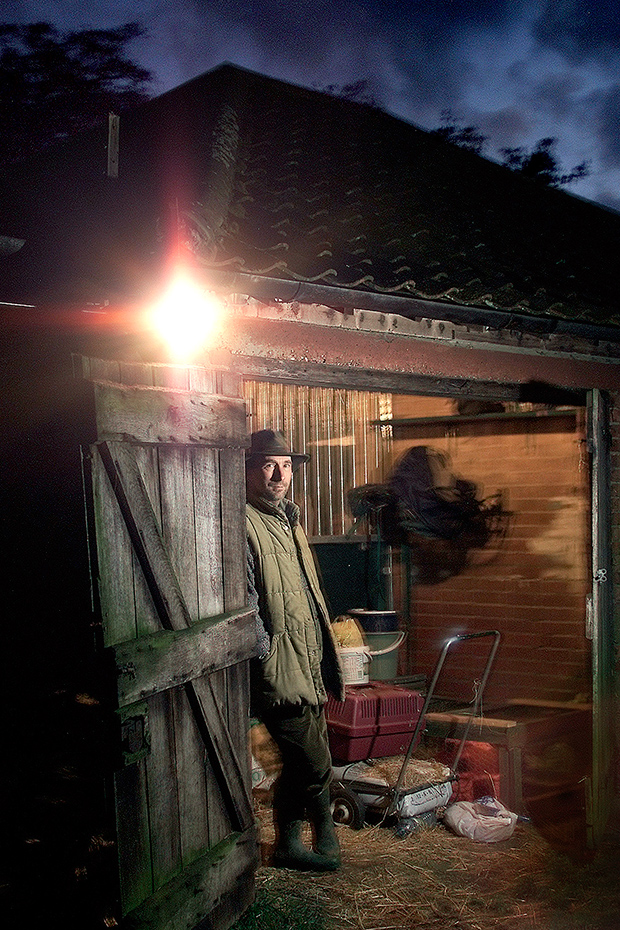
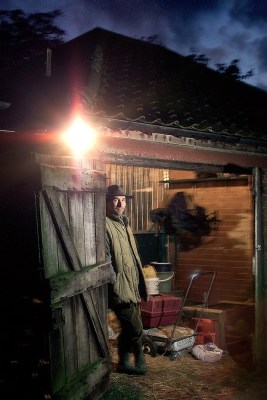
When I arrived at the Suffolk farmhouse of journalist and author Simon Barnes, he and his wife were busy chasing one of their horses around the yard. By the time the mare was back in one of the stables it was all but dark, but I had seen just how wonderful the other stable looked lit by the 60 watt bulb inside it. 

This image called for the mixing of available light and fifty joules of Lumedyne flash. The flash head had it’s diffuser cap over the standard reflector at an angle of 60° from the lens axis and at a height of about six inches above Simon’s eye level. I had to use the flash a lot lower than I would have done because I wanted him to keep his hat on and the if the flash had been higher his face would have been in shadow from it’s wide rim.

Cut down to it’s minumum 50 joules at a distance of seven feet the flash reading on 200 ISO was still f6.7, which was a lot more than I would have liked. At f6.7 the inside of the stable needed an exposure of about 1/3rd of a second, and the sky needed 1/2 of a second to get some detail in the lighter areas. The discrepency between the two exposure requirements was only half a stop, so I went with the longer exposure because a little over exposure inside the stable would be fine. 

With a 28-70 f2.8L series lens on a DCS520 I started shooting pictures of the upper half of his body and a little of the stable roof and sky. Without changing the exposure I changed lenses to the 17-35 f2.8 and moved back. As I moved back the sensor floodlight came on and the light shining into the lens gave some strange pink flare (bottom right) and the floodlight made an excellent element in the composition. By this time I was hand holding the camera at 1/2 second, which meant that there would be some camera shake so I shot about twenty frames at the same exposure in the hope that a few of them would be still enough to work. 

I shot some safer images as well with the inside of the stable lit by another Lumedyne head complete with a warm up filter to simulate the tungsten glow. The image worked really well, and I am more than happy with it. It shows that light and location are the most important factors when planning a location portrait.

Footnote: Immediately after this job I started to carry a sheet of -2 stop neutral density gel in my bag. I have learned lots of lessons the hard way since the beginning of my career in 1986 and, whilst they are fewer and farther between, I still learn plenty of things that way.

Canon’s EOS 6D – pressed into service

With Photokina drawing the crowds in Germany and with both Canon and Nikon announcing important new DSLRs I have (typically) been having a good look at a camera that has been on the market for ages. I bought my EOS 6D for a very specific reason; the ability to use it as a remote and control it from my smart phone. It performed that task rather well and I will definitely be making use of that function again but I also wanted to blog about what it’s like as a daily working camera.

Canon's small, light full frame DSLR. ©Neil Turner, September 2014.

Canon’s small, light full frame DSLR. ©Neil Turner, September 2014.

I was at another major show last week – The Southampton International Boat Show to be precise and I wanted to carry as little gear around with me as I could. Most of the work was going to be shot using EOS 5D MkIII cameras which have become my favourites (although they are far from perfect) for day-to-day jobs but I had a problem with one of them and decided to use the 6D as my second body once it had performed it’s (not able to post the pictures here) remote task. I had quite a bit of confidence in the camera having used a borrowed one when it was first launched and so I stuck a 16-35mm f2.8L lens on it and away I went.

Press day at the Boat Show is a mixture of dull press events, glitzy celebrity appearances and the search for different and interesting pictures that nobody else has. I found myself drawn to the official opening despite there being over a dozen other photographers there. To get something different I managed to get on board the tall ship Phoenix to see if I could shoot a different angle to everyone else. It wasn’t much of a gamble as the value of having the same picture as everyone else was pretty low on this job for me and I managed to get this nice frame of a couple of the invited children at the helm of the moored ship.

The sons of the late Olympian Andrew

The sons of the late Olympian Andrew “Bart” Simpson at the helm of the tall ship PHOENIX alongside Europe’s largest temporary marina. ©Neil Turner, September 2014.

Anyway, back to the EOS 6D. It is a tiny bit smaller than the 5D MkIII and it is a tiny bit lighter. It has fewer buttons and fewer megapixels (20 for the 6D and 22 for the 5D MkIII) and it only has a single SD card slot compared to the CF + SD combination on the 5D MkIII. It doesn’t have the same amazing auto focus and it isn’t as well built as the 5D MkIII either but, and it is a big but, it is really nice to use. It fits in your hands well and the controls are easy to use even with the camera to your eye – ergonomically speaking it ticks a lot of the boxes for me. I haven’t used it with a big lens attached yet and I suspect that with something like a 70-200 f2.8L IS it might feel a little unbalanced without a battery grip but with the 16-35 and with a range of primes including the 135mm f2L it feels great without a grip (I’m not a grip fan). The shutter sound is OK and the ‘quiet’ option is also pretty good.

I have written a lot about processing RAW files from various cameras recently and I found the 6D files to be remarkably similar to the 5D MkIII ones and that is a big plus for me.

As always there are a few things that I’d like to see changed on. Canon have this amazing knack of producing “almost perfect” cameras and the 6D is no different here. In no particular order:

  • I’d like them to add the ability to add custom file names in camera in the same way that you can in the 5D MkIII and the 1DX – surely this could be done as part of a firmware update?
  • All Canon cameras need to have the ability to lock the diopter adjustment on the eyepiece. Having to put bits of gaffer tape on every camera is getting boring.
  • I know that the camera already has built-in wifi but better Eye-Fi integration and the option to assign a button (the Q button?) to “protect” an image for transmission would be great.
  • Twin card slots on a MkII would be far better than the single slot that this version has. 2x SD would be fine.
  • Similarly, USB2 on a camera of this generation is poor.

I don’t shoot a lot of on-camera flash and I was caught out on this job where I only had a single 580exII with me. With not much time to work I found that the flash exposure with an older lens wasn’t great. It works well with the newer lenses and flash but the technology has left a couple of my older (but still great) L series lenses behind.

There was photocall with a couple of celebrities (Eddie Jordan and Claudia Winkleman) on the Sunseeker luxury yacht stand and I managed to steal the former Formula 1 team boss onto the bridge of a £3.8 million boat for a quick shot. I had to flash it and the head linings of the boat made a low but useable place to bounce from. Sadly my “exclusive” was ruined when a local agency photographer jumped in and did much the same shot. You win some and you lose some!

Former F1 boss Eddie Jordan on the bridge of a £3.8 million Sunseeker. ©Neil Turner, September 2014.

Former F1 team boss Eddie Jordan on the bridge of a £3.8 million Sunseeker. ©Neil Turner, September 2014.

So what about the 6D’s performance as a working camera then? It is good without being brilliant. Lovely to use but not perfect. I could have written the same summary of just about any camera I have ever used but for anyone needing a full-frame Canon body on a tight budget it really does represent a great buy. It will get used again soon and I will add anything that crops up. Anyone want to lend me a 7D MkII for a day?