Turner

Not the DSLR, I’m having fun

© Neil Turner, March 2014. Shadows on the pavement as a pedestrian passes along Tottenham Court Road.

© Neil Turner, March 2014. Shadows on the pavement as a pedestrian passes along Tottenham Court Road.

Question: Why are so many professional photographers using mirrorless cameras, micro 4/3rds format cameras and experimenting with pretty much anything that isn’t a DSLR?

It’s a tough question and without conducting some sort of major survey I can only give an answer based on my own experiences and those of close friends and colleagues. DSLRs have been my main cameras for over sixteen years now and they have become an extension of me when I’m working. They do what I need them to do with no real fuss, the quality has moved from “acceptable” back in 1998 to “extremely good” and they allow me to do the day job without having to worry about my gear very much. But, and there’s always a ‘but’ – they have become a little bit boring and little bit ‘too good’.

When I’m shooting pictures for the joy of it (and despite doing this for a living since 1986 I still do that) I want to feel something different. Elegant competence isn’t enough any more. (more…)

Another ‘classic’ technique posting from the old site

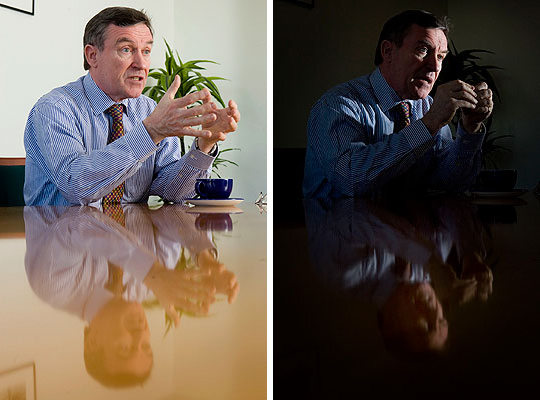
The idea here is to have two separate lighting set-ups for one interview portrait without having to constantly move around the room adjusting lights. This interview was with a senior businessman who chairs a body that decides how much teachers’ pay rises will be each year. The reporter wasn’t all that comfortable with me shooting through the interview but it was what the picture editor wanted, so that’s what I did. This job required a bit of quick thinking so that I could get two different set-ups in place.

©Neil Turner/TSL, April 2008.

©Neil Turner/TSL, April 2008.

The picture on the left was lit using a single Lumedyne head at 50 joules bounced off of a wall almost in front of the subject. The image on the right was lit by a single Canon 550ex flash gun with a Honl Photo snoot attached aimed directly at the subjects face and set further away from the camera.

Both flash units were fitted with Pocket Wizard receivers set on different channels from each other. The idea here is that by simply switching between channels on the transmitters I could switch between two very different lighting styles without moving.

The left hand image is far more evenly lit. The large expanse of off-white wall made a very good and large light source. The exposure here was 1/60th of a second at f5.6 on ISO200. There was some available light play – without flash the scene would have been two stops under exposed with that amount of flash. You can see from the diagram below how the room was laid out and the flash head was positioned at about 10 degrees above the subjects eyeline.

The right hand image is far more starkly lit. The exposure was 1/250th of a second at f13 on ISO 200. There is almost no available light in this picture and the lighting effect is dramatically different. The very narrow angle of the light offered by the Honl snoot makes it difficult to always get the subject right in the centre of the small pool of light and so you need to be careful when aiming it to centre it on where the subject is most likely to be.

The layout of small conference room where the interview took place.

The layout of small conference room where the interview took place.

The point of this technique is that you can arrange more than one style of lighting and then switch between them at will simply by selecting a different channel on the trigger. I find that I use the Honl snoot a lot more than I had imagined that I would. It fits into a bag very easily and it is simple to use. When you are in complete control of the lighting, it’s very easy to achieve dramatic results. This style of light might not be to every picture editor’s taste and so the evenly lit alternative is a very good idea.

After the storm

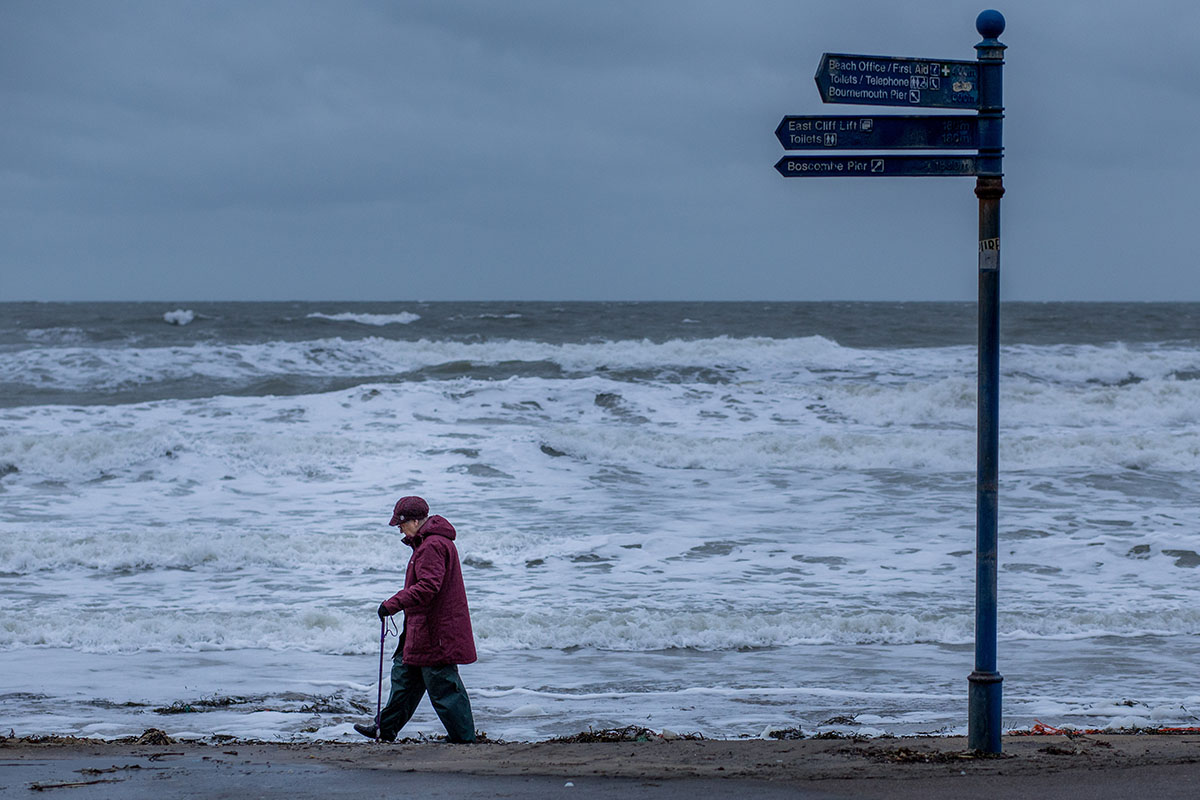
©Neil Turner, November 2014. A pensioner walks along the beach near Bournemouth Pier.

©Neil Turner, November 2014. A pensioner walks along the beach near Bournemouth Pier.

Following on from my post about zoom and prime lenses I was out with just the primes yesterday – walking along one of my favourite bits of beach in wild winds and failing light. I was just out having some photographic time before getting into the car for yet another drive up the M3 for work. This one was shot at 640 ISO at 1/1000th of a second at f4 with an 85mm f1.8 Canon EF lens on my rather lovely little Canon EOS6D – a camera that I am becoming increasingly fond of. When I’m doing personal work like this I tend to set the white balance to daylight and accept whatever colour cast I get and in this case it wasn’t far off of what the naked eye saw.

Three important things

Many, many years ago I started to post technique examples and opinions on my website. By 2002 I had about fifty articles on the site and over the last couple of years I have been recycling many of them because I still thank that they are worth reading. None of it is unique wisdom and much of it can be found in the form of YouTube videos by other people. I like to think that I was marginally ahead of the curve back then at least. Here is one of my favourites…

There are many things that help make a great photograph – a good photographer, the right equipment and luck can all play a part but there are three things that, in different proportions, are absolutely essential.

  1. Light: Possibly the most important element to making an ordinary photograph into a good one.
  2. Composition: Getting all the right elements in the right places.
  3. Subject Matter: It’s true that what you are photographing can very easily make the difference between good, very good and great pictures.

Light: You not only need the right quantity of light, but the right quality and direction of the light are vital too.

  • Too much light can be just as much of a problem as too little. A picture that relies on shallow a depth of field for it’s impact will be hard to achieve if there is too much light to work with wide open lens. Of course if there is too little light to freeze the action when that’s vital to the picture, that’s also a problem.
  • Many pictures rely on hard shadows and extreme contrast for their effect and others need even and soft light to make the photograph work.
  • What direction the light is coming from in relation to the subject matter is important. Strong backlight will be perfect for some subjects and ninety degree side light will do it for others.

Composition. Whatever else is going on in the picture, this is the element of the total package over which you have the most control.

  • What lens you use is an absolutely critical decision to take in terms of the composition. What you can see through the viewfinder is utterly controlled by this decision.
  • Where you position yourself in relation to the subject is another crucial decision.
  • Confusion is the greatest enemy of clarity! How successful you are in keeping extraneous details out of the photograph has an enormous bearing on the final result.

Subject Matter: All great photographs tell their own story, and that’s just as true for a product shot of ball bearings as it is for Pulitzer prize winning documentary images.

  • If what you are photographing tells it’s own story, then you need to strip the content down so that the story isn’t confused.
  • Some things aren’t that interesting, so you need to add content. Telling the story sometimes requires the photographer to set the context.
  • Photographs don’t always need to be great art. Sometimes subject matter is all, and nothing else matters. If there is only one picture of a vital news event and it’s out of focus and taken from video it may well qualify as a great picture.

Three elements that go together to make great pictures. Sometimes light takes the lead and other times the composition is the most important. It doesn’t matter if one element is dominant, but photographs where all three are well balanced and well done then the image is guaranteed to be a winner.

There is, however, one extra element that you can’t legislate for. Magic. Like many things in photography, you know it when you see it but you cannot measure it or define it. Well composed and lit pictures that have great subject matter are (relatively) easy to come by, but once in a while they have magic too.

Shadows

© Neil Turner, July 2014. Shadows on the south bank of the River Thames in London.

© Neil Turner, July 2014. Shadows on the south bank of the River Thames in London.

On my way to a meeting today walking along the south bank of the River Thames I was taken by the quality of the light as it formed shadows through the trees. A pair of office workers out for a stroll stopped and had a chat and we passed a very pleasant few minutes talking about light and London. The conversation was interrupted a few times as people strolled through my composition and I grabbed a frame or two. This was my favourite of maybe a dozen very similar frames.

Another picture shot on my Fujifilm X20 and added to the blog just because I liked it…

Where does the work come from?

It has been a little while since I last posted on this blog; apologies for this but sometimes life gets in the way of blogging! Anyway, I thought that those who are interested in the business side of photography might be interested in something that came into my thinking on a long drive back from a job listening to a business programme on BBC radio. When I got home I produced a couple of reports from my invoices using the wonderful Billings Pro application on my Mac. The one that caught my eye was one that gave me the raw data to work out how the bulk of my work (based on turnover) in the last six years as a freelance has come in.

Conventional wisdom says that a photographer gets out there with their folio after making cold calls and arranging appointments with potential clients. When I say ‘conventional wisdom’ I mean ‘what they taught me in college’. It is the classic sales tactic: research potential customers, show them what you have to offer and then (hopefully) close the deal at a mutually acceptable price. 99% of photographers and probably 88% or all businesses will probably tell you that it is neither that simple or that straightforward.

I started by working out some categories for the way I have initially got the work:

  • Cold calling and portfolio viewings
  • People finding me via the web
  • Referrals from family and friends outside the photography business
  • Referrals from other photographers
  • From colleagues I knew before going freelance
  • Sub-contracted work via other photographers
  • Other odd sources

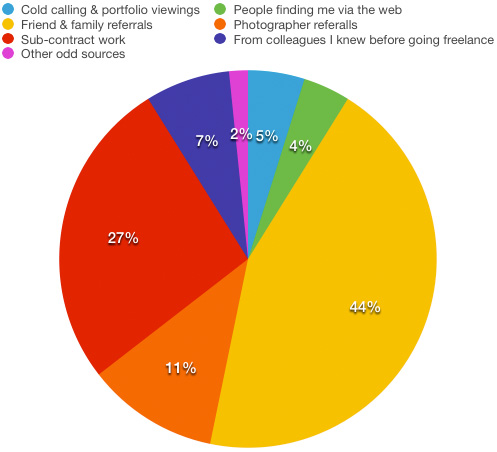
I then quickly added up how much work (monetary value) each of those six sections accounted for and got the following results:
monetary_value


The monetary value for each client is based on that initial method of contact. Some high value clients have been very loyal to me and I hope that I have, in turn, given them the photographs that they need to keep those excellent two-way relationships going. On the flip side, most of the work that has come via the web has been one-off jobs for clients who don’t have a lot of work to commission.

Now I don’t know about you, but I found that to be quite a shocking set of results. Only 5% of my income has been generated by getting out there and trying to make sales in what you would call a ‘traditional’ way yet more than twice that figure came from referrals from other photographers. The sub-contract figure at 27% is also a lot higher than I thought that it would be but the biggest surprise is how low the figure for income generated via work from pre-freelancing colleagues. In my first year as a freelance that figure was considerably higher but it has been eclipsed by the friends and family percentage which, at 44%, is somewhat higher than I would have thought. People finding me through the web includes not only those who have found my website through searches but also the various social media platforms that we all spend so much time working on – 4% isn’t a great return on all of that effort either.

If I had the time, I’d like to work out how different the chart would be if I based the figures on the amount of time spent on the jobs rather than the money invoiced. My strong suspicion is that the cold calling and portfolio section would be a fair bit bigger as would the one for pre-freelancing colleagues because those are both news and editorial biased sections whereas the friends and family one is far more corporate and commercial.

So what conclusion should I draw from this? Maybe I should spend less time trying to generate work from cold-calling and spend a lot more time with family and friends? I suspect that the true answer is that I need to change my targets for the cold calling to more corporate and commercial ones simply because they have a higher value per job.

One that didn’t make the folio

©Neil Turner/TSL. June 2008, Hertfordshire.

©Neil Turner/TSL. June 2008, Hertfordshire.

When I was putting a massive “long-list” of photographs that I was considering putting into one of the galleries on my portfolio website I looked at this picture and couldn’t make my mind up one way or the other. I was aware that I already had a lot of images from schools – which isn’t surprising when you consider that I have worked in over 3,500 of them in 15 different countries – and that it didn’t add anything to the mix.

I like this picture a lot because it is simple, demonstrates the use of good composition and shallow depth of field as well as reminding me of the kind of work that still makes me want to get out of bed in the morning and go and shoot pictures. These days most of my school based work is shooting for their prospectuses and websites with the odd news story thrown in from time to time but this remains the kind of picture that has a lot of uses and draws the most comment from those who are commissioning the work.

The truth is that almost anyone could take an acceptable picture of primary school children on a scavenger hunt in an enclosed copse. I hope that it also proves that it takes a lot more to produce as good as this on a miserable and rainy day early in the morning when the light is awful and the gear is getting wet. I have kept a few photographs that didn’t make it to one side and I intend to publish a few of them here on the blog with a bit of the background to why I like them along with a bit of the story.


Techie Stuff: Canon EOS1D MkII with a 16-35mm f2.8L lens at 16mm. Canon CR2 RAW file 640 ISO, 1/90th of a second at f2.8 on daylight white balance and converted using Adobe Camera RAW in Photoshop. At the time it would have been ACR in Photoshop CS3 but the file was re-worked using ACR in Photoshop CC.

Portfolio updates – finally!

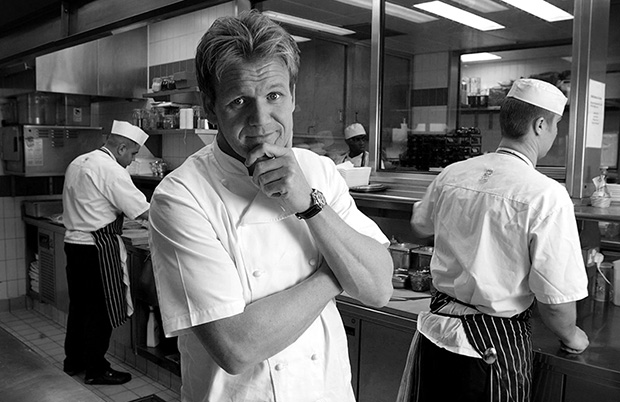
©Neil Turner/TSL February 2003. Gordon Ramsay photographed in his kitchen

©Neil Turner/TSL February 2003. Gordon Ramsay photographed in his kitchen

I have just finished uploading a major update to my website with a refreshed selection of new and old images in the portfolio section and an updated look to the templates pages with links to all of my social media.

I still do most of the work on my site myself and so it takes a lot longer to do but I am very happy with the way that photographs look on my site and I guess that is a major selling point. There will be lots more changes over the next couple of weeks but I’d like to invite you come to the site and have a look at the new portraits selection as well as two new galleries of personal work which will definitely be updated as they are both about continuing passions of mine.

My website is www.dg28.com and if you have any feedback, I’d love to hear it.