UK

My iPhone & not taking pictures with it

iphone_grabThere’s no getting away from two facts:

1. I am a fan of almost everything Apple for the work that I do and the way that I do it.

2. I rely on my two and a bit year old iPhone 5S for quite a lot of things when I’m out on assignments.

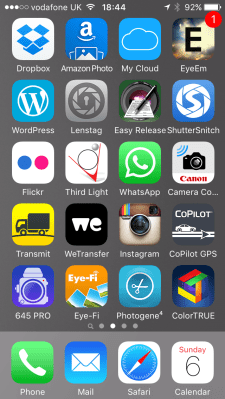
The speed of the 4G network and the brilliant array of apps available for all smartphones has changed the way that I do some of my jobs quite a lot in the last few years. Recently I wrote about getting pictures away quickly  and I have also written about the workflow that I use with some of the phone apps and you can see from a current grab of one of the app pages on my phone I have quite a few ways to do similar things.

I’d like to talk in this blog about some of many of the ‘un-sung heroes’ of my mobile life – at least one of which is a very new and a very, very welcome addition to the set up.

The backbone of my mobile image acquisition and transmission system is formed of the Eye-Fi and Photogene apps which have been covered at length before but you can also see plenty of other work related apps on this single screen. (more…)

Canon 16-35 f4 L IS

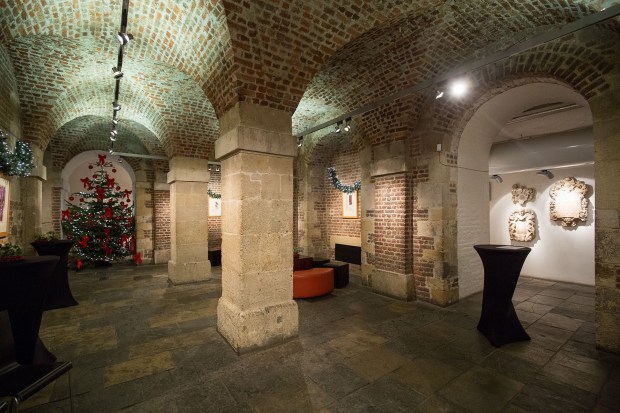
Test shot with Canon 16-35 f4 L IS in the crypt of St Martin-in-the-Fields

London. 08 December 2015 Test shot with Canon 16-35 f4 L IS in the crypt of St Martin-in-the-Fields Photo: Neil Turner

A couple of months ago I cracked and bought the Canon 16-35 f4 L IS lens to replace my very elderly 16-35 f2.8L having borrowed both this one and the f2.8L MkII to see what all the fuss was about. I shoot quite a few pictures of buildings and having a 16mm lens is very useful – especially when the space is really tight.

My old 16-35 and just about every other super-wide lens I have ever used has suffered from barrel distortion, been less than pin sharp in the corners and generally required a bit of work to get great pictures that are as free from distortion as possible.

I was on a job last night in a tight space where the 16-35 f4 L IS was being pressed into service to do shots of an empty venue before an event. I hadn’t brought a tripod because I hadn’t expected to be doing these shots but I did my best with what I had. The photo above was taken hand-held at 1/60th of a second at f4 on 2500 ISO with the IS switched on with a Canon EOS5D MkIII. I have applied no correction to the uprights and the frame is un-cropped at 16mm focal length.  (more…)

What makes this photo a Flickr favourite?

Waiting for people and texting their friends outside the Apple Store, Covent Garden.

Waiting for people and texting their friends outside the Apple Store, Covent Garden. © Neil Turner. November 2015

When I rejoined Flickr a couple of months ago my main aim was to learn the ins and outs of how it works so that I could help an important client build their Flickr profile. One of the side-effects is that I have become quite interested in how and why some pictures get no attention and why some others get loads. This was made all the more interesting when one single picture of mine went from the normal 100-200 views and 2-3 likes to having over 10,000 views and around 130 likes.

I don’t think that it is any better or worse than most of the rest of the (178 and counting) pictures I have uploaded so why did it get so much attention?

I genuinely don’t think that it is because it is a wonderful image so maybe it is because someone influential in the Flickr-sphere decided that they liked it and that prompted their followers to also like it. Maybe it is because I uploaded it on the right day at the right time in the right groups to get so much attention.

The truth is that I don’t know – (more…)

The story behind a picture #3

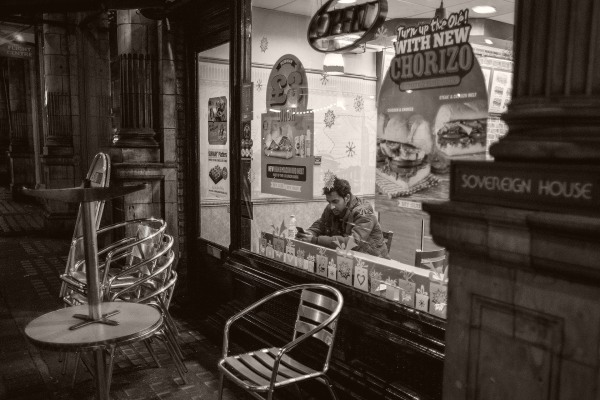
Sitting in the window seat at Subway on Shaftesbury Avenue Photo: Neil Turner Photo: Neil Turner

Sitting in the window seat at Subway on Shaftesbury Avenue
© Neil Turner, November 2014.

This photograph falls into the ‘personal work’ category. I had been to a meeting in central London during the evening and had arrived fashionably on-time having failed to park in my favourite evening parking space near the location of the meeting. That had forced me to park a bit further away. As a result my walk back to my car at around 10.30pm was both longer and much more interesting than usual.

I nearly always have a camera with me and it is nearly always either my Fujifilm X100S or it’s little brother the X20 but on this evening I had a Canon EOS6D with a couple of fast prime lenses and so I shot some photographs of things that interested me as I walked. This shop window – a branch of Subway that stays open until the early hours was the very first thing that caught my eye and I was very interested to see just how good the EOS6D is at higher ISOs. This was shot at 3200 ISO with a shutter speed of 1/250th of a second at f1.8 using a Canon EF 28mm f1.8 lens. For a DSLR this is about as unobtrusive as you can get – the quiet shutter mode is really good and the speed and accuracy of the auto focus on the centre focusing point means that you can ‘snatch’ a frame in really low light with quite a high degree of certainty.

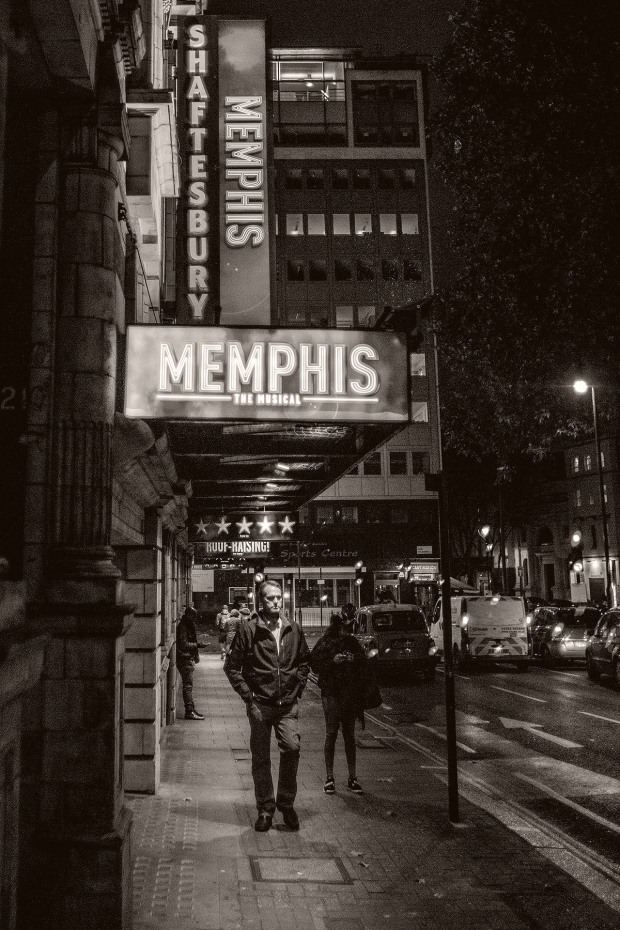
Just around the corner I saw the potential for another nice image with the frontage of a theatre after the last member of the public had left the building. I composed, waited and finally got this frame as a solo pedestrian passed through the frame.

Pedestrian passes under the "Memphis" banner outside a west end theatre at night. © Neil Turner November 2014.

Pedestrian passes under the “Memphis” banner outside a west end theatre at night. © Neil Turner November 2014.

This photograph was also shot at 3200 ISO but was better lit at 1/640th of a second at f1.8. I was actually quite disappointed when I got back to my car and realised that I had a two and a half hour drive home. I knew that I had half a dozen good photographs and I sat in the car and transferred a couple of them to my phone using the camera’s built-in wifi before uploading them to EyeEm and Twitter. Then I drove home…

Reliance on the internet

As photographers we have got used to using a range of web-based technologies to deliver our work to our clients. Most of the time it works and nobody notices how amazing these technologies are. Over the years we have come to expect more and more in terms of bandwidth and speed and we have come to rely on getting good connections to easily accomplish what would have been regarded as time-sensitive alchemy only a few years ago.

On an overseas job last week the client wanted a lot of high resolution Jpegs delivered to them very quickly and their chosen method was WeTransfer. It’s a very good and reliable system in itself but it depends on a half decent internet connection. Sadly we didn’t get that connection and out of sheer frustration I did these screen grabs:

wetransfer

Yes that’s right: one million, two hundred and one thousand, seven hundred and thirty hours to complete a transfer that should have taken about half an hour on a half decent network. In case you are interested that is fifty thousand and seventy-two days or one hundred and thirty-seven years and sixty-five days. A bit slow. The second screen grab says less than a minute but that was also wildly inaccurate as no further data moved.

In the end I had to abandon the ethernet and wifi networks that the client had arranged for us to use and head outside where I could pick up a great 4G mobile signal by tethering to my iPhone and use my roaming package to send the pictures – which took about 44 minutes (by then I had 1.2Gb of pictures). The point here is that now we have come to reply on the internet for almost all of our image delivery it has become crucial that we have multiple ways of connecting to the internet.

Dusk at the National Theatre

Dusk approaching at the National Theatre on London's South Bank. ©Neil Turner, March 2015.

Dusk approaching at the National Theatre on London’s South Bank. ©Neil Turner, March 2015.

Interesting evening light plus some fabulously brutal architecture makes for some interesting photos. Whilst walking to meet up with a friend and colleague at the National Theatre yesterday evening I was drawn to this section of concrete staircase and shot a few frames in one of those “just because…” moments.

Fujifilm X100S 800 ISO 1/250th of a second at f8.

Twenty-five years ago today

©Neil Turner, 13th February 1990. Whitecross Street Market, London EC1.

©Neil Turner, 13th February 1990. Whitecross Street Market, London EC1.

Over the last few years I’ve posted a few pictures from my own filing cabinet when they have had some relevance or when there is a specific anniversary. This picture was taken twenty-five years ago today as I went for one of my regular wanders around bits of London that were near Metro – the 24 hour laboratory where we all got our E6 transparency film processed. It was about a mile and a half from our Hoxton office (before it was trendy) and it took about twenty minutes to walk there or five minutes to drive. Sometimes there would be other photographers around and we would adjourn to a local cafe for a cup of something and a sandwich and at other times I’d take myself off for a walk around one of the many fascinating side roads and markets that made up the Clerkenwell/Farringdon/Smithfield area and take a few personal and/or stock pictures whilst the film made its hour and three quarter journey through the system and the ‘soup’ at Metro.

On this particular day I went to Whitecross Street with a couple of cameras and a couple of rolls of Kodak Tri-X film. It is amazing what you remember when you start to think about a day and a place and my memory of this day is that I was half an hour into the walk when I bumped into another photographer (there were three or four agencies close by) and we had a coffee anyway!

The man in the photograph (who said his name was Frank but I’m not sure he was being 100% honest judging by the cheeky look in his eye) had been a stall holder at the market selling books and a few magazines for many years. Trade was brisk as the workers from the many offices on the edge of the City of London were having their lunch hours and I didn’t really finish my conversation with him.

Anyway, another ‘archive’ picture that brings back happy memories and brings a smile to my face. This was, quite literally, half of my lifetime ago and I still love the photograph.

Techie stuff: Nikon FM2 camera with a 135mm f2 Nikkor, Kodak Tri-x film.

Electronic viewfinders and me

©Neil Turner, February 2015. The cliff tops at Boscombe on a dull winter's day.

©Neil Turner, February 2015. The cliff tops at Boscombe on a dull winter’s day.

A few months ago a colleague whose work I know and love said that it took him a little while to get used to electronic viewfinders and now that he has been using them for a while he cannot remember why he had been so resistant to them in the first place. Resistant to electronic viewfinders? That summed up my attitude until a couple of weeks ago too. After carrying my beloved Fujifilm X20 around with me I decided that it was time to give an X100S a run out. The lack of a zoom lens and the small jump in size and weight is compensated for by a big increase in the higher ISO quality (which isn’t to be sniffed at during the winter time) and a few more megapixels (allowing a bit of judicious cropping here and there) and so for the last few weeks I have been shooting my personal work with the X100S. The idea hit me that now I had the option of using the electronic viewfinder (to be known as the EVF from here on in) instead of the optical viewfinder (known from here as the OVF) and that’s what I started to do.

For the first few days I was getting annoyed by the EVF to the extent that I had to have a few days off from it. During that time I shot some photographs that I really liked and I had to force myself back to using the EVF with something of a heavy heart. That was just over a week ago and I am now really pleased to announce that I have got the hang of shooting using an EVF. Welcome to the twenty-teens, welcome to the world of the EVF enthusiast and welcome to a wide world of possibilities I hear some of you saying. Not quite.

The current situation is that I am perfectly capable of shooting with an EVF and that I can see why some photographers have made the switch but not me. I still prefer the OVF to the extent that I don’t want to use the electronic version and to the extent that the kind of work that I have been doing with my Fujifilm cameras isn’t as fulfilling without the old-school optical set up. If I were tempted to buy a Fujifilm XE-2 or an XT-1 I’d have to forego one of the main pleasures that I derive from using kit that, despite some huge flaws, makes me want to go and just shoot pictures.

I’m not going to tell all of the EVF enthusiasts I know that they are wrong but I am now in a position where my choice to carry on using OVFs and DSLRs is made from knowledge and not from ignorance. There, I’ve said it.