why

Performing the ritual of “The Selfie”

For as long as I can remember I have shot pictures of my wife and I on holiday with a compact camera at arm’s length. I have examples in the family album dating back to 1984 and, whilst I’m not claiming to have invented “The Selfie”, it really isn’t anything new in our house. We started doing those pictures just because there was never anyone else around to take the picture for us and so it was very much a second best picture. Slowly and over the many holidays that we have enjoyed together it became something of a tradition to do at least one of those arm’s length couple pictures but we always liked to get a passer-by to do the picture if we could. It is a phenomenon that I am fascinated by and I often shoot pictures of people as they perform the Ritual of the Selfie.

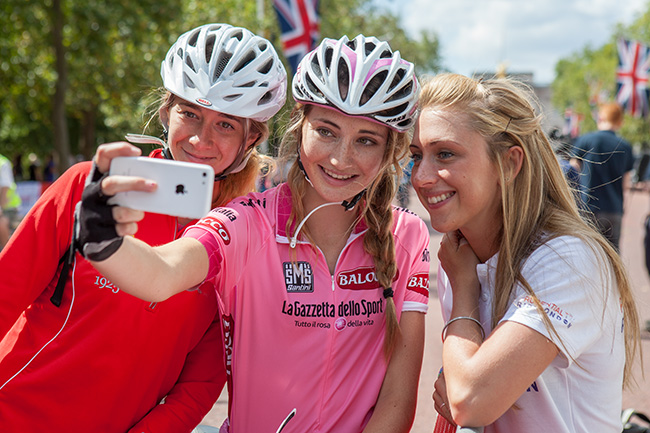
Olympic and Commonwealth Gold medallist Laura Trott posing with riders on The Mall in a break between media interviews during the Freecycle event - part of Prudential RideLondon. 9th August 2014.

Olympic and Commonwealth Gold medallist Laura Trott posing with riders on The Mall in a break between media interviews during the Prudential RideLondon Freecycle event. ©Neil Turner, 9th August 2014.

I was prompted to compose this blog post because I suddenly realised why it works so well. One of the media team working with Prudential RideLondon had offered to take the picture and the three young women dutifully posed but their faces didn’t come alive until they rescued the phone and performed the ritual of the selfie. There seems to be a confidence and a joy in taking your own picture of yourself and your friends or, in this case, you, your friend and an Olympic and Commonwealth champion. Is it because these days that can see themselves in the screen and only shoot when they are happy with what they see? I believe that there’s an element of that in it but the sense of self-reliance is just as important as far as I can see. There is a joy in The Selfie that is missing from a perfectly well taken group photo. Time after time we all saw people enjoying taking self portraits during the event and that’s the case almost everywhere almost every day.

Where I depart from the celebration of The Selfie is where media outlets and PR companies encourage people to do it and post them as part of marketing campaigns. For me the innocence and joy of the ritual gets lost when it is prompted like that. Where I also have an worries about it is when people do it dozens or even hundreds of times a day. I had a link request on EyeEm the other day from a guy who have over 6,000 images on his account and, from what I could see, they were all of himself.

I don’t object to The Selfie at all. In fact I indulge in the ritual myself from time to time. All I’d ask is that marketing people without another great idea stop trying to make something from them that isn’t really there. Photography is about a lot of things and fun is right up there as one of the most important.

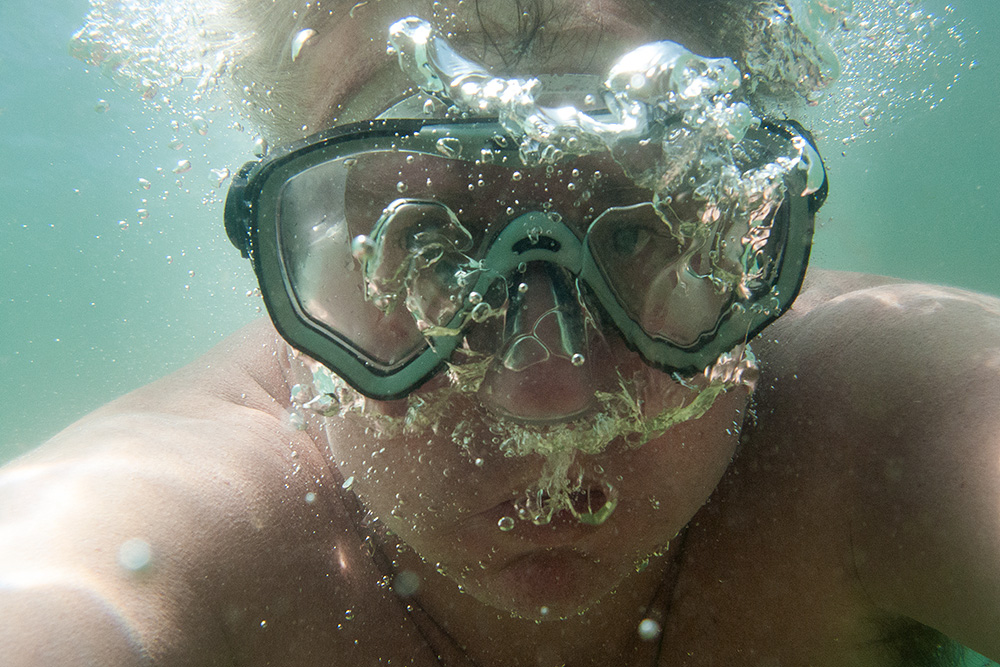
The one "selfie" that I do like of mine - under water at the beach in Bournemouth in the summer of 2013. ©Neil Turner.

The one “selfie” that I do like of mine – under water at the beach in Bournemouth in the summer of 2013. ©Neil Turner.

The light on the train

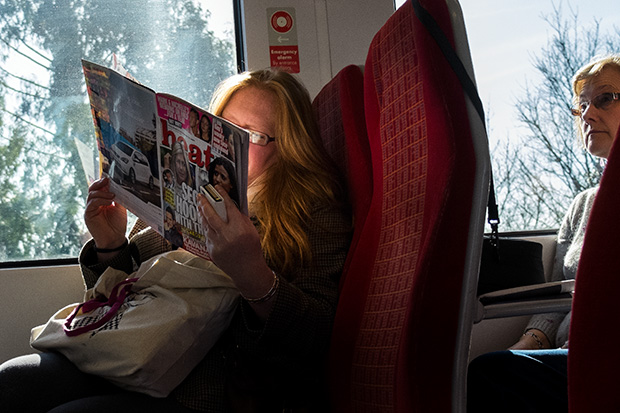
March 2014. Passenger on the train between Bournemouth and London Waterloo reading HEAT magazine as the train passes through Woking. ©Neil Turner

© Neil Turner, March 2014. Passenger on the train between Bournemouth & London Waterloo reading HEAT magazine.


Every once in a while I take the train to London for meetings and the occasional job where I don’t have to carry half a ton of cameras, lights and computers. One of my favourite ways to pass the time is to do a bit of train photography and yesterday’s journey gave me a few nice frames where the light was good. Normally I just bung them from the camera (in this case my adorable Fujifilm X20) via an Eye-Fi card onto my iPhone or iPad and then straight to Twitter or EyeEm. I rarely give them a second glance when I get home but I wanted to post this picture because of the light. The sun was coming at just the right angle to reflect a lot of light back into the woman’s face from the pages of Heat Magazine at exactly the same time as the woman sitting behind her appeared to be getting interested in the page through the small gap between the seats. I have no idea if she was actually looking at the page or whether it was a happy coincidence – either way, the light made me do it!

This frame was taken about five minutes after I’d posted a similar but inferior one on EyeEm so I kept it and decided that it would make a nice “just because” picture on this blog. I’m sure that I’ll get around to writing something more serious soon…

Dogs on the beach and the Fujifilm X20

My addiction to taking pictures of dogs walking on the beach with or without their owners shows no signs of abating and neither does my joy at shooting pictures with my Fujifilm X20. When I get to shoot bon the beach with the X20 my photographic life is almost complete (laughs ironically there). So, once again, for no other reason that I loved taking and editing the picture here is a photograph taken last Saturday at Boscombe Manor during a break in the foul weather that the whole of the country has been getting.

© Neil Turner, February 2014. A couple walk their dog on the beach between storms.

© Neil Turner, February 2014. A couple walk their dog on the beach between storms.

To the north of us was the wreckage of broken beach huts, to the east was an area closed off to the public and to the west was the only stretch of the beach where you could walk with reasonable safety. Happy days.

New year’s resolution

We all do it… make promises to ourselves about what we are going to do and how we are going to do it as another year begins. Take more pictures, get more exercise, make more money, be nicer etc etc. You can take it as read that I’m attempting all of those but I thought that I’d talk about the first one – taking more pictures.

©Neil Turner January 2014

©Neil Turner January 2014. Shot using a Fujifilm X20

Time after time in my career I have realised that the more I shoot, the better my reactions are and the more instinctive the operation of the camera becomes. I’m pretty sure that someone could even devise a mathematical formula for it where x is the number of pictures you shoot over a given period of time, y is the number of days over a given period where you don’t take pictures and z is the probability that when you are shooting an assignment you absolutely nail the job. Unfortunately I’m not an imaginative and innovative mathematician so I’m not going to be able to define that formula – if you have the ability, please feel free to finish the task for me but not until you have read the rest of the puzzle:

All of this seems to be rational, don’t you think? There are a couple of flies in the ointment though: If you do too much of the same kind of thing, you can get into a rut and just keep producing cookie-cutter images.

So does that mean that there is an optimal amount of pictures to be taken? Well yes… and no… If you are shooting very different images on each occasion then you can take a lot more pictures and get a lot sharper without becoming stuck in the rut that I mentioned just now. There is a further variable that we need to include in our increasingly complex formula – having the time between shoots to properly edit our own work and to reflect on why and how certain pictures did and didn’t work and this requires a degree of knowledge and of technical and analytical skill.

Now we need to clarify what the formula needs to say:

  • Take lots of different pictures using different techniques and different equipment.
  • Don’t take so many pictures that you get stuck in your ways.
  • Have the time to edit and analyse your work.
  • Learn from your successes and mistakes.
  • Make sure that you know why and why the pictures that you like worked and why the rest didn’t.

All of this makes me re-assess my new year’s resolution. It isn’t just to take more pictures – it’s to take more different pictures and to learn as much as I can in the process. If I get time I might even learn a bit more about mathematical formulae too.

Poor old Photographer B

There is a heated discussion about the winner of this year’s Taylor Wessing Portrait prize on a photographers’ forum at the moment. Some people love Spencer Murphy’s picture and other’s don’t get it – which makes it a perfect demonstration that personal taste is a major factor in “liking” an image. One thread of the debate is the winning photographer’s use of large format film and The Guardian having quoted him as saying “I chose to shoot the series on a large format film, to give the images a depth and timelessness that I think would have been hard to achieve on a digital camera.” Hard to achieve? Hard for whom?

All of this prompted me to expand a little on something that is happening in photography right now that frustrates me: To make myself clear – I applaud photographers who find ways to make an overcrowded and homogenised market work for them and I applaud the way that they are using different methods to enable them to “see” better.

The idea is gaining momentum that just because something is shot on film it somehow has greater validity and greater truth. This really angers me.

If Photographer A likes the way that they work with film and that there is a market for that work then Photographer A has found a niche and I’m happy for them. Photographer B on the other hand creates great work without resorting to film but potential clients who have bought into the myth about the validity of film are already starting to question why Photographer B isn’t going with the fashion and using Photographer C who is happy to take the money but doesn’t work better on film. Basically, we are in a situation where the means of production could overtake the end result as the goal of the commission. Nobody wins – especially photographers D-Z.

The place where this is most frightening is in our colleges and universities where the small resurgence of film is being leapt upon by lecturers who are miles out of their depth in the digital world supported by managers who are desperate to validate their investments in silver based facilities and avoid having to spend on up-to-date digital ones. We have a generation of students being equipped for professional life in the 1980s based on the achievements of a tiny number of photographers achieving critical acclaim by “seeing differently” and then talking nonsense about it to a small clique of art lovers who lap up all of this stuff so that they can repeat it at Islington dinner parties and sound as if they know what they are talking about.

I come from a newspaper background where there is a good deal of nostalgia for shooting film. Happily most of us who wish to can indulge in this kind of work as part hobby and part self-expression. Each to their own and vive la difference and so on. We owe it to ourselves and each other to take the utmost care that our professional lives are not going to get hijacked by a notion that film – or “heritage media” as I quite mischievously like to call it – is better. After all, there’s a lot of truth in the old saying “be careful what you wish for.”

For the record I like Spencer Murphy’s work and I don’t blame him for mining the niche that he has helped to create. Portraiture should be about telling the subject’s story and not about how we shot the picture. I’ve been guilty on many occasions of shooting pictures where you notice the “how” before the “who” and the “why”. Photographic portraiture is as difficult as you want to make it. Spencer Murphy suggests that he has made a virtue out of simple by shooting with what is in truth a complex medium. My head hurts…

What kind of photographer are you?

© Neil Turner, August 2013. Evening light from London's Tower Bridge. From my EyeEm feed.

© Neil Turner, August 2013. Evening light from London’s Tower Bridge. From my EyeEm feed.

When you are introduced in a social situation as a ‘photographer’ there is almost always a follow up which will vary from “do you do weddings?” via “what kind of photographer are you?” to “I take a lot of pictures myself”. How you respond to these various questions and comments says a lot about you.

There was a time when I got quite annoyed that so many people automatically equated professional photography with wedding photography and it didn’t help that I wasn’t a huge fan of the work most wedding photographers were doing.

That has literally all changed. Fewer people automatically assume that I must shoot weddings at the same time as the quality of the best wedding photography has gone from quite good to extraordinarily good. It is inexcusable, not to mention counter-productive, to get worked up about people not understanding a job market as complex as photography when the only professionals that the majority have met are high street portrait photographers and wedding photographers.

My annoyance has gone away (that could of course be my age showing through) and been replaced with a desire to educate as many people as I can about what makes a professional photographer different from a person with a nice camera. I’ve had a go at defining professionalism on this blog before so I want to visit my notions of myself as a photographer:

What kind of photographer AM I?

This is an exercise that we should all do no matter what we do for a living and no matter how we have described ourselves in the past. Every website, social media platform and discussion forum that I appear in has some form of description of me but they vary subtly from one to another. For example, on the EyeEm photo sharing site I have been using this;

Middle-aged editorial photographer still obsessed with taking pictures for fun, for a living and for posterity

Whereas on my AboutMe page I use the following;

Middle-aged editorial & corporate photographer, still crazy about pictures after all of these years

And then on LinkedIn – which I regard as the most important and most serious of the social media platforms for work I use a much longer description;

Freelance photographer based in the south of England providing editorial and editorial style photography to the media industries. Features, portraits, case studies and documentary style work for newspaper, magazine, commercial, PR and NGO clients

On the one that matters, I don’t mention my age and I don’t try to be even remotely witty or self-depricating. Horses for courses. Encapsulating who you are and what you do in one line is a lot easier when you have time to think about and when it is written down. I have lost count of the number of people that I’ve met in situations not directly connected to finding work as a photographer who have gone on to provide me with work. Your social media presence, your website or your blog are important shop windows and it is very important to have good and concise biographies available for those who want to know more. It’s important to keep them up-to-date and professional and that is something we all need to work hard on. Responding in person in a social or business setting is a lot tougher unless you give it a great deal of thought and have a few reasonably well rehearsed (without sounding glib or insincere) answers up your sleeve. I say this because it does matter.

So what are the options?

  • You can come up with one or two simple descriptions of what you do that rolls off of the tongue and says exactly what kind of professional you are.
  • There is an option to have a slightly less perfect description that invites further questions to which you have good answers that will lead into a proper conversation rather than you just giving a straight answer to a straight question.
  • It’s very easy to have some rather more enigmatic answers that give hints to what you do for a living but that have the goal of really dragging the other person/people into a detailed analysis of you and your work.
  • Finally you might want to deflect the question altogether – sometimes you meet people who aren’t interested in you and just want to talk about themselves and it is often easier to give them permission to indulge in that. Similarly there are occasions where you meet people who have a camera around their neck and who want to bore you rigid with their questions about the minutiae of photography.

Once you have been in this business for enough years you tend to make snap judgements and use an answer from any one of the four bullet pointed categories above as the situation demands. That isn’t always easy and so my default position is the second option – the imperfect description that invites conversation. The question can be phrased in far too many ways to work out an exact response for each one but my stock response would be something like;

“I make 90% of my living as an editorial and corporate photographer”

That gives them a chance to ask for definitions of editorial and corporate, to ask who my clients are and to ask how I make the other 10% of my income. I guess that there is a hint of ‘enigmatic’ in that answer but it mainly gives me a chance to assess their response and to line up some good descriptions and the odd anecdote. This is basic conversation and we all have conversations all of the time but I’m a very strong believer in responding professionally to enquiries about my profession.

To me, editorial photography is anything used in a newspaper or magazine, on a website or in a video to help to tell or illustrate a story. The pictures should have been shot as a third party where the person paying you doesn’t have a direct relationship with who or what is in the photographs. I also shoot a lot of PR and commercial pictures in an ‘editorial style’ where I use the same styles and techniques of lighting and composition but where I am being paid by someone who have a personal or business relationship with my subject. My corporate work is very similar but isn’t intended for use in an editorial context. The corporate stuff might be for a brochure or an annual report – a blatantly non-editorial context.

You can see that I have spent quite a bit of time thinking about this stuff. It’s important. At a time when the amount of work out there hasn’t increased with the number of people chasing it and when prices are under constant pressure because of supply and demand you have to have some clear ideas and visions about where you want to be, where you are perceived to be and how to marry those two often conflicting views. As time moves on, your own attitudes and positions change as well and you need to be able to give articulate responses to questions because more than ever before everyone you meet is a potential client or knows someone who is.

Because I make 10% of my income without a camera in my hands – something that has come into being in the last five years – I also have to have simple descriptions of what that entails. That, weirdly, is a lot tougher than describing how I make the 90%. Simply put – I teach, write about and consult on editorial and corporate photography. I am at pains to stress that whilst I love having the variety my heart remains with taking pictures and that my value to clients as a teacher, writer and consultant is vastly increased because I’m still a practitioner.

Quite how many social situations allow you to get through the whole script is a whole other blog post. You have to obey the social conventions and be interested in other people too. How easy that is depends on who they are and how engaging they are – exactly what they were thinking about you.
 

Having a gutter mentality

OK so it’s a deliberately eye-catching headline and, unfortunately, this blog post is about composing photographs for use in newspapers and magazines rather than anything X-rated. In publishing the ‘gutter’ is the fold or join between the two pages across a spread. It might be pages two and three, four and five or any other combination through thirty-four and thirty-five to the end of the publication. As photographers we have to handle those spreads carefully because there is always a chance that a badly composed or laid out picture can lose a lot of its impact through an important detail disappearing into the gutter. Experienced photographers and thinking photographers always go out of their way to give designers as much flexibility as possible to use their pictures across a spread without losing those important details.

How the pictures look

Here is an example of an image and how it was used. It’s not the greatest picture that I have ever taken but it is a very good example for the purposes of teaching – something I’ve used this picture for many times. You can see where the gutter lies – halfway through and that there is a single column of text on either side of the cropped picture. The designer could easily have laid the page out with two columns of text in white on the darker background or two columns on either the left or right of the spread – they had plenty of choice. That, to a large extent, is because the photograph was shot with design in mind.

6-003

Space on either side of the image with interesting but unimportant detail makes this an ideal editorial photograph in terms of composition. It could even have been cropped to a single page vertical if the layout hd called for the. Arguably it would have been a shame, but that’s the way it sometimes goes. You’ll also notice that the designer has taken advantage of a large dark area within the image to run a headline. Purist photographers hate having their work used (and they’d argue abused) in this way but I am happy for it to happen as long as it doesn’t trample the important details that I have mentioned previously. Put simply, shooting pictures more loosely than you might otherwise do nearly always gives designers more options.

When I’m teaching editing and workflow to other photographers I often see them cropping their images to perfection. The fact that those crops rarely coincide with the shape of the page and the fact that even if they did coincide things often change is something that I spend a lot of time talking about. The only times you get to crop your images exactly how you want to see them are in a) your self-published book and b) your portfolio. Photographers that want to get used over and over again by the same clients provide options and that means a range of pictures many of which have a strong element of flexibility about them.

I absolutely love shooting for editorial clients. I also love working for corporate clients who like to use images in an editorial way. That means that I have to think about what the designers and sub-editors might want to do with my pictures every time I have the viewfinder to my eye. When I was first starting out that was one of the steeper learning curves – easily as tough as correctly exposing transparency film and focusing manual lenses. Twenty seven years on, it has become second nature.

New work – an answer

A few weeks ago now I posted an open invitation for anyone to ask me a question. I received a few and saved some of them until I was ready to answer them. This one has been playing on my mind for quite a while:

“Why don’t you post new pictures on your blog in the way that you used to when dg28.com was the first website I looked at every week?”

That is what I call a question! There are so many parts to the answer that I have decided to list them as bullet-points:

  • I don’t shoot as much editorial work as I used to and a lot of corporate clients don’t want me to post the images shot for them.
  • I don’t have quite as much time to work on websites as I used to.
  • One of the main reasons that I stopped posting new work was that much of it stopped looking ‘new’ and I wrote about that on this blog.
  • Another reason that I stopped was the number of times people asked me to take pictures down.

Now that I am a freelance photographer I need to be very careful about what I post. Social media, blogs and websites are very public forums for thoughts and ideas and it is far too easy to do or say something that harms your business and freelancing as a photographer is very much a business. There’s also an element of protecting ideas. I published fifty technique examples in the period between 1999 and 2008 and I get emails from photographers all over the world saying that some of those lessons changed their practice. I still meet photographers who tell me that they read those pages over and over again when they were trying to develop their own techniques for using portable flash and that is gratifying but now I’m playing a few of my cards a bit closer to my chest because I have developed a few new ways of working that I’m not ready to share outside of my portfolio.

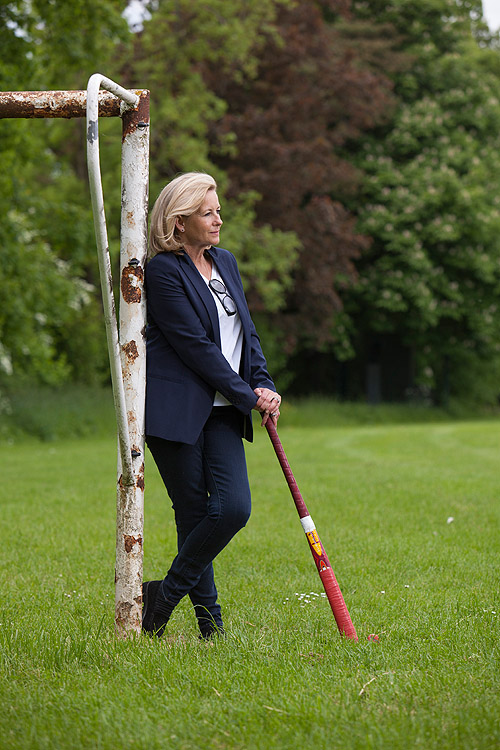
Like I said – there’s no single reason why I stopped posting and I certainly don’t rule out posting some more ‘new’ work over time. As a response to the question that was asked I have decided to post one new portrait that I made a couple of months ago for a women’s magazine. Te story was about three women who had written very personally about their time at school and how that had influenced their later lives. One of the women was journalist and author Gill Hornby and I was asked to photograph her with her dislike of school and team sports in mind. We had a few minutes at a playing field on a less than sunny day and this is the photograph that I liked most:

©Neil Turner. 07 June 2013. Gill Hornby is the author of The Hive (Little Brown).

©Neil Turner. June 2013. Gill Hornby is the author of The Hive (Little Brown).