Author: dg28

I've been a full-time editorial & corporate photographer since 1986 and I'm still as passionate about the work now as I was then. These days I also write about photography, teach photography and act as a consultant on all things photographic - so, basically, photography is my professional life.

Keeping it simple

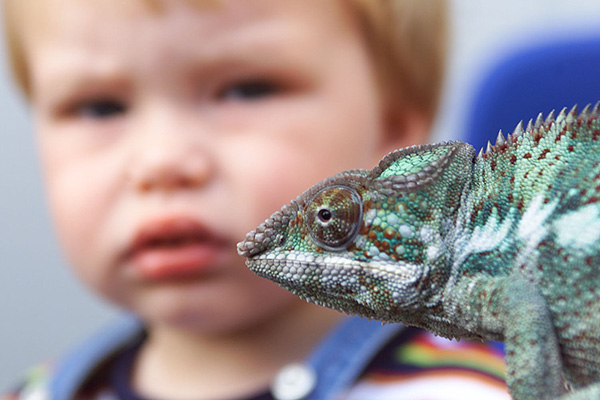
The text books will all tell you that there are a number of rules for composing a photograph (or a painting for that matter) and it isn’t a bad idea to follow these rules 90% of the time. Working on a newspaper has taught me that simple compositions often work the best and that there are several ways of keeping it simple. One of my favourites is to work with a small depth of field. The human eye will always be drawn to the subject that is in sharp focus with a simple out of focus background. Usually this will mean that the background doesn’t contribute to the image, but every so often an out of focus background forms a really important part of the image.

©Neil Turner/TSL | Southampton | August 2001

This picture of three year old boy at a nursery school learning about some creatures that had been brought into the school is a perfect illustration of how throwing the background out of focus gives an enormous boost to the composition and helps to tell the story of the image. The chameleon is in focus, but because the lens (180mm on a 70-200 f2.8 zoom) was wide open at f2.8 the boy becomes an interesting blur. The added 1.6x focal length multiplication brought no change in the depth of field but narrowed the angle down to a 35mm equivalent of 288mm. On this particularly sunny day that meant a shutter speed of 1/4000th of a second on 200 ISO.

Techniques are there to be used, altered, modified and adapted. This one should become really useful to you once you have mastered it. When you are struggling to make an interesting composition it’s always worth considering narrowing your depth of field.

Vocabulary of photography

Language is an ever-evolving thing and a quick search for a famous quote on the nature of language brought up two very interesting thoughts. The first is accredited to Karl Albrecht – a German latter day renaissance thinker (I wish it were the co-founder of Aldi who had the same name)

“Change your language and you change your thoughts.”

This is an important idea when, as press photographers, we are trying to get the world, the rest of the media and the Leveson Inquiry to think about photographers differently. Words like paparazzi have been liberally used during the inquiry and by commentators about the inquiry. Fellow journalists and even some of our peers regularly use the words snap, snapper and snapped to talk about our work. As long as this kind of unhelpful vocabulary carries on being used we are almost bound to carry on having a problem. We are photographers, we take photographs and what we do is photography. Get a thesaurus out and there are plenty of other words that can be used (with increasing degrees of pompousness). It seems likely that it is up to us to start the ball rolling. It is one thing to use slang terms within the tight confines of our profession but an entirely different thing to propagate them elsewhere.

As professionals we owe it to ourselves and our colleagues to change our own vocabulary and to correct everyone else who falls into the lazy trap of using short snappy terms that are just not accurate. Take last Saturday’s Times for example. On the front page of one of their sections they had a line about “What really happened when Beaton snapped the Queen”. Did Sir Cecil Beaton really “snap” anything? The Victoria and Albert Museum, a cultural institution that would claim to respect photography has on their shop website a line about the same photographer saying that after her 1953 Coronation

“(he) snapped the Queen in all her coronation finery.”

As long as what we do is trivialised in this way we are going to have an uphill struggle. A couple of other searches on the web brought up equally depressing quotes – this one comes from a careers website www.allaboutcareers.com and their description of the job “Press Photographer”:

“Press photographers are employed by newspapers, magazines and other print and web publications. These snap-happy professionals are tasked with recording images of current events to support news stories or taking interesting photos to emphasise the point of featured articles.”

We could go on but that would only serve to labour the point. It is hard to think of another profession whose work is so universally undervalued, whose work is widely misunderstood and about whom the vocabulary used is to pejorative.

One final note: whilst looking for quotes about language I found this one attributed to Federico Fellini – the man credited so widely with the origins of the term “paparazzi”;

“A different language is a different vision of life.”

Our language is a very visual one but occasionally even we need to resort to words to make our point. If we aren’t careful, the rapid evolution of the English language will leave us behind and the regular and repeated use of poor and inaccurate phrases will become “correct”.

Folio photo #12: Vic Reeves, Kent, May 2006

©Neil Turner/TSL, May 2006

Comedian and writer Vic Reeves (aka Jim Moir) photographed in the back garden of his home in Kent on the day that he and his wife were moving out. We had to shoot in the garden because the house was full of removal men, boxes and the controlled chaos and stress that goes with moving house. He was the complete and consummate professional and I greatly enjoyed photographing him for a feature that was about his time at school. His biography of his early life was just being published as the feature came out.

Nikon Vs Canon (no, really, honest…)

A Wise man said to me recently that the best way of getting a shed load of traffic to your blog was to make the title something like “Canon versus Nikon” of something along those lines. Well, as it happens, I actually do want to write about Canon versus Nikon – or at least to make the point that with the imminent arrival of both the Nikon D4 and the Canon EOS1DX (at least on specification and raison d’être) the two camera giants will have a broadly competitive and similar offering for the first time since the Nikon F3 and the Canon F1n did battle back in the early to mid 1980s. Both of those cameras were built like tanks, had optional and fast motor drives and were principally designed for heavy duty professional use.

The new offerings have remarkably similar specifications – knock for knock, these are the most similar cameras on the pro market for thirty years. There are a few differences of course: Nikon have stuck their necks out and gone for a dual memory card slot with one of them being for a new and largely untried format. Both cameras have the odd quirk here and there but it will all be about personal preference when purchasing decisions need to be made.

Of course one manufacturer might have exactly the lens range you want or the other might just feel better in your hands but, the bottom line is that for the first time in the digital era and maybe even for the first time since the original EOS1 film camera hit the shelves we don’t have a clear leader. Can’t wait to try them out…

Space makes you think

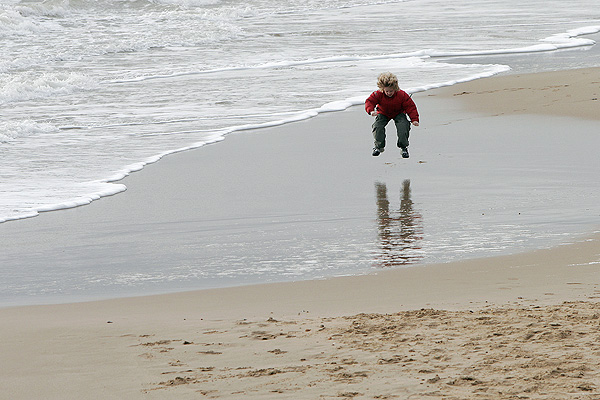
In general I am a fan of tighter compositions, but there are some subject matters that are just crying out for space. A large area of foreground or background can lend an enormous amount of emphasis to an image. Placing a small subject in a large space helps you to tell a story. If you place a person in one of the bottom corners you might suggest loneliness or vulnerability, whereas placing them at the top may well imply the opposite.

©Neil Turner | Bournemouth | January 2005

This photograph of a child playing on the beach in the winter suggests that he is really enjoying his freedom. The photograph was taken from quite a height (maybe 25 feet) to isolate the sand from the confusing background and the fact that he is nearer the right of the frame suggests that he has a lot more room to head into. The oldest rule about composition – the rule of thirds – is being observed.

If the space around the child in the photograph was full of details then the impact of the composition would be lost. You would inevitably give the image more than one subject and spoil the simplicity which is the real secret of the picture. Of course if the child’s mother was in another area of the otherwise empty frame then that would give another message altogether, the space would still be making you think – but differently.

Cluttered photographs are much harder to pull off, simple images are often more effective and this image proves that simple doesn’t necessarily mean tight.

Fun photo: Muscliff or Mogadishu

Out on a walk in semi-rural Dorset… Not the suburbs of Mogadishu.

20120114-114028.jpg

Muscliff, Bournemouth | ©Neil Turner | 14th January 2012

Objects of desire

One of the great joys of being a photographer is the wonderful array of gear, technology and toys we get to use on a daily basis. It is also one of the curses of being in business. If I went out and bought every new camera, every new lens, every new application and every new computer that I fancied I would have no home, no car and no life.

That doesn’t stop me looking. The CES show in the USA has thrown up lots of new “I want one of those” moments and a quick calculation says that I would make a £20,000 hole in my finances if I went and bought it all. The serious point here is that for many photography is a hobby and buying new gear is a matter of “I want it, I’m going to have it”. For professional photographers there is a simpler test which asks “will that piece of kit pay for itself, pay my bills and work how it’s supposed to work?”

I’ve said many times that a lot of my clearest thinking comes from teaching and I’m currently updating my notes for teaching some business studies to my NCTJ Photojournalism group at Up To Speed Media in Bournemouth. In many ways the formula is simple: A. you need to take the cost of purchasing the item, insuring and servicing it and divide that by B. the number of days you work in an average year. Dividing A by B gives you C. To get the final figure D. You decide how many years the item might remain useful (longer for lenses, less time for camera bodies, computers and software).  Finally, you divide C by D and that figure is the cost of that piece of kit per working day.

An example: Telephoto zoom lens

  • A. price paid is £1,400 and it adds £20 a year to your insurance and a further £30 a year to service. That’s a total of £1,450
  • B . working 3 days a week on average over a 52 week year. That’s a total of 156 days
  • C. that’s 1,450 ÷ 156 = £9.29
  • D. lenses last on average 3 years

The final figure for owning that particular lens is £3.09 per working day IF you shoot for 468 days over three years. The cost goes down if you work more and it goes up if you work less. Of course one lens isn’t much use without the rest of the kit and so you can go through your whole stash of gear and do the same calculation for each. I tend to go for 2 years for camera bodies and computers, 3 years for heavy use lenses, 5 years for light use lenses and only 1 year for software including upgrades.

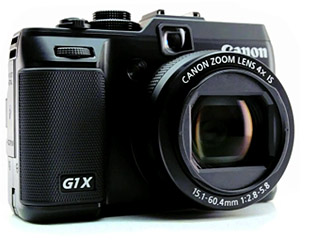
How depressing was that? Let’s end on a lighter note: objects of desire… well… the Canon G1X looks very, very cool, as does the limited edition all black Fujifilm X100. Of course the Canon EOS1DX has to go on the list and I’d love to give the Nikon D4 (and a kit of lenses) a spin. The list is actually a lot longer but nobody reads this far down… do they?

Archive photo: Inner London Education Authority, April 1990

When the Conservative Government finally abolished the Inner London Education Authority (ILEA) which had shared County Hall with the Greater London Council (GLC) Mrs Thatcher could finally look out of the House of Commons and not be reminded of the opposition that her party had faced from across the river. I was sent to shoot a picture of one of the last people still working at ILEA who had done an interview for the Times Educational Supplement about his work wrapping up the affairs of London’s last unitary body (until the Labour government reestablished a London Mayor’s office in May 2000).

I went equipped with a notional headline of “will the last person to leave County Hall please turn out the lights” and I was very pleased when it turned out that the desk where he was working was in a windowless room in the basement of the beautiful if tatty building. I was even more pleased when I had processed my film and had a look at my pictures.

©Neil Turner. September 1990

For the camera geeks: Nikon F3P with 85mm f1.4 Nikkor and Kodak Tri-X film