composition

Five day black & white challenge

©Neil Turner, November 2014. A young woman jogs along the promenade near Portman Ravine in Bournemouth with a child in a pushchair.

©Neil Turner, November 2014. A young woman jogs along the promenade near Portman Ravine in Bournemouth with a child in a pushchair.

A couple of weeks ago I was nominated by another photographer to take part in a Facebook Five Day Black & White Challenge. The idea was simple: to post a new black and white photo every day for five days. I have to admit that I was a bit reticent at first and posted pictures that I’d already taken in the previous few weeks. Then someone mentioned that they found the discipline of having to go out every day and shoot something new invigorating and so I started the challenge over again and shot specifically for it every day. My second challenge ended yesterday but it wasn’t until I was out shooting again today that I remembered that the challenge was over. What to do with the pictures from day six? The answer was to post the chosen frame to Facebook anyway and then to post it here too – as another “just because I like it” frame.

Technical stuff: Canon EOS6D with a 28mm f1.8 EF lens (cropped slightly). 160 ISO and 1/1250th of a second at f11 RAW file converted and desaturated using Adobe Camera RAW CC 2014 with a 5% bronze tint added.

After the storm

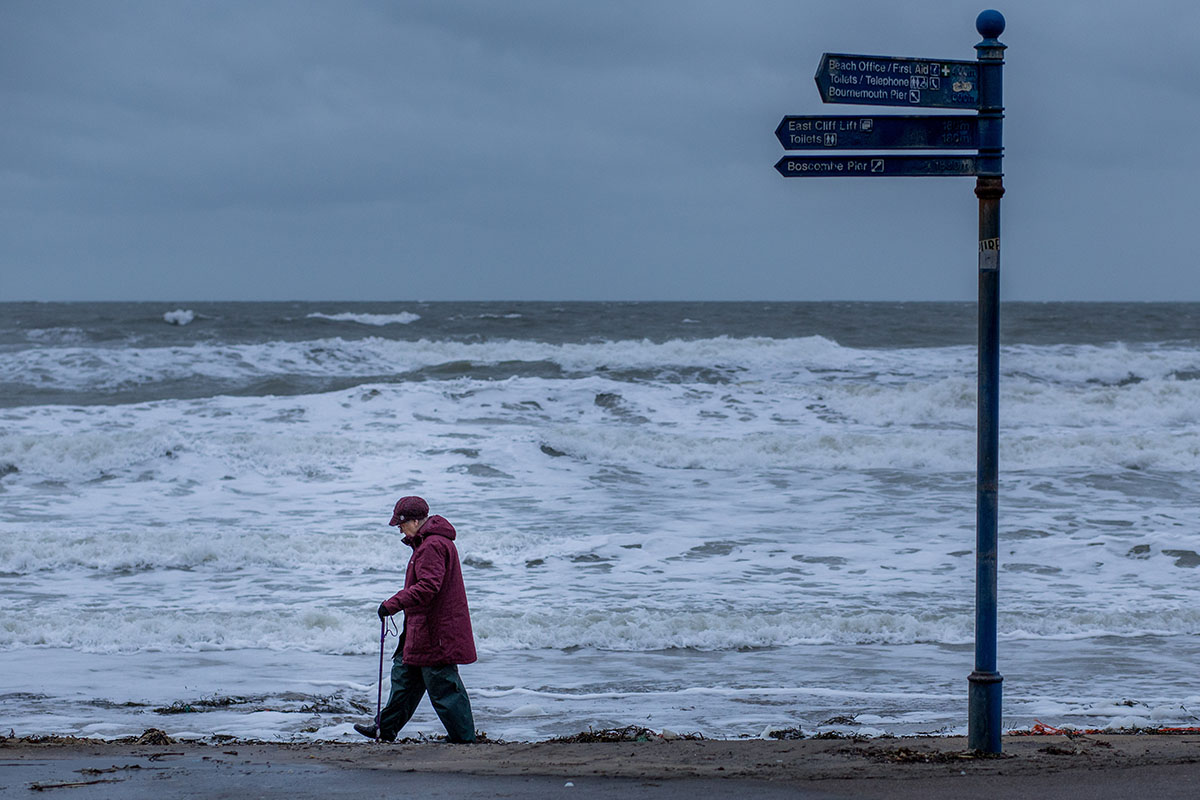
©Neil Turner, November 2014. A pensioner walks along the beach near Bournemouth Pier.

©Neil Turner, November 2014. A pensioner walks along the beach near Bournemouth Pier.

Following on from my post about zoom and prime lenses I was out with just the primes yesterday – walking along one of my favourite bits of beach in wild winds and failing light. I was just out having some photographic time before getting into the car for yet another drive up the M3 for work. This one was shot at 640 ISO at 1/1000th of a second at f4 with an 85mm f1.8 Canon EF lens on my rather lovely little Canon EOS6D – a camera that I am becoming increasingly fond of. When I’m doing personal work like this I tend to set the white balance to daylight and accept whatever colour cast I get and in this case it wasn’t far off of what the naked eye saw.

Zooms Vs Primes

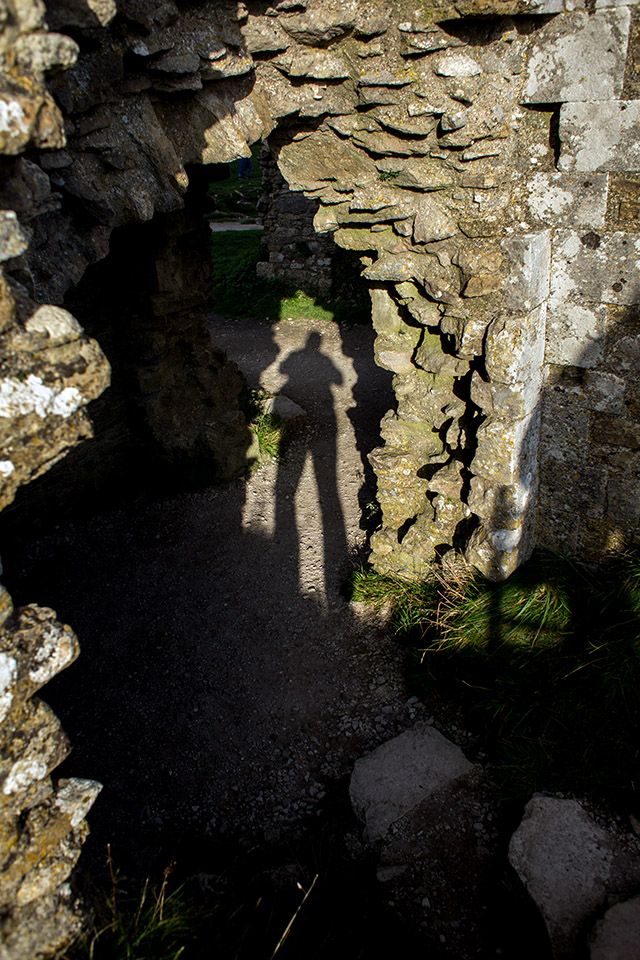
©Neil Turner, October 2014. Shooting my own shadow with a 28mm f1.8 lens.

©Neil Turner, October 2014. Shooting my own shadow with a 28mm f1.8 lens.

Talking and writing about photography on the web seems to have become a whole series of two sided contests. Sometimes it is interesting and a genuine dichotomy (Nikon Vs Canon, Mac Vs PC) where there are absolute direct comparisons to be made and a range of technical and personal preferences to be considered. At other times they are silly (film Vs digital, DSLR Vs mirrorless) where it is comparing bananas with pineapples. Somewhere in the middle of these two extremes sits the Zoom Vs Primes debate. Everyone has their own views and everyone’s work is different.

An amazing 14 years ago (and 14 years into my professional career) I wrote a short piece about choosing lenses and why you might like zooms for some jobs and then have the ability to choose a focal length for others. It wasn’t all that long before then that I’d had to use primes all of the time because zoom lenses weren’t up to the job in terms of quality. For me it all changed in 1995 when I switched to Canon EOS for the first time and the original 70-200 f2.8L and 28-70 f2.8L lenses which, along with the auto focus on the EOS1N, changed everything for me. For ages the only Canon primes I had were the 20mm f2.8 and 300mm f2.8L and the vast majority of my work was shot between 28mm and 200mm.

I’ve spent a lot of my career in press pens and fixed positions where I cannot move and where it made sense to use zooms lenses to compose but weighed against that I’ve also done a lot of work where I have a lot of freedom to move around and can position myself so that I don’t need to use a zoom to fill the frame – I’ve been able to “zoom with my feet”. Here’s what I said in 2000:

There are two ways that you can choose which of your lenses to stick on the camera:

  1. You can say “there’s my subject and here I am, let’s see which focal length on my zoom works best”.  Sometimes at sports matches and political events you have your position and that is that, or…
  2. You could say “I want the effect that my experience tells me a 28mm lens will give me so I’ll select that focal length and move to the right position to make that happen”.

Either of these could be a valid option and, in many cases, the first is decided for you by circumstance. Most news photographers use zoom lenses because it makes sense to have fewer lenses when you are never quite sure what kind of work you will be doing on any given day.

Personally, I use a combination of both approaches. If a position forces me to choose a certain lens then I’m with option 1. Given complete freedom to shoot what I want I’d go with 2. More often than not I’ll go with, say a 24-70mm lens intending to shoot at the 24mm end and get in a position to shoot that way. I will shoot several frames and then start to move around, zoom in and out and shoot a variety of similar images, each with subtle differences. I try to make a point of shooting with just about every focal length available to me on every job. Sometimes I am right about lenses first time but often I’m not. What had seemed like an obvious task for the 28mm ends up being a spectacular 200mm shot and vice-versa but the result is that you often end up with images that are just that bit better.

I nearly always shoot on location so I cannot preplan every detail. Going equipped with a range of lenses is vital. Your choice of lens will depend on so many questions running through your mind. How is this image going to be used? Big, small, upright, horizontal, front page? Double page, back page, website, magazine or newspaper? Is it going to have copy running over it? Will it have more than one usage?

If I cannot answer any or all of those questions, then I’ll shoot every variation I can. Shall I start with a long lens, if it’s a portrait then being further away may relax the subject and I’ll get in with the wide when they are more comfortable. Background, what’s behind them? Can I use a change of lens get rid of a poor background?

Answering self-set questions and making compromises is the key to news photography. Choosing the right lenses helps to reduce the number of technical compromises that you are forced to take, giving you more time to make the creative compromises that you want to make.

So has anything changed in the intervening years to make me come back and have another look at this debate? Yes – several things:

  • The resolving power of the camera chip is now so great that lenses need to be sharp to get the most out of that resolution
  • The amount of pixels crammed onto a chip means that you can “zoom by cropping” in a far more aggressive way that you could ever do before and still end up with a file easily large enough for a wide range of uses
  • Zoom lens quality has improved
  • The choice of super-high quality prime lenses has become far wider
  • The quality of digital images means that how a specific lens renders out of focus parts of the frame has become an issue for a lot of people
  • Photographers are constantly seeking ‘an edge’ and to challenge themselves to see their work differently in an era where we all have much the same gear

This debate has raged and it has ebbed and flowed. I’m not necessarily talking about how the worldwide photographic communities have seen it here, I’m talking about my own psyche and what happens every time I pack a bag to go and shoot some pictures. I love the discipline and the way that having three or four prime lenses in a bag makes me think but I have the it when I have primes and cannot move around as much as I’d like to. Short of taking three zooms and four primes on every job (I don’t have an assistant and my fifty year old spine would buckle under the weight) it is always going to be a compromise. Today I’m shooting an editorial portrait where I have plenty of time and it will be just me and the woman that I’m photographing so I’ve packed the primes. Yesterday I was at a job where moving around wasn’t an option and I went with just two zooms.

My internal debate doesn’t end there though. I am always looking back through my work and being self-critical and, if I’m being entirely honest with myself, I am probably a better photographs with zoom lenses. There, I’ve said it. Much though I love using a 135mm f2 I shoot better pictures eight times out of ten with a 70-200 f2.8. The same goes for the 28 and 50 against the 24-70. How can I ever hold my head up in the company of some of my favourite photographers who never use zooms now? Luckily they are all people who don’t care what you use as long as you get the pictures and the rest of my favourite photographers are shooting 99% of the time with zooms anyway.

It turns out that this is a silly debate after all because we are photographers whose goal is to produce the best and most interesting, creative, exciting work that we can within the bounds of what is possible and what is required. I’m going to persevere with my little bag of primes because I want to. When in doubt it will always be the zooms for me – aren’t I the fortunate one to have the choice?

Three important things

Many, many years ago I started to post technique examples and opinions on my website. By 2002 I had about fifty articles on the site and over the last couple of years I have been recycling many of them because I still thank that they are worth reading. None of it is unique wisdom and much of it can be found in the form of YouTube videos by other people. I like to think that I was marginally ahead of the curve back then at least. Here is one of my favourites…

There are many things that help make a great photograph – a good photographer, the right equipment and luck can all play a part but there are three things that, in different proportions, are absolutely essential.

  1. Light: Possibly the most important element to making an ordinary photograph into a good one.
  2. Composition: Getting all the right elements in the right places.
  3. Subject Matter: It’s true that what you are photographing can very easily make the difference between good, very good and great pictures.

Light: You not only need the right quantity of light, but the right quality and direction of the light are vital too.

  • Too much light can be just as much of a problem as too little. A picture that relies on shallow a depth of field for it’s impact will be hard to achieve if there is too much light to work with wide open lens. Of course if there is too little light to freeze the action when that’s vital to the picture, that’s also a problem.
  • Many pictures rely on hard shadows and extreme contrast for their effect and others need even and soft light to make the photograph work.
  • What direction the light is coming from in relation to the subject matter is important. Strong backlight will be perfect for some subjects and ninety degree side light will do it for others.

Composition. Whatever else is going on in the picture, this is the element of the total package over which you have the most control.

  • What lens you use is an absolutely critical decision to take in terms of the composition. What you can see through the viewfinder is utterly controlled by this decision.
  • Where you position yourself in relation to the subject is another crucial decision.
  • Confusion is the greatest enemy of clarity! How successful you are in keeping extraneous details out of the photograph has an enormous bearing on the final result.

Subject Matter: All great photographs tell their own story, and that’s just as true for a product shot of ball bearings as it is for Pulitzer prize winning documentary images.

  • If what you are photographing tells it’s own story, then you need to strip the content down so that the story isn’t confused.
  • Some things aren’t that interesting, so you need to add content. Telling the story sometimes requires the photographer to set the context.
  • Photographs don’t always need to be great art. Sometimes subject matter is all, and nothing else matters. If there is only one picture of a vital news event and it’s out of focus and taken from video it may well qualify as a great picture.

Three elements that go together to make great pictures. Sometimes light takes the lead and other times the composition is the most important. It doesn’t matter if one element is dominant, but photographs where all three are well balanced and well done then the image is guaranteed to be a winner.

There is, however, one extra element that you can’t legislate for. Magic. Like many things in photography, you know it when you see it but you cannot measure it or define it. Well composed and lit pictures that have great subject matter are (relatively) easy to come by, but once in a while they have magic too.

Performing the ritual of “The Selfie”

For as long as I can remember I have shot pictures of my wife and I on holiday with a compact camera at arm’s length. I have examples in the family album dating back to 1984 and, whilst I’m not claiming to have invented “The Selfie”, it really isn’t anything new in our house. We started doing those pictures just because there was never anyone else around to take the picture for us and so it was very much a second best picture. Slowly and over the many holidays that we have enjoyed together it became something of a tradition to do at least one of those arm’s length couple pictures but we always liked to get a passer-by to do the picture if we could. It is a phenomenon that I am fascinated by and I often shoot pictures of people as they perform the Ritual of the Selfie.

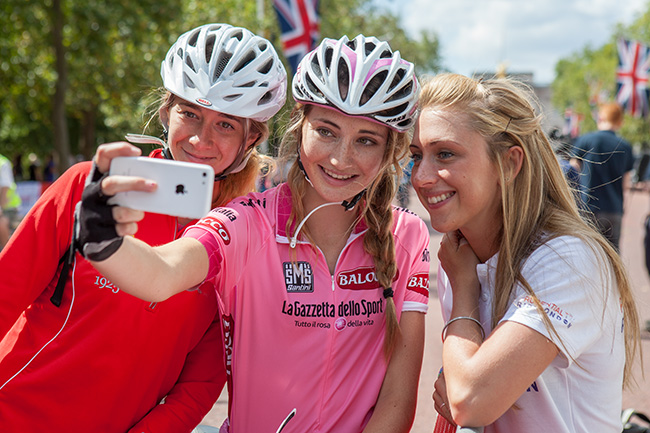
Olympic and Commonwealth Gold medallist Laura Trott posing with riders on The Mall in a break between media interviews during the Freecycle event - part of Prudential RideLondon. 9th August 2014.

Olympic and Commonwealth Gold medallist Laura Trott posing with riders on The Mall in a break between media interviews during the Prudential RideLondon Freecycle event. ©Neil Turner, 9th August 2014.

I was prompted to compose this blog post because I suddenly realised why it works so well. One of the media team working with Prudential RideLondon had offered to take the picture and the three young women dutifully posed but their faces didn’t come alive until they rescued the phone and performed the ritual of the selfie. There seems to be a confidence and a joy in taking your own picture of yourself and your friends or, in this case, you, your friend and an Olympic and Commonwealth champion. Is it because these days that can see themselves in the screen and only shoot when they are happy with what they see? I believe that there’s an element of that in it but the sense of self-reliance is just as important as far as I can see. There is a joy in The Selfie that is missing from a perfectly well taken group photo. Time after time we all saw people enjoying taking self portraits during the event and that’s the case almost everywhere almost every day.

Where I depart from the celebration of The Selfie is where media outlets and PR companies encourage people to do it and post them as part of marketing campaigns. For me the innocence and joy of the ritual gets lost when it is prompted like that. Where I also have an worries about it is when people do it dozens or even hundreds of times a day. I had a link request on EyeEm the other day from a guy who have over 6,000 images on his account and, from what I could see, they were all of himself.

I don’t object to The Selfie at all. In fact I indulge in the ritual myself from time to time. All I’d ask is that marketing people without another great idea stop trying to make something from them that isn’t really there. Photography is about a lot of things and fun is right up there as one of the most important.

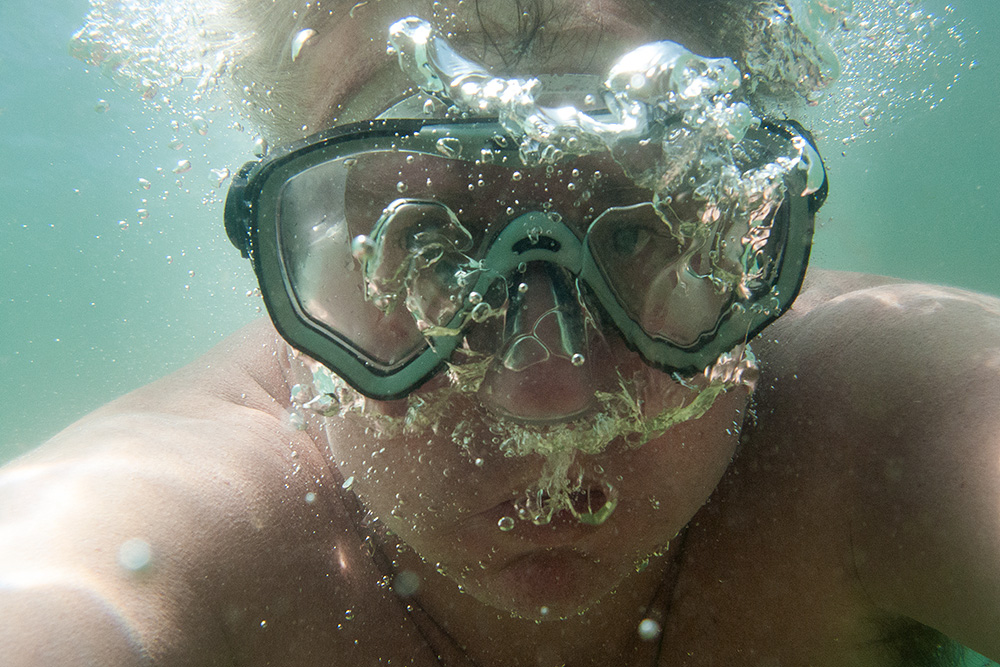
The one "selfie" that I do like of mine - under water at the beach in Bournemouth in the summer of 2013. ©Neil Turner.

The one “selfie” that I do like of mine – under water at the beach in Bournemouth in the summer of 2013. ©Neil Turner.

Shadows

© Neil Turner, July 2014. Shadows on the south bank of the River Thames in London.

© Neil Turner, July 2014. Shadows on the south bank of the River Thames in London.

On my way to a meeting today walking along the south bank of the River Thames I was taken by the quality of the light as it formed shadows through the trees. A pair of office workers out for a stroll stopped and had a chat and we passed a very pleasant few minutes talking about light and London. The conversation was interrupted a few times as people strolled through my composition and I grabbed a frame or two. This was my favourite of maybe a dozen very similar frames.

Another picture shot on my Fujifilm X20 and added to the blog just because I liked it…

One that didn’t make the folio

©Neil Turner/TSL. June 2008, Hertfordshire.

©Neil Turner/TSL. June 2008, Hertfordshire.

When I was putting a massive “long-list” of photographs that I was considering putting into one of the galleries on my portfolio website I looked at this picture and couldn’t make my mind up one way or the other. I was aware that I already had a lot of images from schools – which isn’t surprising when you consider that I have worked in over 3,500 of them in 15 different countries – and that it didn’t add anything to the mix.

I like this picture a lot because it is simple, demonstrates the use of good composition and shallow depth of field as well as reminding me of the kind of work that still makes me want to get out of bed in the morning and go and shoot pictures. These days most of my school based work is shooting for their prospectuses and websites with the odd news story thrown in from time to time but this remains the kind of picture that has a lot of uses and draws the most comment from those who are commissioning the work.

The truth is that almost anyone could take an acceptable picture of primary school children on a scavenger hunt in an enclosed copse. I hope that it also proves that it takes a lot more to produce as good as this on a miserable and rainy day early in the morning when the light is awful and the gear is getting wet. I have kept a few photographs that didn’t make it to one side and I intend to publish a few of them here on the blog with a bit of the background to why I like them along with a bit of the story.


Techie Stuff: Canon EOS1D MkII with a 16-35mm f2.8L lens at 16mm. Canon CR2 RAW file 640 ISO, 1/90th of a second at f2.8 on daylight white balance and converted using Adobe Camera RAW in Photoshop. At the time it would have been ACR in Photoshop CS3 but the file was re-worked using ACR in Photoshop CC.

Space makes you think – part 2

©Neil Turner, March 2013. Family enjoying an early spring afternoon near Fisherman's Walk in Bournemouth, Dorset.

©Neil Turner, March 2013. Family enjoying an early spring afternoon near Fisherman’s Walk in Bournemouth, Dorset.

A very long time ago when I was studying photography at the Medway College of Design I was surrounded by like-minded and equally obsessive photography students who all wanted to unlock the many ‘secrets’ of great photography so that we could all some-day be someone. We were only a very short distance along the journey (it was the first term of the first year) when we were set a project to shoot an object against a background where the object would be very small and still have great composition and make sense. It was a lesson that I will always remember for two reasons:

  • The first is that I loved it and actually shot four or five entirely different pictures – ranging from a damp and golden autumnal leaf on a grey path to a red balloon against a bright blue sky.
  • The second reason is that during a group critique someone (and I have no memory who) said “space makes you think”.

Space makes you think has stuck with me to this day and as a short and snappy phrase it appears in my thinking and in my discussions on a very regular basis. From the day I learned that lesson and then learned to leave space in my compositions for mastheads, strap line, type and headlines I have always looked for pictures with space. Cropping images really tightly is a great way to shoot some subjects and I remember another phrase from my student days which sums that up too “if an element doesn’t add to the composition then it detracts from it”. That’s also true and that, ladies and gentlemen, is why photography is so enthralling, confusing, infuriating and rewarding. Two ‘rules’ that appear to directly contradict one another that form the basis of one of those secrets that we as students of the art/science/profession spend our lives trying to grasp and the interpret in our own ways.

Rules are there to be obeyed most of the time and broken often enough to make sure that we remain creative in our thinking. That was true back at Medway College, it still is and I hope it always will be.

* Those other “obsessives” included Jez Coulson, David Chancellor, Bill Green, Richard Gosler, Mike Cooper, John Baxter, Richard Ansett and Andy Eaves who, I am delighted to tell you, are all still as obsessed as they were! There were 28 photographers in our year and I’m sure more than those listed above are still plying the trade.