press

Folio photo #14: Children on a bug hunt, south London, May 1999

©Neil Turner/TSL. May 1999, south London

This picture from a story about children from a local primary school going on a “bug hunt” in Nunhead Cemetery was shot for a special supplement to the TES about the environment. The outdoor lesson was led by Richard ‘Bugman’ Jones, a professional entomologist who undertook a residency at the school. Like a lot of my favourite pictures it doesn’t tell the whole story but it is a ‘moment’ that hopefully makes you want to know more.

I had switched to shooting most of my work digitally the previous year but the Picture Editor working on this section was still keen that we shoot pictures for these glossy extra sections on transparency film. I think that this was the last commission that I ever shot using a Leica M6. The wider shots were definitely on the Leica but I also shot some longer lens pictures using a Canon EOS5 and a fixed 85mm f.18 lens

Geek moment: Leica M6 with 35mm f2 Summicron and Fuji RDP100 transparency film.

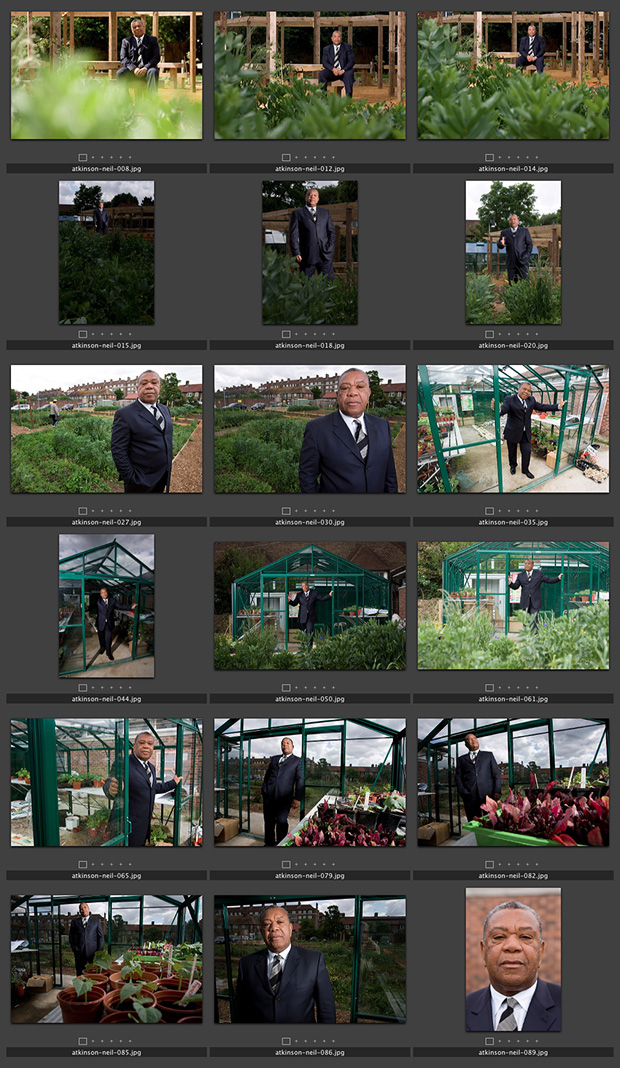
William Atkinson portrait – the “contact sheet”

When I took these pictures in May 2008 it was only a month before William Atkinson was Knighted in the Queen’s birthday honours list. He had been the Head Teacher at The Phoenix High School in west London since 1995. I shot these portraits on the school’s “farm” which had been an unused area of land which has been brought into use as a community resource and outdoor classroom.

©Neil Turner/TSL. May 2008, London

His CV is long and distinguished and he is an impressive man. Shooting his portrait took patience because he had quite a bit to say about quite a few topics and, like so many head teachers I have photographed, he was constantly watching what was going on around us. This wasn’t the first time I had photographed him – I first shot pictures at Phoenix when he first arrived back in 1995 and the lovely thing was that he still had a copy of that magazine cover on his wall.

I shot 92 frames on this job and submitted a tight edit of 11 having previously trimmed the selection down to 18. Looking back through a lot of the portraits that I did between 2000 and 2008 it is amazing how often 18 was the number of frames that I kept. There has to be an explanation but I am afraid that I cannot think of it!

Techie stuff: Canon EOS1D MkII cameras with 16-35 f2.8L, 24-70 f2.8L and 70-200 f2.8L lenses. Lumedyne Signature series flash and a 23″x24″ Chimera soft box.

The personal frames you shoot…

I have shot thousands of editorial portraits over the last 26 years and every once in a while I shoot a few “personal frames” at the end of a job. What I mean is that there are pictures that I shoot if I have time that I know the client would not publish in a million years and so I am doing them for my own amusement/sanity/experience/curiosity. When you start shooting pictures, everything you do is an adventure. Slowly you learn how to achieve the results that you (and your client) want and it becomes very easy to just take the pictures that you need to take without pushing any boundaries or trying anything new.

Professor Lewis Wolpert. London, March 2004. ©Neil Turner/TSL

I wrote an essay in 2004 about why black and white is so effective and why so many people profess to preferring it to colour for a lot of ‘serious’ pictures. The reason that I have always believed is that good photography is about giving people a view of your subject that they recognise but that, at the same time, is not how they themselves would have see the same scene. There are plenty of ways of achieving this but the one that non-photographers seem to respond to most positively is to show black and white pictures. For about two weeks after writing that for the first time I consciously shot pictures that I could convert to black and white to prove or disprove my theory. I even submitted a few black and white images with my edits to the newspaper I was working for.

The experiment developed a little and I started to try to actually mimic the feel of black and white film and prints. Lots of filters and plug-ins were appearing on the market at the time and I played with as many as I could get my hands on. The experiment ended when I shot this portrait of Professor Lewis Wolpert at the Department of Anatomy, University College London in March 2004. I had spent quite a while using Photoshop’s darkroom style tools to dodge, burn, correct contrast and generally make an otherwise ordinary picture look rather nice. I really liked the picture but I decided that the personal frames idea needed to head off in a different direction and so I stopped shooting with mono in mind for quite a while.

In common with almost all of the work that I was doing at that time, this was shot on a Canon EOS1D with a 70-200 f2.8L lens. It was shot at 640ISO (which for me was the highest you could go on the original EOS1D without getting a lot of noise) at 1/125th of a second at f2.8.

Professor Paul Black portrait – the “contact sheet”

When I shot these portraits for the Times Educational Supplement in 2008, Paul Black was Emeritus Professor of Science Education at King’s College London. He started his career as a physicist before teaching physics and then moving into the world of educational research. He wrote a policy document for the then Conservative Government in 1988 and was widely regarded as one of the country’s leading experts on all form of assessment.

©Neil Turner/TSL. April 2008, London

The photographs were taken in his office at King’s College and he was a wonderful humble man. Like a lot of people who have never really been the subject of media attention he was bemused, amused and slightly confused by the process of having his portrait taken. I very much enjoyed taking his picture – partly because he was such a nice man and partly because I was using a Canon 85mm f1.2L lens for the very first time.

Techie stuff: Canon EOS1D MkII cameras with 16-35 f2.8L, 24-70 f2.8L and 85 f1.2L lenses. Mostly available light but some with Lumedyne Signature series flash and a 70cm shoot through umbrella.

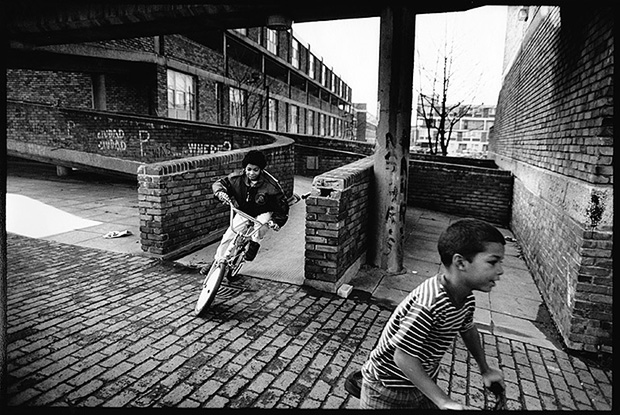
Archive photo: Brixton, July 1990

©Neil Turner. July 1990, Angell Town Estate, Brixton

I was shooting a piece about the work being done by some amazing community volunteers in conjunction with outreach workers employed by the Local Education Authority around one of Brixton’s many estates and we were being ‘buzzed’ by some boys on bicycles just out enjoying themselves. Neither of the boys in this picture were the subjects of the work involved so the picture didn’t really add to the story but I have always liked it and I thought that it would make a good picture to post here.

I had posted this image on Twitter a while ago and I think that I mis-captioned the date. Checking the negatives today, it should have said July 1990.

The camera would have probably been a Nikon F3P with a 24mm f2 Nikkor and Kodak Tri-X film but I am not entirely sure because at the same time I had FM2 bodies and a Leica M6 as well.

Interviewing for September 2012 NCTJ Photojournalism course

It only seems like a few weeks ago that I was writing about how excited I was about being involved with the development of a new photojournalism course here in Bournemouth. It was actually well over a year ago and since then we have completed one cycle of the six month course and we are over half way through a second one. The course has already evolved and we are now in the process of recruiting people for the next course which begins in September 2012.

Photo of me playing the 'role' of a confused and lost motorist during a creative flash workshop. January 2012

The idea of the course is a simple one: to train people who already have a decent standard of photography to a level where they can start or improve their careers as editorial photographers. We cover news, features, portraiture, sport and several other sub-genres of photography as well as teaching about workflow, media law, video, caption writing and story development. At the end of the course, and all being well, our students have an NCTJ Preliminary Certificate in Photojournalism as well as a lot of business studies and market knowledge. It isn’t an easy course and it isn’t particularly cheap but it is highly focused on becoming a freelance photographer in today’s rapidly changing market place.

My own involvement averages out to one day per week during which I will bring all of my knowledge and experience into play as well as getting some of my contacts to come along to the course and give seminars and talks.

The course is run by Up To Speed Journalism, based in their offices at The Bournemouth Echo and is divided into two terms – one of which is very much theory and classroom based and the other is all about shooting portfolio pictures and arranging work placements. If you are interested in finding out more, please get in touch with Tom Hill at thill@uptospeedjournalism.com

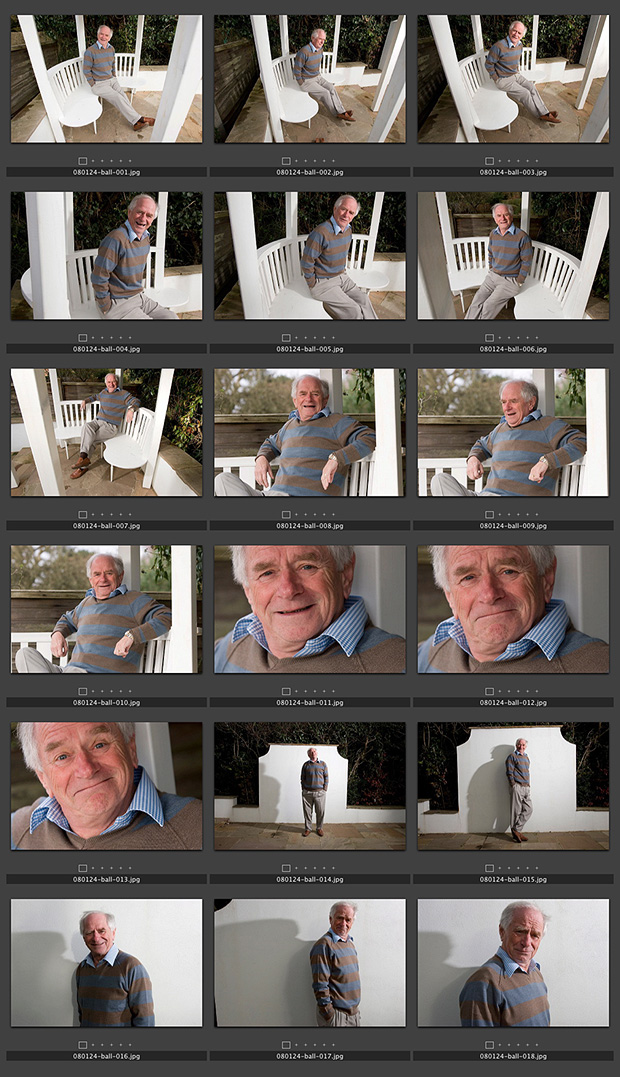
Johnny Ball portrait – the “contact sheet”

Johnny Ball was always on television when I was growing up. He was a wonderful performer who gave a very human face to science and mathematics and made some otherwise difficult and dull concepts a lot easier and a lot more fun. These days he seems to be better known as Zoe Ball’s Dad.

©Neil Turner/TSL. January 2008, Berkshire

In much the same way that the Vic Reeves set was shot this final edit of 18 images that were submitted are all landscape. The TES magazine had a set layout by this time for these interviews with interesting and famous people about their time at school. The shoot took place in the back garden of Mr Ball’s house in and around various structures that he himself had designed and built. It was one of the most relaxed shoots that I did for the magazine and, although I was only there for half an hour, I think we got a really good variety of images from it.

Techie stuff: Canon EOS1D MkII cameras with 16-35 f2.8L, 24-70 f2.8L and 70-200 f2.8L lenses. Lumedyne Signature series flash and a 23″x24″ Chimera soft box.

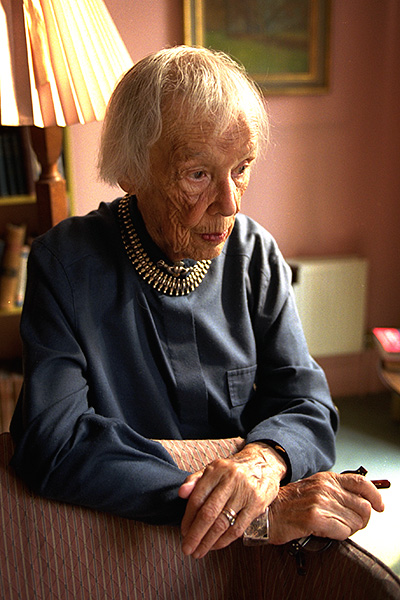
Archive photo: Frances Partridge, London, May 1995

Frances Partridge was the last surviving member of The Bloomsbury set when she died, aged 103 in 2004. She had lived an amazing life full of love and tragedy and had known the brightest and the best people of her generation. She was a writer and a famous diarist. I photographed her when she was a mere 93 in 1995 at her home in London.

©Neil Turner/TSL. London, 10th May 1995

When I arrived she seemed agitated, which I didn’t think was unusual given her age and the fact that she had a stranger in her home but it became obvious that something specific was bothering her. She told me that her only corkscrew had broken and that she hadn’t been able to have a glass of wine. Like all good photographers I had a Swiss Army penknife and so I was able to open her bottle – which cheered her up a little. The thing that really made the rest of the job go very well was that I was able to fix her corkscrew so that she would be able to have he wine the following day too.

Mrs Partridge looked old and she knew it. She had spent most of her life surrounded by artists and writers and had been photographed many, many times. She celebrated her age and was keen that I portray her in my own way. We spent a good deal of time working out where she should be in her flat and the light coming in in early May changed every few minutes. I tried to shoot as little flash as I could – not because she didn’t like it but because somehow I thought that ambient light was more in keeping with the ethos of the Bloomsbury group.

Geek moment… I was using two Canon EOS1n cameras with 28-70 and 70-200 f2.8 lenses and Fuji 800 ISO colour negative film without flash and the frames shot with flash were in Fuji 200 ISO colour negative film. The scans were done with a Kodak auto feed scanner onto a Photo CD.