advice

Some answers to your questions

A couple of weeks ago I invited people to ask me questions about anything. The idea was to generate some ideas for blog posts because some of the best ones that I have written in the past have been initiated by good questions. I have kept a couple of the most inspiring back for longer answers (and let the questioners know) and I thought that I’d give some answers to some of the other questions now. So, in no particular order, here goes:

Q: Do you do one-to-one training with other photographers and would you be happy to do that in my hometown of Oxford?

A: Yes I do and yes I’d be happy travel if the travel costs were covered. It doesn’t come particularly cheaply but I hope that people who book training with me get an awful lot out of a session. Anyone who has read my blog lately will know that we did a new small group workshop at Up To Speed in Bournemouth a couple of weeks ago. It was a wonderful day with five great people attending the session. You can get in touch with me if you are interested in one-to-one or small group sessions and we can take it from there.

Q: How has you move from London affected your work? Have you tried to hide it from London clients? Do you get any sense that you are looked down upon at all by London-based clients, or have you found benefits in being an out of town photographer?

A: I have always had a home in Dorset, even when I was working as a staff photographer in London. In that respect nothing has changed – I still have bases in both London and Bournemouth. What is different is that I have tried very hard to change the balance of the work that I do so that I can spend a lot more time at home in Bournemouth. My clients all know that I have two bases and one or two have definitely chosen not to pick up the phone for simple jobs that they perceive would involve me popping up to London for a quick portrait or a one hour PR job. The truth is that the vast majority of my photographic work comes from London clients and a big percentage of that is still in London. That’s absolutely fine: I stay up in town as and when I need to. On balance the work that comes from London is better paid, more interesting and more plentiful. The photographic market down here is a lot smaller and there is a relatively large number of photographers chasing that small pool of work. There are one or two photographers down here that will work for stupidly low fees and I am not about to get into a race to the bottom with them. All of that adds-up to the status quo where I am working all over the country for mostly London or overseas clients and less than 5% of my work is locally sourced. The benefits of living down here are self-evident: it’s a lovely place, I was born here and have lots of family and friends here. When I’m not shooting I am able to do the other stuff (like blogging) at home. The drawbacks are all about perception and I spend a lot of time on the phone trying to change negative perceptions.

Q: Best portable light modifier for location work (for the Quadras)? I’m toying with the idea of getting a Rotalux Deep Octa (100cm I think it would be) as an upgrade to my current brolley, grid or small Easybox softbox, and wondered what you have found to be the ‘best’ portable light modifier for your Quadras?

A: Quantify best… For me, it’s all about the compromise between quality of light and ease/speed of use. I have a huge soft spot for the Chimera ProII soft box that I’ve owned for well over ten years. It’s a 32″ x 24″ rectangular box with an inner diffuser that fits onto the Quadra via the Elinchrom soft box adapter and a suitable speed ring. I can assemble and attach it in under a minute (30 seconds if I’m on form) and it rotates on the speed ring allowing either portrait or landscape orientation. I also use a shoot through translucent umbrella. Many years ago I acquired a Lastolite umbrella box which is as quick as an umbrella to put up, almost as cheap as an umbrella and yet give a really nice even efficient light in the way that a soft box does. It has been in and out of my bag over the years as I get bored with doing things the same old way but I recently started to use it again and it finally broke. I have ordered a new one and when it comes I expect to get back to using the umbrella box for a while. I think that the important thing here is to have options and to know when and where to use each of them. I never, for example, use the translucent umbrella outdoors – too much loss of light. The Rotalux deep boxes are great but they are expensive and relatively cumbersome. I have never owned one but I’d like to.

Q: Hello. I own a 5D mark1, 24-105, 430ex2. I work with ambient light & tripod mostly because I’m scared of flash. This is OK for landscapes/architecture etc but not for people shots in low light. I have tried E-TTL in P & Green mode but am always disappointed. Would you have safe manual settings you could share with me for low light people shots?

A: Shooting people in low light requires quite a lot of practice to get great results and shooting direct flash whilst keeping the flash unit in the hot shoe will make getting better results really hard. The ‘secret’ to great flash photography is how you modify the light – bouncing it off of walls, reflectors or almost any surface that will direct the light onto the subject from a pleasing angle is what makes the picture. Shooting modes are a secondary issue. I know people who use E-TTL and some of the auto modes who get great results because they know how to bounce or modify the light. You should experiment with bouncing and you shouldn’t be afraid to try a wide range of surfaces. I wrote about how to approach bouncing a few months ago and that is a good starting point. As far as settings go, you need to think about how much power you have in your flash (not that much) and so you need to use apertures like f4 or f5.6 to conserve the flash power. If you are new to shooting in manual modes you might consider using aperture priority and deliberately setting the ambient exposure at -1 or -2 stops. Alternatively you can set everything manually and use the screen on the back of the camera to judge whether the exposure is a good balance or not. Introducing flash as a secondary light source is scary and you need to take some baby steps. Changing absolutely everything at once is a tough call because you will probably take longer to work out what works for you. If you have some money I’d suggest that you get a small light stand, a white umbrella and a either a Canon ST-E2 remote trigger or a pair of off-camera radio triggers so that you can get the flash out of the hot shoe and open up a world of creative options. After that, many of my old technique samples will make a lot more sense.

Q: The Enterprise and Regulatory Reform Act… How do we fight against the potential legislation this has paved the way for?

A: There are lots of things that we can all do. The first is to get into a dialogue with your Member of Parliament. Ask them to oppose the orphan works proposals as they stand and point out that the work that the Intellectual Property Office has done so far has left photographers and other creators angry and feeling as if the IPO has an agenda which doesn’t include us or our livelihoods. Your MP will almost inevitably write back quoting a generic reply from Lord Younger pointing out that the stripping of metadata is illegal (which is circumvented by so many websites terms & conditions) and that the right to attribution of your work already exists. This is a red-herring of a response and needs to be challenged if you don’t want you MP to think that they have fulfilled their obligation to you. Next, you should keep the discussion up within your professional and social circles. Don’t let the subject drift into the background. The good news is that there are plenty of people working on this as we speak. Stop43, EPUK, the NUJ, the British Photographic Council, the major agencies and The BPPA amongst others are going to meetings with people that matter and keeping up the pressure on the IPO and the legislators. The Stop 43 website is a useful one to bookmark if you want to keep up to date. Finally it is important that we all try to influence those websites (Flickr, Instagram, Twitter, Facebook etc) whose websites strip metadata to change their ways. You can avoid adding images to them or actively use their competitors who don’t strip stuff and you can try to persuade your friends to follow suit. It’s going to be a tough battle and we need as many people to join-up as possible so your efforts in helping others to get involved will be vital.

Thanks to everyone who has sent me questions so far. Please keep them coming…

Ask me anything…

©Neil Turner, June 2012. Dorset.

©Neil Turner, June 2012. Dorset.

Whilst looking back through some of my most popular blog posts in the last few years a surprising number of them were written in response to questions that other photographers and students of photography have asked me. That got me thinking about posting this simple update with a very simple request/offer:

“ASK ME ANYTHING… WELL SOMETHING… ALMOST ANYTHING…”

So not exactly ANYTHING – I’m only going to answer interesting questions about photography and my own work! Please use the contact form or reply to this blog posting. You could tweet me but I might miss that given the avalanche of stuff that goes across my desk each day. I will then pick out a couple of questions and use them to write future blog posts. Great… get other people to come up with the ideas!!!

← Back

Thank you for your response. ✨

Elinchrom Ranger Quadra Update

What do you call it when something that was already very good gets quite a lot better? Well I guess that would be an upgrade. That’s exactly what happened yesterday when I changed to the new Lithium Ion batteries on my Elinchrom Ranger Quadra kit.

New lithium ion on the left and the old lead gel on the right.

New lithium ion on the left and the old lead gel on the right.

From the picture above, you can see that there is an appreciable size difference – which is always handy but there’s no way that I would have swapped them out just because of that – after all, they weren’t exactly huge to start with. There are four real reasons that I swapped:

  1. My old batteries were over four years old and had stopped holding a full charge – especially in the cold weather
  2. Elinchrom claim a higher capacity of up to 320 full-power flashes per charge for the new battery compared to only 150 for the old ones
  3. Faster recycle times. I’m going to have to believe Elinchrom and my own gut feeling here because you cannot compare brand new batteries to four year old ones in any meaningful way but at full power the recycle time appears to have halved to just over 1.5 seconds
  4. They weigh a lot less – 892 grammes less each. The new battery is 784 grammes compared to the old one which was 1,676 grammes. With two batteries in my kit I have saved a massive 1,792 grammes

Less weight, even in a rolling case, has got be a good thing 99% of the time and I am really looking forward to having to carry less. Of course I have always loved using the pack and battery to weight the base of the lighting stand down when working outdoors. I might have to find a few rocks and bricks lying around to supplement the pack more often that I used to but that’s fine by me.

I’ve only managed to shoot two small jobs with them so far and the speed of the recycling is great – even with my four year old Ranger Quadra pack and S heads. Some portraits yesterday afternoon shot indoors and on a lower power setting had the kit recycling in a fraction of a second which made the job go very smoothly indeed.

I have yet to try out the new Quadra Hybrid pack which promises all sorts of extras that I don’t think that I need. Elinchrom offer an upgrade to packs as old as mine to get the brighter display but my purchasing decisions these days are made on a perceived need rather than on wanting the shiniest and newest kit.

I’ve blogged about this Elinchrom kit before. The first time was in May 2009 when I’d only had the kit a short while. 32 months later I blogged again and, in what has become my most popular posting ever, I gave my considered review of the kit. One of the first comments on that posting alerted me to the new batteries being on their way. It’s taken me twelve months to get around to getting the new batteries and having the small modifications done to the S heads and I’m a happy man.

In the “32 months on” review I mentioned a few other things that I’d like to have seen produced to go with this kit. In the last six months I have become less and less pleased with the Skyport remote system that comes with the Ranger Quadra. The original triggers were prone to falling out of the hot shoe and the controls on the mark two version are tough to see in low light. I know that the whole raison d’être of this system is to be small and lightweight but they went too far with the Skyport transmitter – so much so that I’ve gone back to using Pocket Wizard Plus III transceivers a lot of the time at the expense of being able to remotely control the power.

So, Elinchrom – I hope that some senior managers are reading this… if you really want to make my happiness complete, can you please produce a transmitter that works with the EL Skyport receiver built into my Quadra pack that takes AA batteries, is about the size and weight of the Pocket Wizard Plus III unit with a digital display that has all of the functionality of the small Skyport transmitter but that is easy to use in subdued light, doesn’t require a tough-to-find button battery and that stays in the hot shoe properly. Pretty please?

Getting colour right on four year old cameras

Back in June 2010 I wrote a blog post about getting the colours to match on multiple Canon digital camera bodies. Ever since then I have tried really hard to keep my cameras synchronised for colour and contrast as well as making sure that the clocks are set to identical times. What has become obvious to me is that as cameras get older they shift their colour balance and the shift seems to accelerate a little. What has also become obvious is that the clocks built into Canon digital cameras get out of synchronisation far too quickly.

WB Shift on a Canon EOS5D MkII

WB Shift on a Canon EOS5D MkII

Getting the clocks the same is a simple task: you can either do it in the menu on the camera or synchronise the clocks when the camera is connected to the computer using the very useful Canon EOS Utility software – a simple task that I find needs to be checked at least every four to five weeks. When I did the synch’ this morning two Canon EOS5D MkII bodies were nearly fifteen seconds different.

Moving on to the much trickier question of colour, I suggest that you read the old post before actually doing any work. Getting two cameras to match takes a while and getting three to match when one of them has a significantly different chip is even harder. This time I was simply wanting to get my two four-year-old 5D MkIIs to give me the same colour rendition as each other. I had started to notice that one required quite a bit more magenta removal than the other and so I put my 70-200 lens on a tripod, connected the first camera (which was giving me some fairly magenta images) to the laptop and mounted the body onto the lens. I built myself a little still life with a cereal box and a grey card, lit it with a reliable flash on manual power output and shot a frame or two.

My makeshift test target

My makeshift test target

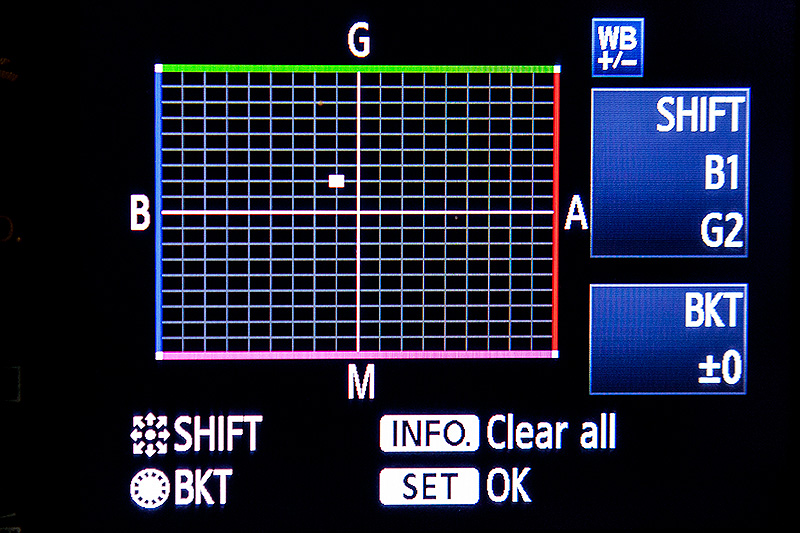
The images were brought into Canon’s EOS Utility software and then into Photo Mechanic on the calibrated computer screen and I had a look. The grey was noticeable pink and the whites on the cardboard box were too and so I adjusted the white balance shift (WB SHIFT/BKT in the camera menu) from it’s starting position of B1,G2 to B1,G4 and took a couple more frames. Much better, but still a tiny bit magenta. I shifted it to B1, G5 and took another picture and the grey was finally grey and the white was finally as white as it could get.

That was the first camera sorted. All I had to do was to get the second one to match it. Leaving the lens on the tripod I simply swapped the bodies over,  matched the exposure and fired a couple more frames. This body was on B0, G1 and, after a bit of fiddling, I got the colours to match by eye on B1 G2. Comparing the frames shot on the two cameras showed that one was a tiny amount more contrasty than the other and so I simply adapted the Picture Style “standard” that I habitually use for RAW files to get the contrast between the two cameras to match as well.

All-in-all it took about thirty-five minutes to set the kit up and get the results that I wanted (including synchronising the clocks). On my shoot today everything was the right colour as soon as I dragged it into Adobe Camera RAW from both cameras and I saved myself a fair amount of computer time – which is important because in the editorial markets where I make most of my money nobody pays for the time you spend in front of the screen and adjusting images from two different cameras can take quite a bit of time.

For me, this kind of techie stuff is vital. A lot of people just plough on and shoot without ever calibrating or changing anything but I am sure that thirty-five minutes work once every few weeks will save an enormous amount of time in between and time is, they say, money!

The Copyright Fight

It’s not very often that something comes up that threatens your livelihood in quite such a stark way as the current piece of legislation going through the UK Parliament. My colleague Eddie Mulholland says it far better than I could so please follow this link, read what he has to say and let your MP know that they need to remove the copyright clauses from the bill before our industry is damaged (again).

The Copyright Fight.

Bouncing balls, hosepipes and shadow puppets.

This is not an attempt to secure higher rankings by filling the title full of potential seedy euphemisms. I came up with the title when I was teaching a flash workshop this morning and I was trying hard to come up with ways of explaining some very basic concepts regarding the best way to think about how best to use light.

We all know what bounce flash is and most of us use it from time to time. It isn’t a difficult concept to explain either but I have always referred to school science lessons (Physics in my case) when explaining the best way to angle a flash to get the optimum effect. That drew a couple of blank stares today and I had to come up with an alternative (and it appears better) way to explain it. I’m convinced that this isn’t an original concept but I came up with the bouncing ball; simply put, if you stand two people three metres apart (or 2.8 metres for anyone who has ever been to one of my seminars) and one of them wants to bounce a ball to the other and have it reach them at the same height it left at then the optimum point for the bounce is 1.5 metres from the thrower or 1.5 metres from the receiver or exactly half way. The same goes with flash; point the flash at a midway point and you will get the greatest amount of light.

Of course that doesn’t tell the whole story… and thats where the hosepipe comes in. It is entirely possible that bouncing the light at the half-way point isn’t desirable because there is a chance that the angle of the reflector on the flash means that some light will actually hit the subject without having been bounced – light from the very edge of the flash. If you imagine a powerful hosepipe and pointing the stream of water at the wall the water will mostly bounce in the same way that a rubber ball might but the spray of the water will fan out in the same way that flash light does. If your object is to soak the subject, you aim the hose directly at them. If you have to bounce it, then you pick the halfway point. If you want to get them wet without the water going where you don’t want it to go then you pick an aiming point which might not provide the greatest amount of water but will allow you the most control. Obviously, the same goes for light. Direct flash might give you f16 and the halfway point bounce might reduce that to f8 but the nicest light might be a couple of f-stops weaker still at f4 but that might not actually matter.

©Neil Turner, October 2010. Bouncing flash off of a warm-toned brick wall.

©Neil Turner, October 2010. Bouncing flash off of a warm-toned brick wall.

Put simply we are talking about the difference between quantity and quality of light. By deliberately avoiding using the most efficient bounce we often end up with a more pleasing light quality. I often bounce off of walls and surfaces six, seven, eight or more metres away and for that you need to make the bounce as efficient as you can but when the wall is only three or four metres away you have many more options. Suddenly efficiency isn’t the main concern and you can often sacrifice some quantity in favour of quality.

One of my favourite ways of teaching bounce flash is to pick very unlikely surfaces such as wood panelling or brick walls and bounce the flash off of those. Of course you often get a colour caste but a good bit of RAW shooting and/or custom white balancing will sort that out pretty quickly. Above is a sample of a picture shot bouncing the flash off of some yellow-coloured medium toned bricks. It was taken at a University a couple of years ago when I was working on a project with some very cool students.

So what about shadow puppets? Well, we were also talking about creative options and casting deliberate shadows in all sorts of shapes and the best way that I could demonstrate was to throw shadow puppet type shapes in front of the digital projector onto the screen. You can make all sorts of cool shapes from card, through venetian blinds, through windows and doors and even through the back of a wooden chair. If you get the light right, you can do some very creative stuff and all with a basic flash unit off camera.

During lighting workshops I talk about a lot of other stuff but I was amused that in one day I came up with three new ways (new to me that is) of explaining techniques and concepts – techniques and concepts that I normally have no problem describing by referring the school science lessons. Maybe they aren’t teaching science in the same ways that people my age remember any more.

The value of your online portfolio

martina_cole

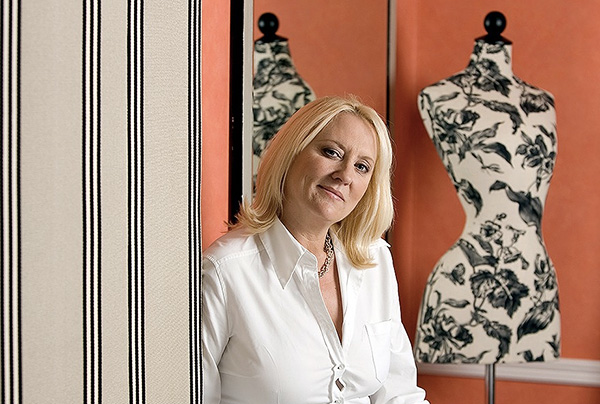
Crime writer Martina Cole photographed at a London hotel © Neil Turner/TSL

I’ve had a web presence of some sort or other since 1999. First of all I was just dipping my digital toe in the water with some free web space and free software supplied by AOL when I was with them. That morphed into the original dg28.com website which was all about helping other photographers to understand light and lighting. Like most things we do in life, my site has grown and changed and it has mirrored my work – both have been through many changes to get to where I am now.

January as a freelance is traditionally a tough time – or so I’m told. One of my goals for this month has been to re-evaluate my online presence and to give my website both a freshen-up and to make it more iPad/iPhone/Android friendly. Work, happily, got in the way and so I haven’t got anywhere near finishing what I started. I have given a lot of thought to deciding exactly what the point of an online portfolio is:

  • I know that I haven’t been inundated with work from it
  • I’m sure that my SEO (search engine optimisation) isn’t state of the art
  • My Google rankings by name are great
  • My Google rankings by occupation, specialism, location and other useful factors are not great
  • I know that it gets a lot of visitors because I have all of the relevant analytical data

Who are my visitors? Where do they come from? Why are they visiting my portfolio so much? Would they notice if it wasn’t there? Would my business suffer? Five very important questions to which I don’t know the definitive answers. That got me thinking and it got me going online to see what other people thought about the very same issue. Professional photography is unlike most other businesses – clients that I work with don’t order online and the amount of repeat business is good but not to the extent that we’d like it to be.

From digging around myself, chatting to friends, colleagues and a couple of web professionals and generally canvassing opinion I have come up with a few absolute truths and one or two bits of generally accepted notions by which changes and upgrades to my web presence are going to be governed in future:

  • You have to have a web presence
  • It has to be good
  • It has to show your work off
  • It has to be focused and demonstrate clearly who you are and what you do
  • You have to assume that it is being looked at by the right people
  • Probably fewer than 10% of the viewers are the right people
  • Most of those ‘right people’ are there because they want to look at my work – they haven’t stumbled across my site randomly

So that means if I want to do more than one thing, I have to have more than one website. That means that I need to show pictures – the kind of pictures that I want people to notice, be impressed by and then to commission something along the same or similar lines.

By now I sense that most people who have read this far are saying “tell us something we didn’t know”. I apologise for being un-original but the truth is that there isn’t a magic formula – despite what SEO expert George keeps emailing to say. So where next? Should I invest money in getting a site built for me that is a bit better than I could build myself? What format should the pictures (because they are the most important thing on the site) be in?

In trying to answer those questions I have been looking at a lot of options ranging from template drive sites to slide shows to contact sheets to bespoke (and expensive) “wow” sites. As I get nearer to the end of the revamp process I find myself getting more and more apprehensive about the various options and technologies. So here is the thing… I have been playing with a software package called Wowslider and I have put a single test page together and asking for opinions and feedback about that page. So here it is www.dg28.com/folio/2013-01/ and I’d be very interested to hear opinions. I know this one thing for sure… what worked last year is probably very different from what will work next year and so January 2014 will probably see me going through this very process again. See you in twelve months time!

Why do YOU take pictures?

Most of this blog is about the professional side of photography but, like a lot of people who make their living taking pictures, there is a passionate enthusiast inside me too. From time-to-time I get a lot of emails from keen amateurs asking me how they can improve their photography. The first answer is always “take more pictures” but beyond that it really helps to know what you are taking photographs and who the audience for those pictures is.

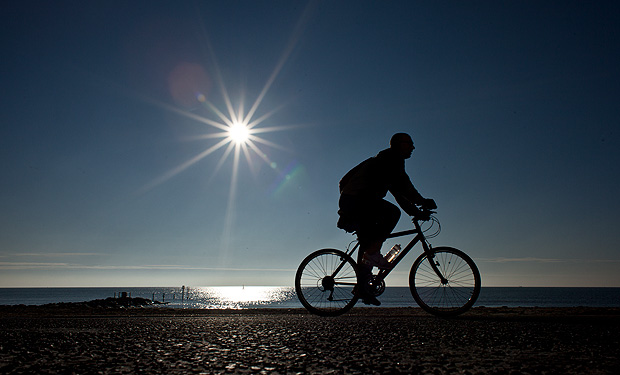
©Neil Turner. November 2011, Branksome Beach, Dorset. This picture was taken as part of a set to illustrate why the BH13 post code area is such a desirable place to live.

Defining who your audience is and realising what their requirements are is a huge step towards becoming a better photographer – especially if you care about what others make of your work. Of course there are many among us who would profess that they only take pictures for their own enjoyment and who don’t really care what other people think. I’m sure that those people exist but they are an incredibly tiny minority. The rest of us want to share our work, get feedback on it and (hopefully) have praise heaped upon it.

A few years ago I wrote an essay entitled “Commission Yourself” as an early attempt to give some direction and purpose to photographers who had a desire to be out there taking pictures but who struggled with what, when and why they were doing it.

It doesn’t matter if you are a professional photographer, a keen amateur or a weekend and holiday compact user – shoot the best pictures that you can. It is all a matter of approach so here is how I suggest you try to take pictures. There are a number of things that a professional photographer knows long before he or she starts to take pictures. The pro knows who the client is, what the end use of the pictures will be and what they will be taking pictures of. This enables them to “focus” on the job ahead, an approach that can easily be translated into the type of photography you do.

The “client” could be your partner or your children and you know that the pictures are destined for the family album. The pictures might be of a child’s birthday party. Already you are starting to think in a far clearer manner and you can concentrate on making a list of the important images. You could, for example, need a range of images that would fit accross a double page in the album. You need a shot of the birthday boy – maybe a nice tight one. You need some pictures of the guests – perhaps a wider picture with three or four revellers in it. Some smaller images of a cake and other guests and something with a bit of humour. A total of five or six images, shot from different heights and some tight, some wide. To get five or six good images you will need to shoot at least thirty pictures and on a digital you have wasted nothing by trying different things. You can print images to different sizes and edit on screen adding captions as you go.

By deciding what your goals are in advance you will actually spend less time just snapping and hoping. Next time you will know how well you did and what worked in the framework you set yourself and adjust your self-commission accordingly. It is one of the great ironies in photography that tighter briefs often make better pictures. I have never been able to just “go and take photographs”, but if I am looking for a something specific I nearly always get what I want.

As you become a better photographer you can learn to recognise what you like about certain images and trying to shoot in a given style becomes a great way of finding your own. So go out and commission yourself tomorrow and if nobody is having a party try to document your garden or street. Pick out details and shoot the wide picture – you’ll soon have your own photo story in the can.

Of course it is equally true that there are people out there who don’t really care about what they shoot; they just want to own and be seen with some very cool and expensive gadgets. I have met so many people with cameras over the years who can quote the features of their kit as if they had learned the brochure by heart but who don’t actually like taking pictures. Each to their own.

Another tactic for becoming a better photographer is to analyse and even mimic the pictures that we see from other photographers. Shooting street scenes in the style of Henri Cartier-Bresson or portraits in the style of Terence Donovan can be a real creative spur and sooner or later you will develop your own spin on those styles and start to move towards having your own way of shooting. There are fashions in photography related to specific lenses that you can follow and there is a constant cycle of effects doing the rounds that you can analyse and adopt if you need more inspiration. It’s all out there waiting. Light, subject matter and composition – master being able to assess those three elements in other photographers’ work and you will be well on your way to being a much better photographer.