portfolio

Space makes you think – part 2

©Neil Turner, March 2013. Family enjoying an early spring afternoon near Fisherman's Walk in Bournemouth, Dorset.

©Neil Turner, March 2013. Family enjoying an early spring afternoon near Fisherman’s Walk in Bournemouth, Dorset.

A very long time ago when I was studying photography at the Medway College of Design I was surrounded by like-minded and equally obsessive photography students who all wanted to unlock the many ‘secrets’ of great photography so that we could all some-day be someone. We were only a very short distance along the journey (it was the first term of the first year) when we were set a project to shoot an object against a background where the object would be very small and still have great composition and make sense. It was a lesson that I will always remember for two reasons:

  • The first is that I loved it and actually shot four or five entirely different pictures – ranging from a damp and golden autumnal leaf on a grey path to a red balloon against a bright blue sky.
  • The second reason is that during a group critique someone (and I have no memory who) said “space makes you think”.

Space makes you think has stuck with me to this day and as a short and snappy phrase it appears in my thinking and in my discussions on a very regular basis. From the day I learned that lesson and then learned to leave space in my compositions for mastheads, strap line, type and headlines I have always looked for pictures with space. Cropping images really tightly is a great way to shoot some subjects and I remember another phrase from my student days which sums that up too “if an element doesn’t add to the composition then it detracts from it”. That’s also true and that, ladies and gentlemen, is why photography is so enthralling, confusing, infuriating and rewarding. Two ‘rules’ that appear to directly contradict one another that form the basis of one of those secrets that we as students of the art/science/profession spend our lives trying to grasp and the interpret in our own ways.

Rules are there to be obeyed most of the time and broken often enough to make sure that we remain creative in our thinking. That was true back at Medway College, it still is and I hope it always will be.

* Those other “obsessives” included Jez Coulson, David Chancellor, Bill Green, Richard Gosler, Mike Cooper, John Baxter, Richard Ansett and Andy Eaves who, I am delighted to tell you, are all still as obsessed as they were! There were 28 photographers in our year and I’m sure more than those listed above are still plying the trade.
Updating my folio and painting the Forth Bridge

folio_screen_grab

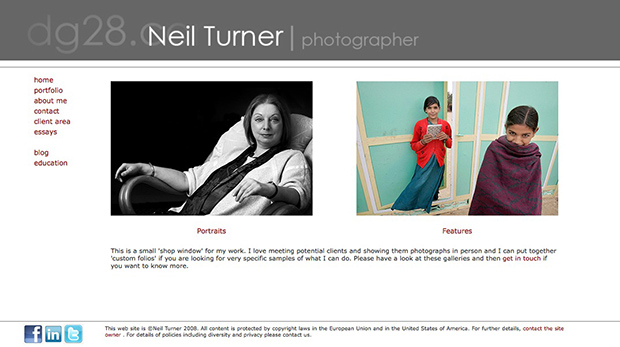
In the UK we have a saying that describes a never-ending task “painting the Forth Bridge”. The idea is simple; once the painters have finished painting the bridge, it’s time to start back at the other end which has been weathering for a number of years by then. Keeping your own portfolio up-to-date is a similar task. There are so many ways to present your work and none of them are perfect and so I keep tinkering with content, layout and even the technology. Five years ago it was Flash and then basic HTML code and then a bit of Javascript and now it is a combination of everything except Flash. My idea is that I want to be able to update easily and regularly without having to format and code stuff. Preparing the images is done using a couple of Photoshop Actions and then the images themselves are inserted into a “slider” which is set to play automatically but which can be stopped and images can be picked out for a closer inspection.

I would be very interested in any views and opinions that anyone has about the site and the way it works. It isn’t an exact science but I think that I’m getting closer to understanding how it all works. Of course photographers are their own worst editors and I suspect that the content will annoy many of you. Whatever you think, let me have it.

The bridge is freshly painted, I’m having a day or two off and then I’m going to start again. One of these days I might even change the colour…

A very old favourite portrait

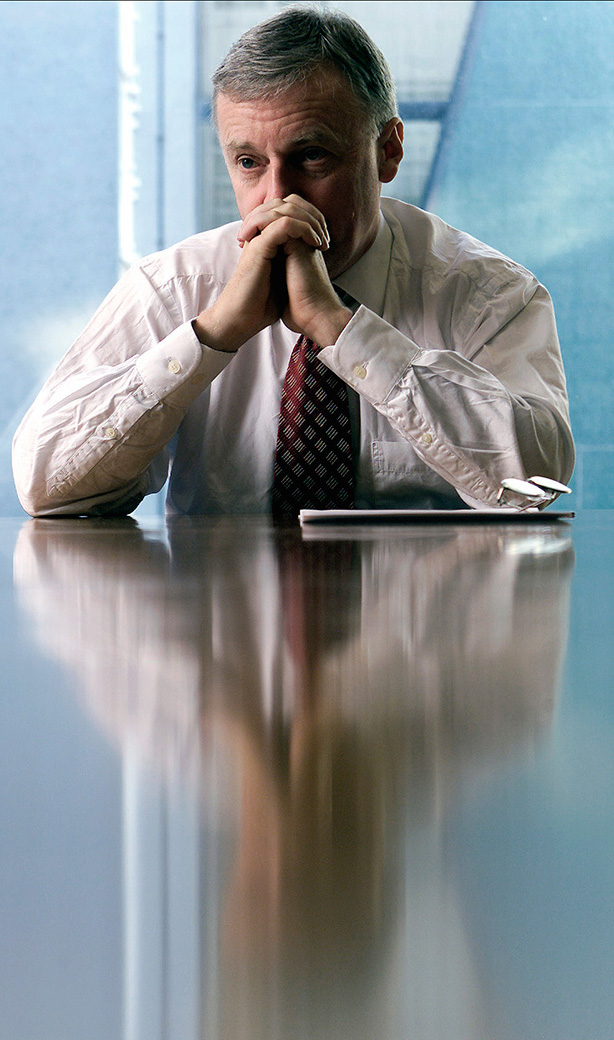
I don’t know if it happens to you when you are looking for something specific but I often search for images and, quite by accident, find something I wasn’t looking for and then that sends me off on a trip down memory lane. I’ve certainly blogged quite a few times in the past about images that meant something to me – either personally or professionally. This portrait of former General Secretary of the Trades Union Congress, John Monks (now Baron Monks of Blackley) was taken in his office at the TUC during an interview with the Times Educational Supplement about his appointment to the Government’s Learning and Skills Council in October 2000.

©Neil Turner/TSL, October 2000. John Monks, TUC General Secretary.

©Neil Turner/TSL, October 2000. John Monks, TUC General Secretary.

The reason that I like this picture is that when I shot it I was delighted to have turned a complete disaster of a shoot into a really nice image. The interview wasn’t going well and the room had a huge picture window which Mr Monks insisted was behind him. The room had dark walls, very dark furniture and no matter how hard I tried the pictures weren’t coming together. I had moved the light (I was working with a single Lumedyne battery powered pack and head with a 70cm shoot through umbrella) to the left of the interviewer and the picture was still boring. There was a decent reflection of the subject in the highly polished table but balancing the lift between the ambient coming through the window and the flash in the room was proving tricky. You need to remember that in those days we were shooting on 1.9 megapixel Kodak DCS520 cameras with tiny LCD screens and you could only get a basic idea of lighting balance.

I was limited where I could place the flash because at that time I was still using Wein optical triggers and the lights in the room had a fault which made them flicker – enough to trigger the flash every second or so. That meant reverting to the emergency back-up synch lead and all of the range restrictions that it placed on where the cable could reach and how it ran around the room.

Gradually I kept changing the shutter speed to allow more and more ambient light into the exposure. I had started at 1/125th of a second at f5.6 on 200 ISO and by the time I got to 1/15th of a second the ambient light really started to kick in and the light reflecting off of the blue tiles and glass in the courtyard outside his window magically took over and eliminated virtually all traces of the gloom and dark wood in the room. I managed to turn the main light off in the room without causing too much trouble – I had to do it because the ambient light inside the room was starting to have an effect on the exposure.

A colourless portrait of a greying man in a dull room sprang into life and I started to relax. This was one of the last frames, shot just as the interview was winding up and it was at 1/8th of a second with the camera resting on the table to try to make sure that there was as little shake as possible. I shot almost all of the interview on a Canon 70-200 f2.8L with a few frames on a Canon 28-70 f2.8L and my old 17-35 f2.8L. Apart from having overcome some difficulties to shoot the portrait, I genuinely loved the colours and I loved the placement of his spectacles. This is a gentle crop that got rid of anything that didn’t add to the overall feel and it quickly became a favourite for a few of the right reasons and many of the wrong ones. That means that it is a good picture and possibly worthy of a place in my portfolio back then but that I was too pleased with my own input to judge that properly!

Sometimes when you shoot pictures through an interview it all goes well and you listen to what’s being said because you are so relaxed. If the pictures are going badly you pick up on the mood of the interview but don’t really hear the conversation. This was definitely a case of the latter. I had no real idea that the interview had been a tough one!

Cool watchmakers

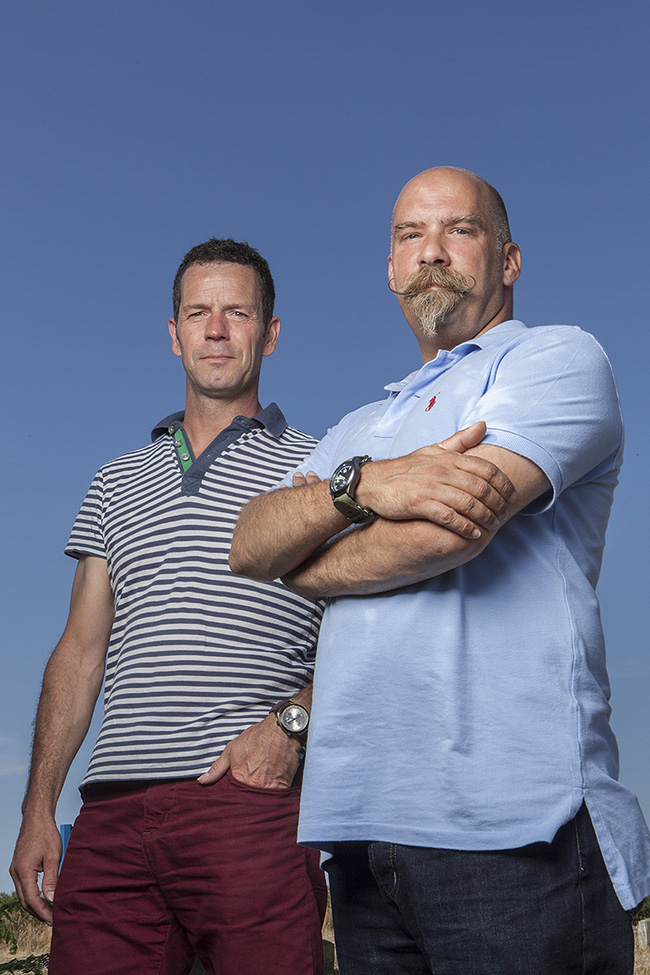
©Neil Turner, July 2013. Alex Brown and Ian Elliott of Elliott Brown.

©Neil Turner, July 2013. Alex Brown and Ian Elliott of Elliott Brown.

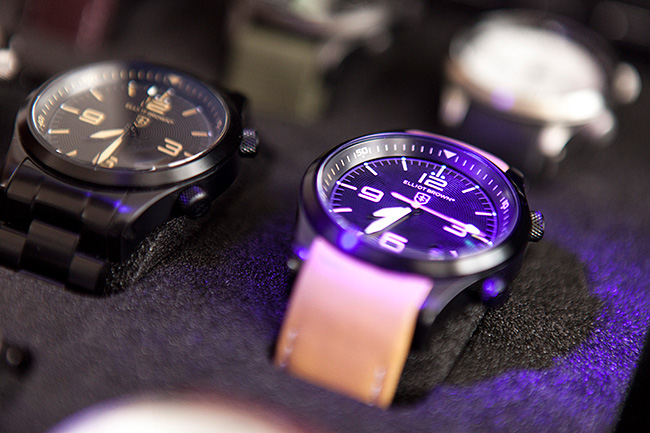
I promised to share new work as and when I could and to add a bit of technical detail whilst doing so. This two person portrait shot on a sweltering July day in Dorset for a leading UK business magazine is a great example of the kind of picture I get asked to shoot. The story was a simple one about a new business partnership designing, making and selling very high class mens’ watches.

There was a limited amount of time for the interview, the pictures and a short video grab and so when I got my slot the two subjects, the reporter and the Picture Editor all jumped into my car and we headed about three quarters of a mile from the company offices to shoot on some open heathland because the style of picture I was being asked for needed an expanse of deep blue sky. We couldn’t shoot at the offices because there just too many tall building around and I had to rely on some local knowledge to find the right spot.

The location was far from perfect because I would have liked a decent amount of shade to put my two subjects in. That wasn’t going to be easy and so I had the reporter holding a large black reflector aloft to give me some artificial shade. There was only the slightest breeze but that was enough to force me into something of a ‘plan B’ which was to move into the shade of some tall bushes about fifty yards away. The downside of this was to lose the unbroken blue sky from behind my subjects (you can see some scrubby heath behind them in the bottom of the frame) but it did allow me to balance the flash (single Elinchrom Ranger Quadra with a 32″ x 24″ soft box) with the sky without the subjects being in direct sunshine themselves. Free from his reflector holding duties, the reporter was happy to hold onto the lighting stand to make sure that it didn’t blow over. No matter how light the breeze, soft boxes act like sails!

I have described shooting from the shade a couple of times before and the basic principle is an easy one: the subject is in deep shade and only lit by the flash whereas the rest of the scene is metered normally and the skill comes from balancing the two halves of the exposure. In practice on a bright and sunny day this almost always means the ambient exposure is going to be 1/200th of a second on 200 ISO at somewhere between f16 and f22. All you then need to do is to get enough power out of your flash to balance that. This sometimes means that you have to lose your light modifier (soft box/umbrella etc) if you don’t have a lot of power and almost always means moving the flash quite close to the subject if you want to keep the light modifier in place. Compromise… I’ve used that word once or twice before too. The camera was a Canon EOS5D MkII and the lens was a Canon 24-70 f2.8L.

The two guys in the photograph make some very cool watches. It’s a new business by the name of Elliott Brown and their first collection goes on sale about now.

©Neil Turner, July 2103

©Neil Turner, July 2103

Smash Up!

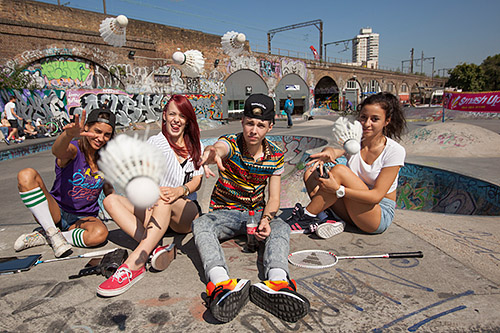
The caption that goes with these photos simply says “Badminton England takes to the streets to celebrate ‘Smash Up!’ a new way to play in schools, featuring music and text message breaks.” The client , Badminton England, asked me to go along and get a range of stills at a video shoot which would be the basis for a campaign to promote “Smash Up!” The idea was simple: take a few of the best young badminton players in the country to a skate park in east London and get them to hang out, play a few rallies and generally have fun.

This presents a couple of challenges that a lot of working photographers would be familiar with:

  • Fitting shooting stills around a video crew who have limited time and a lot to do
  • Taking pictures that can be used for promotional materials and not just interesting and creative ones

Experience really helps here but so do people skills and it took me a few minutes to work out who was who and what my best options were. There were a lot of skateboarders and BMX riders at the park and they were dressed much the same as the very young video crew. The folks from Badminton England were a bit easier to spot and my plan quickly evolved into one of keeping out of the way when they were shooting the wider video shots and then to get stuck back into the general image grabbing when the video guys were reviewing their work or setting up their next shots.

Very near the beginning of the morning they were shooting some sequences with two of the young badminton stars and three cameras and so I needed to be out of the way. Next to the skatepark is a railway arch with some decent graffiti and so I went with one of the other players and a BMX rider with my lights to see what we could get.

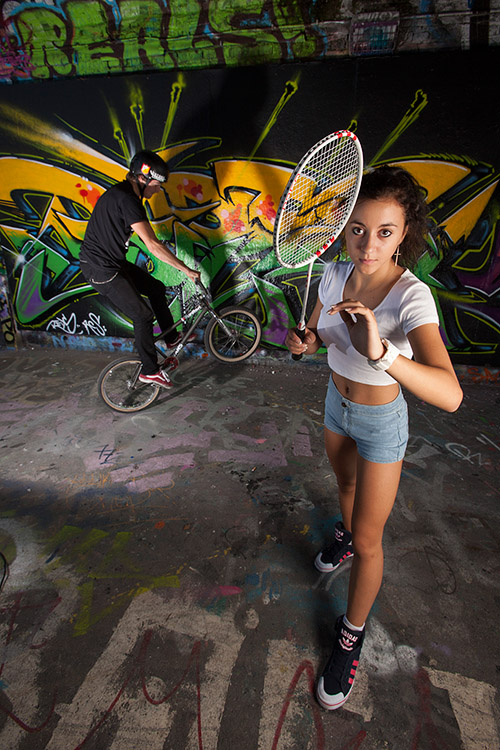
©Neil Turner, August 2013. Young badminton champion and BMX rider in the railway arches.

©Neil Turner, August 2013. Young badminton champion and BMX rider in the railway arches.

And this is one of the frames selected by Badmiton England to be released with the video. Reasonably simply lit with a 24″ x32″ soft box on an Elinchrom Ranger Quadra from the right hand side of the picture, the player stands as if she is about to receive a serve whilst the BMX rider who was lit by a second Elinchrom Ranger Quadra with no diffusion messed around in the background. We shot versions of this with both of them in action but this was the better shot for the purposes of publicity. There was almost no ambient light in the tunnel and so the whole shot is lit by the the two flash heads (running from a single pack). The camera was a Canon EOS5D MkII with a 16-35 f2.8L lens at 1/125th of a second f9 on 200 ISO.

© Neil Turner, August 2013. Rally taking place next to the skatepark bowl.

© Neil Turner, August 2013. Rally taking place next to the skatepark bowl.

Most of the morning was spent shooting action as it happened – either staged by the video crew or as it really happened. It was a case of hanging around with three cameras each with a different lens (16-35, 24-70 and 70-200 f2.8L series Canon lenses) and making pictures. The whole shoot was around two hours and I sent the client just over 90 pictures – 70 of which were these grabbed shots and the other 20+ were staged and lit images.

© Neil Turner. August 2013. Messing about at the end of the shoot.

© Neil Turner. August 2013. Messing about at the end of the shoot.

As fun shoots go, this was right up there. A client happy for me to shoot what I wanted and a video crew who understood that we both had a job to do under interesting conditions and with a very strict time limit. The campaign goes live very soon and I hope that badminton gets the boost in young players that it deserves.

images 34,59 or 78

New work – an answer

A few weeks ago now I posted an open invitation for anyone to ask me a question. I received a few and saved some of them until I was ready to answer them. This one has been playing on my mind for quite a while:

“Why don’t you post new pictures on your blog in the way that you used to when dg28.com was the first website I looked at every week?”

That is what I call a question! There are so many parts to the answer that I have decided to list them as bullet-points:

  • I don’t shoot as much editorial work as I used to and a lot of corporate clients don’t want me to post the images shot for them.
  • I don’t have quite as much time to work on websites as I used to.
  • One of the main reasons that I stopped posting new work was that much of it stopped looking ‘new’ and I wrote about that on this blog.
  • Another reason that I stopped was the number of times people asked me to take pictures down.

Now that I am a freelance photographer I need to be very careful about what I post. Social media, blogs and websites are very public forums for thoughts and ideas and it is far too easy to do or say something that harms your business and freelancing as a photographer is very much a business. There’s also an element of protecting ideas. I published fifty technique examples in the period between 1999 and 2008 and I get emails from photographers all over the world saying that some of those lessons changed their practice. I still meet photographers who tell me that they read those pages over and over again when they were trying to develop their own techniques for using portable flash and that is gratifying but now I’m playing a few of my cards a bit closer to my chest because I have developed a few new ways of working that I’m not ready to share outside of my portfolio.

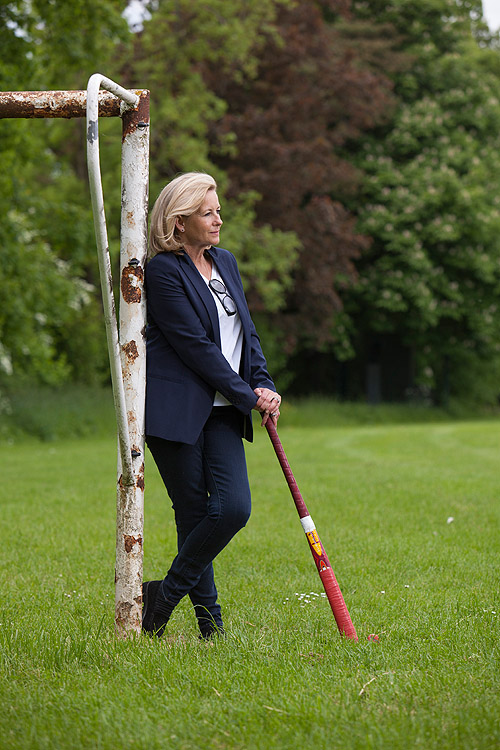
Like I said – there’s no single reason why I stopped posting and I certainly don’t rule out posting some more ‘new’ work over time. As a response to the question that was asked I have decided to post one new portrait that I made a couple of months ago for a women’s magazine. Te story was about three women who had written very personally about their time at school and how that had influenced their later lives. One of the women was journalist and author Gill Hornby and I was asked to photograph her with her dislike of school and team sports in mind. We had a few minutes at a playing field on a less than sunny day and this is the photograph that I liked most:

©Neil Turner. 07 June 2013. Gill Hornby is the author of The Hive (Little Brown).

©Neil Turner. June 2013. Gill Hornby is the author of The Hive (Little Brown).

People in the news bringing back memories

©Neil Turner/TSL. Hilary Mantel, January 2007.

©Neil Turner/TSL. Hilary Mantel, January 2007.

I seem to have a very strong memory for where, when and why I photographed people in the past. When names come up in the news I often think “ah yeah I shot them at such and such a place”. Hilary Mantel, double Booker Prize winning author has been in the news a lot this week. She gave a lecture where she commented on the Duchess of Cambridge and in comparing her to the late Princess Diana (the Mother-in-Law she never knew) called her “precision-made, machine-made, so different from Diana whose human awkwardness and emotional incontinence showed in her every gesture.” The lecture was long and talked of many things but the reactions against Hilary Mantel’s views were both harsh and often mistaken.

This made me wonder if my view of the situation and the criticism is in any way tainted by having met her, by having admired her books and by actually listening to what she said when I watched the extended highlights of the lecture on YouTube. Of course I cannot really be sure but my memory of meeting Ms Mantel is pretty strong. I can remember her apartment and I can remember her hospitality. I can remember her reluctance to have her picture taken and having spent a lot of time chatting before ever getting a camera out of its bag. I can even remember getting to the location with a lot of time to spare and I can even remember the chat that I had with a chap walking his dog along the street where I parked up and waited in the chilly January air.

Without having much to say, I thought that I’d share my favourite frame from the job. It was shot in colour like the rest of the set but I felt the need to convert it to black and white and submitted two versions to the Picture Editor. I wasn’t surprised when they ran it in colour but I have a very strong memory of being mightily disappointed.

For the many techies who read my blog, it was shot on a Canon EOS1D MkII with a Canon 70-200 f2.8L IS lens at 1/250th of a second at f4.5 on 100 ISO. It was lit with a Lumedyne flash with a shoot-through translucent white umbrella deliberately set up to lose as much of the ambient light as possible.

The value of your online portfolio

martina_cole

Crime writer Martina Cole photographed at a London hotel © Neil Turner/TSL

I’ve had a web presence of some sort or other since 1999. First of all I was just dipping my digital toe in the water with some free web space and free software supplied by AOL when I was with them. That morphed into the original dg28.com website which was all about helping other photographers to understand light and lighting. Like most things we do in life, my site has grown and changed and it has mirrored my work – both have been through many changes to get to where I am now.

January as a freelance is traditionally a tough time – or so I’m told. One of my goals for this month has been to re-evaluate my online presence and to give my website both a freshen-up and to make it more iPad/iPhone/Android friendly. Work, happily, got in the way and so I haven’t got anywhere near finishing what I started. I have given a lot of thought to deciding exactly what the point of an online portfolio is:

  • I know that I haven’t been inundated with work from it
  • I’m sure that my SEO (search engine optimisation) isn’t state of the art
  • My Google rankings by name are great
  • My Google rankings by occupation, specialism, location and other useful factors are not great
  • I know that it gets a lot of visitors because I have all of the relevant analytical data

Who are my visitors? Where do they come from? Why are they visiting my portfolio so much? Would they notice if it wasn’t there? Would my business suffer? Five very important questions to which I don’t know the definitive answers. That got me thinking and it got me going online to see what other people thought about the very same issue. Professional photography is unlike most other businesses – clients that I work with don’t order online and the amount of repeat business is good but not to the extent that we’d like it to be.

From digging around myself, chatting to friends, colleagues and a couple of web professionals and generally canvassing opinion I have come up with a few absolute truths and one or two bits of generally accepted notions by which changes and upgrades to my web presence are going to be governed in future:

  • You have to have a web presence
  • It has to be good
  • It has to show your work off
  • It has to be focused and demonstrate clearly who you are and what you do
  • You have to assume that it is being looked at by the right people
  • Probably fewer than 10% of the viewers are the right people
  • Most of those ‘right people’ are there because they want to look at my work – they haven’t stumbled across my site randomly

So that means if I want to do more than one thing, I have to have more than one website. That means that I need to show pictures – the kind of pictures that I want people to notice, be impressed by and then to commission something along the same or similar lines.

By now I sense that most people who have read this far are saying “tell us something we didn’t know”. I apologise for being un-original but the truth is that there isn’t a magic formula – despite what SEO expert George keeps emailing to say. So where next? Should I invest money in getting a site built for me that is a bit better than I could build myself? What format should the pictures (because they are the most important thing on the site) be in?

In trying to answer those questions I have been looking at a lot of options ranging from template drive sites to slide shows to contact sheets to bespoke (and expensive) “wow” sites. As I get nearer to the end of the revamp process I find myself getting more and more apprehensive about the various options and technologies. So here is the thing… I have been playing with a software package called Wowslider and I have put a single test page together and asking for opinions and feedback about that page. So here it is www.dg28.com/folio/2013-01/ and I’d be very interested to hear opinions. I know this one thing for sure… what worked last year is probably very different from what will work next year and so January 2014 will probably see me going through this very process again. See you in twelve months time!