UK

Early morning winter sun

©Neil Turner, January 2015. Early morning wintery sunshine on the beach at Bournemouth.

©Neil Turner, January 2015. Early morning wintery sunshine on the beach at Bournemouth.

It’s almost always about the light. Watery winter sunshine on the beach at Bournemouth this morning. I shot a frame and edged closer, then shot another before moving closer still. It was my sixth move that caused a few seagulls to finally move off and then I shot this just as the water came through my right boot.
Fujifilm X100S, 1/600th @ f9, 640 ISO.

©Neil Turner, January 2015. Early morning watery sunshine on the beach at Bournemouth.

©Neil Turner, January 2015. Early morning watery sunshine on the beach at Bournemouth.

The Pier has seen better days and I’m not sure that the potted palm trees do much for the area but they make good pictures.
Fujifilm X100S, 1/1200th @ f8, 640 ISO.

I was born less than three miles from where these pictures were taken and the beaches along this part of the coast still hold an almost endless fascination for me.

Not the DSLR, I’m having fun

© Neil Turner, March 2014. Shadows on the pavement as a pedestrian passes along Tottenham Court Road.

© Neil Turner, March 2014. Shadows on the pavement as a pedestrian passes along Tottenham Court Road.

Question: Why are so many professional photographers using mirrorless cameras, micro 4/3rds format cameras and experimenting with pretty much anything that isn’t a DSLR?

It’s a tough question and without conducting some sort of major survey I can only give an answer based on my own experiences and those of close friends and colleagues. DSLRs have been my main cameras for over sixteen years now and they have become an extension of me when I’m working. They do what I need them to do with no real fuss, the quality has moved from “acceptable” back in 1998 to “extremely good” and they allow me to do the day job without having to worry about my gear very much. But, and there’s always a ‘but’ – they have become a little bit boring and little bit ‘too good’.

When I’m shooting pictures for the joy of it (and despite doing this for a living since 1986 I still do that) I want to feel something different. Elegant competence isn’t enough any more. (more…)

What’s your favourite lens?

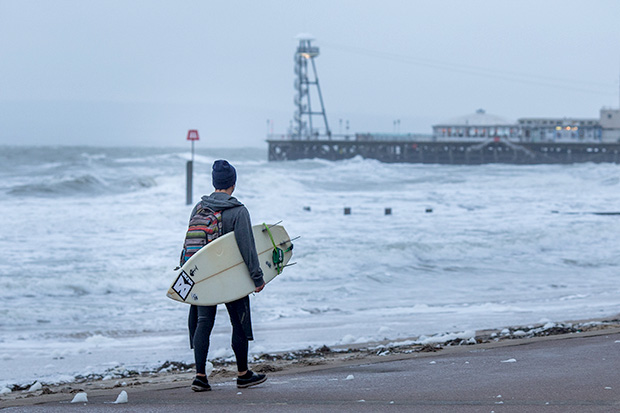
©Neil Turner, November 2014. Surfer heads towards Bournemouth Pier as the waves get bigger during a storm.

©Neil Turner, November 2014. Surfer heads towards Bournemouth Pier as the waves get bigger during a storm.

It’s been a while since I’ve directly answered a question from a reader on this blog. I haven’t been ignoring people – it’s just that the questions best suited to an answer on here haven’t been coming my way. A fellow news photographer causing mischief asked this one last week:

“What’s your favourite lens?”

It’s tough to answer because one of the things I love doing in my work is to use as wide a variety of focal lengths as possible and to use the right lens for the situation (if I own it and/or have it with me of course). I’ve written before about the best lens for portraits and I’ve written about zooms versus primes quite recently and so I thought that I’d give a couple of different answers to the question.

Most used lens

There is one lens that I use more than any other, one that I’d find it hardest to live and work without and which has given amazing service over many years. That lens is my Canon 70-200 f2.8L IS. (more…)

Card readers are the new camera bags…

©Neil Turner, December 2014. A small selection of the CF card readers that I own

©Neil Turner, December 2014. A small selection of the CF card readers that I own

As I sit here about to hit “buy” on yet another new reader for compact flash cards I am feeling more than a little bit of deja vu. And when I say “deja vu” I mean multiple layers of it. Sure I’ve bought plenty of CF, SD and even PCMCIA card readers in my time and of course none of them has been perfect but that feeling is an identical replica of the feeling I get when I buy a new camera bag – it’s a complex emotion; optimism meets resignation as I want to think that “the one” that I am buying is as perfect as I long for it to be whilst knowing full-well that it is going to be just as disappointing and just as deeply flawed as the last one, the one before that and the twenty or more before that.

It appears to be part of the psyche of professional photographers that we have to seek perfection in the equipment that we buy and use without acknowledging that such a thing doesn’t exist and that it probably never will. In just the same way that there is a colossal amount of choice in the camera bag market, there are lots of different CF card readers out there. Where the two markets diverge is in the quality of the construction and the longevity of the products. I have camera bags that have lapped the world and lived in more car boots than I can remember and that are still perfectly serviceable whereas CF card readers are cheap, poorly made and don’t appear to be of professional quality at all.

It isn’t completely the fault of the manufacturers: the pin design on compact flash cards isn’t as tough as you’d like and the way that the current crop of USB3 readers with separate cables  experience problems with the cable to reader connection would imply that it may be the USB3 standard that is at fault rather than the manufacturers quality control or design. This is backed up by the number of portable USB3 hard drives that are being reported as failing due to that same connection. It wasn’t always this way. I still have a couple of Sandisk Firewire 800 card readers that are as good as new despite having a hard life and being pretty much obsolete and the ancient PCMCIA reader that lives in a box in the loft was a proper professional bit of kit.

The accepted wisdom was that readers with removable cables were a good idea because the cables were the part of the kit that was prone to damage but that’s no longer the case. In an almost heretical move I am leaning towards the idea that built-in cables, avoiding the car crash that is the USB3 standard, are once again a good idea – and that is why my finger is hovering over the “buy” button because Delkin Devices have produced a reasonably solid looking USB3 reader with a built-in, chunky cable. Of course I’m resigned to the idea that there will be issues – this is one of those moments where optimism is high and the deja vu is strong.

Here goes…

Another ‘classic’ technique posting from the old site

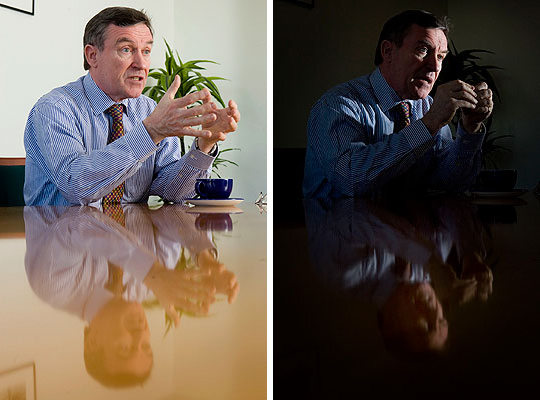
The idea here is to have two separate lighting set-ups for one interview portrait without having to constantly move around the room adjusting lights. This interview was with a senior businessman who chairs a body that decides how much teachers’ pay rises will be each year. The reporter wasn’t all that comfortable with me shooting through the interview but it was what the picture editor wanted, so that’s what I did. This job required a bit of quick thinking so that I could get two different set-ups in place.

©Neil Turner/TSL, April 2008.

©Neil Turner/TSL, April 2008.

The picture on the left was lit using a single Lumedyne head at 50 joules bounced off of a wall almost in front of the subject. The image on the right was lit by a single Canon 550ex flash gun with a Honl Photo snoot attached aimed directly at the subjects face and set further away from the camera.

Both flash units were fitted with Pocket Wizard receivers set on different channels from each other. The idea here is that by simply switching between channels on the transmitters I could switch between two very different lighting styles without moving.

The left hand image is far more evenly lit. The large expanse of off-white wall made a very good and large light source. The exposure here was 1/60th of a second at f5.6 on ISO200. There was some available light play – without flash the scene would have been two stops under exposed with that amount of flash. You can see from the diagram below how the room was laid out and the flash head was positioned at about 10 degrees above the subjects eyeline.

The right hand image is far more starkly lit. The exposure was 1/250th of a second at f13 on ISO 200. There is almost no available light in this picture and the lighting effect is dramatically different. The very narrow angle of the light offered by the Honl snoot makes it difficult to always get the subject right in the centre of the small pool of light and so you need to be careful when aiming it to centre it on where the subject is most likely to be.

The layout of small conference room where the interview took place.

The layout of small conference room where the interview took place.

The point of this technique is that you can arrange more than one style of lighting and then switch between them at will simply by selecting a different channel on the trigger. I find that I use the Honl snoot a lot more than I had imagined that I would. It fits into a bag very easily and it is simple to use. When you are in complete control of the lighting, it’s very easy to achieve dramatic results. This style of light might not be to every picture editor’s taste and so the evenly lit alternative is a very good idea.

A fourteen year old technique post

Between May 1999 and June 2008 I posted a large number of technique examples on the original http://www.dg28.com taken from my daily work to show how I used light in an era where digital cameras were pretty poor at ISOs over 800 or even 400 in the case of the venerable Kodak DCS520. These days flash is a creative choice rather than a technical necessity but the techniques still stand up. From time to time I re-post one of these old examples just to remind myself how life used to be. This one was first posted fourteen years ago and for a very long time it was amongst my favourite pictures that I had posted.
©Neil Turner/ TSL, November 2000.

©Neil Turner/ TSL, November 2000.

At the time it felt as if I spent every evening answering follow-up questions about the pictures and techniques that I’d described. These days there are thousands, if not tens of thousands, of people publishing ‘how-to-do-it’ photography blogs but back then there were only a small number of us. It was such an exciting time in our profession. Anyway, here’s the post as it appeared back in November 2000:

Arriving at the job is usually the best times to start having ideas about locations for a portrait. Buildings often have features that lend themselves to use in a photograph, and the grounds can be just as inspirational.

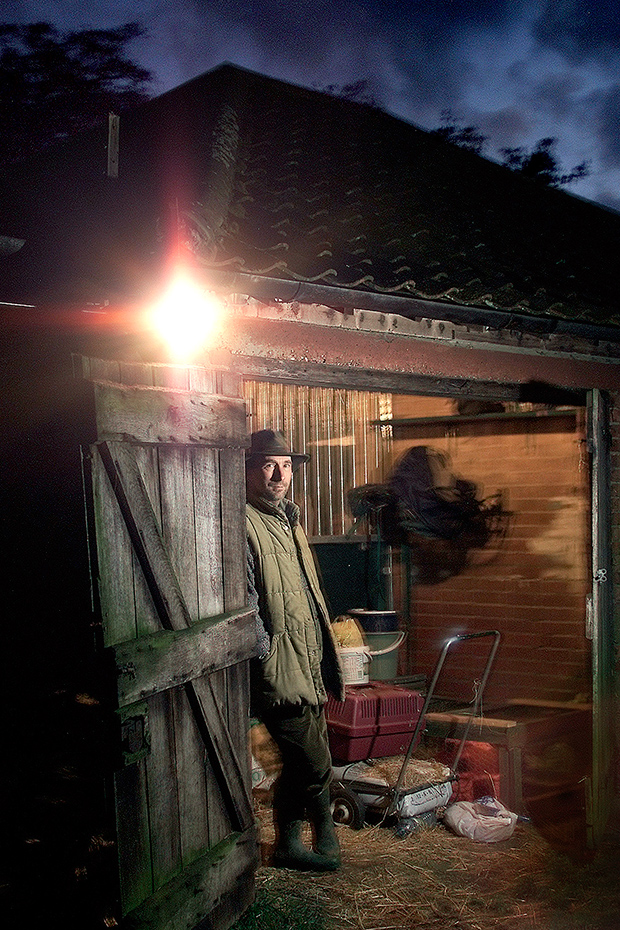
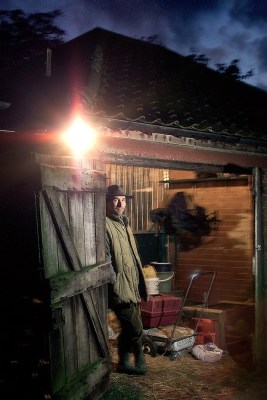
When I arrived at the Suffolk farmhouse of journalist and author Simon Barnes, he and his wife were busy chasing one of their horses around the yard. By the time the mare was back in one of the stables it was all but dark, but I had seen just how wonderful the other stable looked lit by the 60 watt bulb inside it. 

This image called for the mixing of available light and fifty joules of Lumedyne flash. The flash head had it’s diffuser cap over the standard reflector at an angle of 60° from the lens axis and at a height of about six inches above Simon’s eye level. I had to use the flash a lot lower than I would have done because I wanted him to keep his hat on and the if the flash had been higher his face would have been in shadow from it’s wide rim.

Cut down to it’s minumum 50 joules at a distance of seven feet the flash reading on 200 ISO was still f6.7, which was a lot more than I would have liked. At f6.7 the inside of the stable needed an exposure of about 1/3rd of a second, and the sky needed 1/2 of a second to get some detail in the lighter areas. The discrepency between the two exposure requirements was only half a stop, so I went with the longer exposure because a little over exposure inside the stable would be fine. 

With a 28-70 f2.8L series lens on a DCS520 I started shooting pictures of the upper half of his body and a little of the stable roof and sky. Without changing the exposure I changed lenses to the 17-35 f2.8 and moved back. As I moved back the sensor floodlight came on and the light shining into the lens gave some strange pink flare (bottom right) and the floodlight made an excellent element in the composition. By this time I was hand holding the camera at 1/2 second, which meant that there would be some camera shake so I shot about twenty frames at the same exposure in the hope that a few of them would be still enough to work. 

I shot some safer images as well with the inside of the stable lit by another Lumedyne head complete with a warm up filter to simulate the tungsten glow. The image worked really well, and I am more than happy with it. It shows that light and location are the most important factors when planning a location portrait.

Footnote: Immediately after this job I started to carry a sheet of -2 stop neutral density gel in my bag. I have learned lots of lessons the hard way since the beginning of my career in 1986 and, whilst they are fewer and farther between, I still learn plenty of things that way.

Mint in box

©Neil Turner, November 2014

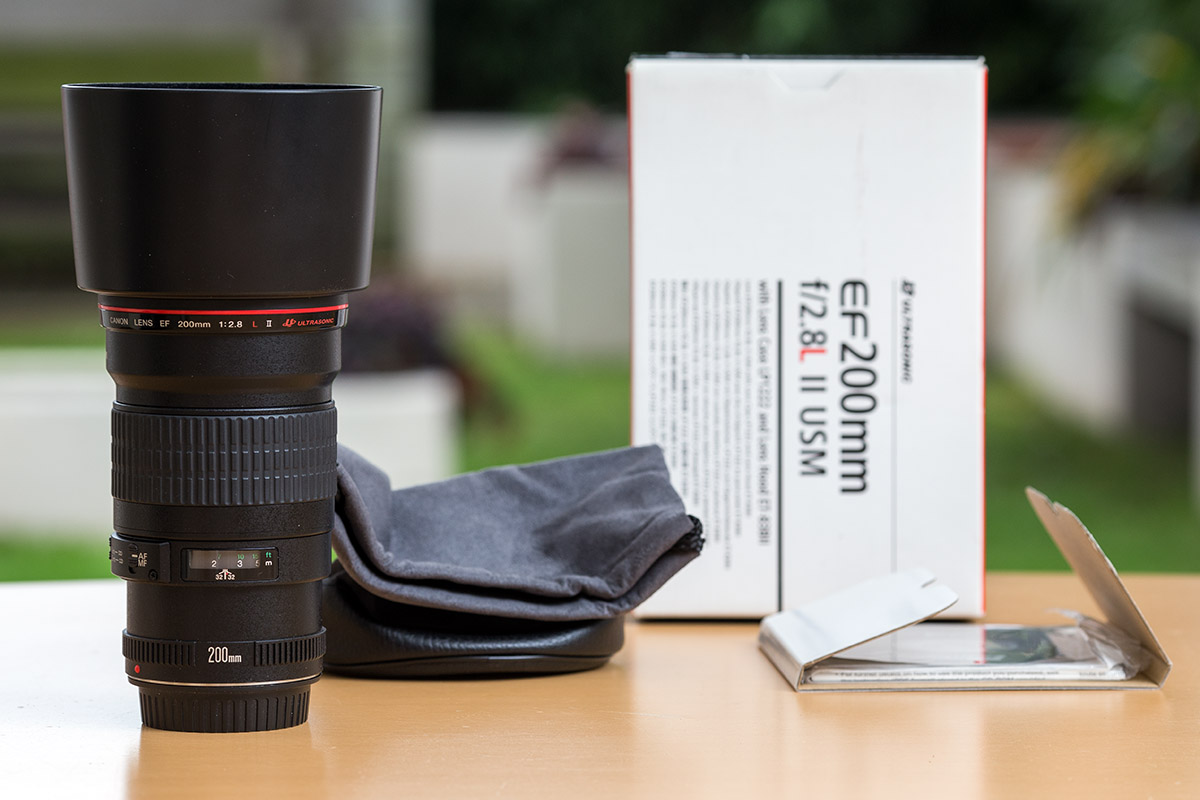
©Neil Turner, November 2014. Canon EF 200mm f2.8L II USM lens.

There are lots of things about the world that I don’t understand. Some of them I ignore, some I oppose and there are others that I just go along with.

One of those that sits squarely in the latter category is the obsession with keeping the boxes for items of photographic and computer equipment that you are intending to use. I go along with it because people are actually prepared to pay more for a used item if you have the original packaging. Basically, it appears, you are prepared to pay me a premium for a secondhand piece of kit if I keep cardboard, plastic and polystyrene in my loft so that you can do the same during your ownership of that item.

It makes sense for collectables where the market loves “mint in box”. We have a few Star Wars items safely tucked away still sealed in their original packaging and I have a couple of Corgi model cars in their boxes too (the box for one on my desk is actually more attractive than the die cast metal contents anyway). But the logic of hoarding packaging for something that is in use is beyond me. Again, I get the concept of saving the instructions and any accessories (I have a massive box full of both of those) but not the packaging. It’s no big deal which is why I am now going with option 3 and just accepting that it is just the way it is. No sense fighting against it and ignoring it isn’t much of a principled stand!

I wasn’t always of that opinion. Somewhere there’s probably a whole load of boxes being safely squirrelled away that look exactly like the original boxes for the items they were bought with but they are just substitutes. When I bought my first two Canon EOS5D MkII bodies a dealer bought the boxes and instructions from me. I thought it a bit weird at the time but £20.00 is £20.00 and I sold them. He presumably “re-united” those boxes with cameras that were missing theirs and sold them on to some unsuspecting soul who thought they were getting the original packaging.

I’m not even sure why this is taking up an hour of my time thinking about why I find it so absurd – other than the fact that I am getting rid of some superfluous gear and one of the lenses really is “mint in box”.

“What gear is that?” I hear you ask – it is a Canon EF200mm f2.8L II USM prime lens that I bought a few months ago when I was going through a phase of using prime lenses for as much as I could while my 70-200 f2.8L IS (ditched the box for that one in 2003) was away having major surgery. The repairs cost less than I had expected and in the end I only used the 200mm lens twice – both times indoors for large groups of head shots. I had bought the lens as secondhand myself although Castle Cameras did (which I trust) say that it had barely been used and had been originally purchased through them a few months before that. So here we have it; a fabulously sharp current model lens with all of the correct bits and pieces – including cardboard, plastic and polystyrene – which retails for £569.00 new going for the bargain sum of £449.00 + delivery.

I am loath to stick it on eBay given the massive commissions that they now charge but the average selling price for one of these (and it would be impossible to be in better condition) is £473.91 on the auction site. The lens is registered with Lenstag and so I would obviously transfer that over. By clicking on the link you can check that it is verified – such a good system!

I will be clearing some more gear out soon. None of it will be ‘mint in box’ because 99% of my equipment gets used for many years before I sell it on but it will be well looked after, properly serviced and verified by Lenstag.

Five day black & white challenge

©Neil Turner, November 2014. A young woman jogs along the promenade near Portman Ravine in Bournemouth with a child in a pushchair.

©Neil Turner, November 2014. A young woman jogs along the promenade near Portman Ravine in Bournemouth with a child in a pushchair.

A couple of weeks ago I was nominated by another photographer to take part in a Facebook Five Day Black & White Challenge. The idea was simple: to post a new black and white photo every day for five days. I have to admit that I was a bit reticent at first and posted pictures that I’d already taken in the previous few weeks. Then someone mentioned that they found the discipline of having to go out every day and shoot something new invigorating and so I started the challenge over again and shot specifically for it every day. My second challenge ended yesterday but it wasn’t until I was out shooting again today that I remembered that the challenge was over. What to do with the pictures from day six? The answer was to post the chosen frame to Facebook anyway and then to post it here too – as another “just because I like it” frame.

Technical stuff: Canon EOS6D with a 28mm f1.8 EF lens (cropped slightly). 160 ISO and 1/1250th of a second at f11 RAW file converted and desaturated using Adobe Camera RAW CC 2014 with a 5% bronze tint added.