Author: dg28

I've been a full-time editorial & corporate photographer since 1986 and I'm still as passionate about the work now as I was then. These days I also write about photography, teach photography and act as a consultant on all things photographic - so, basically, photography is my professional life.

Fifteen minutes of low level fame

To be entirely honest it was actually thirty-four minutes rather than fifteen but Andy Warhol’s observation that everyone will be famous for fifteen minutes is a gift of an opening and it’s so much punchier than thirty-four!

The half an hour plus four minutes in question was the time that I spent giving evidence to The Leveson Inquiry into the culture ethics and practice of the British press on behalf of The British Press Photographers’ Association. If you didn’t already know, I am very proud to be one of the two Vice-Chairmen of The BPPA – an organisation that supports and promotes news photography in the United Kingdom.

I have written a short blog about my experiences and there is a link to actually watch a Flash (boo!) video of me in action. This isn’t about self-promotion, its about the important message that I was given the honour of presenting to this important inquiry. Did it go well? Go to The BPPA’s blog site and find out…

Canon announces a new 24-70 f2.8L lens

New objects of desire on the equipment front will probably start to appear with monotonous regularity between now and The London 2012 Olympic games. Overnight Canon have announced a new version of the 24-70 f2.8L lens – the mark II.

The older version has been my workhorse for so many years now that I would find it hard to do my job without one and the appearance of a new (and improved?) version makes get my abacus out and start to apply the cost/benefit calculations that professionals need to make every time we consider a new piece of kit.

If I decide that I cannot justify buying it, then it still remains an object of desire! Apparently another major camera manufacturer has also been busy on the launch pad overnight. Nikon have announced the D800 with more megapixels in a 35mm style DSLR body than anyone thought possible/desirable/necessary. Given Nikon’s recent track record of getting things right I would not bet against this being a great piece of kit and a runaway success. For my part, I hope that the next full-frame Canon doesn’t follow suit and re-ignite the megapixel race. A 5D MkIII with decent AF and a chip at around 24-25 megapixels with decent options to shoot smaller (and maybe custom sized?) RAW files would suit my needs rather well.

Archive photo: Carl Djerassi, London, June 1999

©Neil Turner/TSL. London, June 1999

I shot this portrait of Carl Djerassi, co-inventor of the contraceptive pill, scientist and playwright in his London flat. He was mainly resident in San Francisco but kept a home in the UK as well. He was a very quiet and considered man who was used to, but not particularly keen on, publicity. I was attracted to the shape of his dining chairs and the almost egg-like shape of the top. I don’t recall whether we discussed the shape at the time!

College Principal, July 2006, London

©Neil Turner/TSL. July 2006, London.

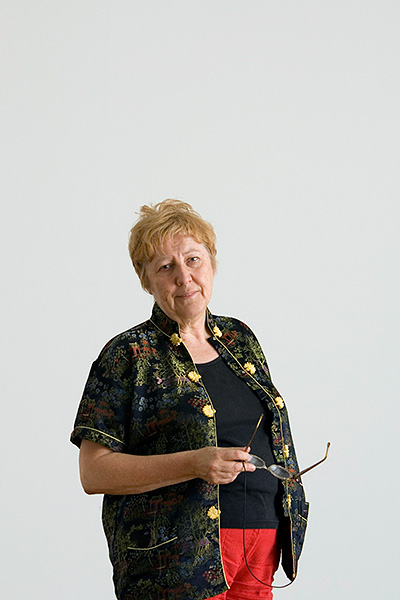
Jane Rapley was about to take over as the new head of Central St Martins College in London when I shot her portrait in July 2006. After 17 years at the famous arts college in a variety of posts she became the Principal in August 2007. I photographed her in her office and then in one of the galleries that they use for student shows at Central St Martins on Southampton Row in central London.

This particular frame was shot in case the designer wanted to use the portrait full page and run a headline and some text over the image itself. The rest of the shoot was more varied and included some very wide portraits, which seem to have been what I was interested in at that time. It is fascinating that when you look back at your own work on a chronological basis you can definitely see trends and fashions in the way you compose, light and post-produce pictures. This was one of my softer lighting periods!

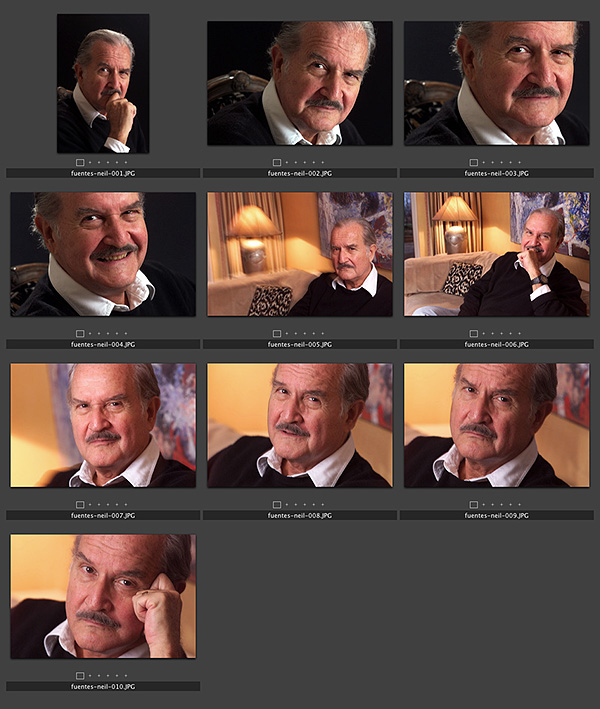
Carlos Fuentes portrait – the “contact sheet”

Going back through an old portfolio I was reminded of a lot of portraits that I used to love. One of them is this session with Mexican author Carlos Fuentes shot at his London home in December 1999. He was both charming and cooperative and his home was easily spacious enough to set up as much gear as I had been able to carry up the stairs.

©Neil Turner/TSL. December 1999. London

He had already been interviewed by a reporter to whom he was obviously a hero and I had spent a while asking her about him and his work. These were the days when the internet was just starting to become useful for background research. The trouble was that this was a last minute assignment and getting on line when you were on the road was a very tricky task. These days we all have smart phones with Google and Wikipedia but back then it was a lot tougher to become an instant expert of your subject. I looked his CV up later and was a bit embarrassed that I had never heard of him. I read a coupe of translations of his books over that Christmas break and I hope that I will never get caught out like that again.

Techie stuff: Kodak/Canon DCS520 cameras with 17-35 f2.8L, 28-70 f2.8L and 70-200 f2.8L lenses. All lit with a Lumedyne Classic series flash and a 70cm shoot through umbrella with the hair light in some frames provided by a Canon 550ex flash unit.

Define the word “PHOTOGRAPHER”

When does a person with a camera, even a person with an expensive camera, become a photographer?

Apologies if this seems to be getting a bit philosophical but it’s a question that someone casually threw at me a week or so ago and I’ve been struggling with it ever since. Let’s get the dictionary stuff out of the way…

Right now we can really get on with the real business of working out what a photographer is. I’ve always been a fan of simple definitions and I like the idea of making a comparison between things, so how about this:

Someone with a camera tries hard to get everything into the picture whilst a photographer does their level best to keep as much out of the picture as they can.

All that means is that there comes a point in your photographic journey where you realise that most pictures are much stronger when you leave absolutely everything out that doesn’t need to be in. In a paraphrase of the old saying “what doesn’t kill you makes you stronger” (which isn’t necessarily true by the way) we can come up with “what doesn’t add to the composition detracts from it”.

The dictionary definition above, which comes from the English dictionary built into the Apple OSX operating system, steers away from the word professional and I’m really glad that it does because there are an awful lot of superb photographers out there that take pictures for fun and not for a living. Being a good photographer is not the same as being a professional photographer. On balance, MOST professionals are good but there isn’t a direct relationship between earning a living and being proficient.

These days there is a belief that ‘everyone is a photographer’. I wouldn’t argue that almost everyone takes pictures and that almost all of them take two, three, four and even twenty times as many pictures as they would have done when we had to buy film. Someone who I once discussed photography with reminded of another old adage – the one about if you give enough monkeys enough paper, enough typewriters and enough time sooner or later one of them will create the complete works of Shakespeare. It doesn’t hold up here and I told him as much.

People with cameras are largely rational, intelligent and reasoning beings and so most will work out what they do and don’t like and then take better and better pictures over time. Their image making isn’t the random act of monkeys with no comprehension what they are doing – the point here is that when it comes to learning that less (content) is more (better pictures) some will figure it out for themselves , some will need to have it pointed out to them and the rest will remain blissfully ignorant of it.

For some lucky people the knowledge is instinctive. The rest of us have learned through trial and error and/or formal education to know a good picture when we see one. Those that take the next step by learning what makes it a good picture can call themselves “visually aware”. The final (and never ending) stage is to develop the skill to see the picture and make the best of it before and during the pressing of the shutter. Those people can call themselves photographers.

See also COMPOSITION

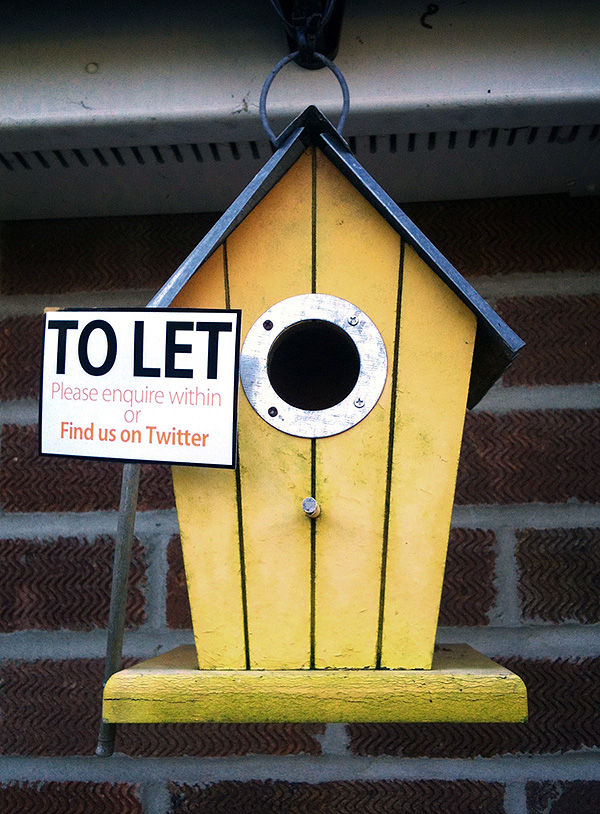
Fun picture: bird house to let

©Neil Turner. February 2012, Bournemouth

Completely staged photo opportunity this morning in Bournemouth…