Archive photo

Having a gutter mentality

OK so it’s a deliberately eye-catching headline and, unfortunately, this blog post is about composing photographs for use in newspapers and magazines rather than anything X-rated. In publishing the ‘gutter’ is the fold or join between the two pages across a spread. It might be pages two and three, four and five or any other combination through thirty-four and thirty-five to the end of the publication. As photographers we have to handle those spreads carefully because there is always a chance that a badly composed or laid out picture can lose a lot of its impact through an important detail disappearing into the gutter. Experienced photographers and thinking photographers always go out of their way to give designers as much flexibility as possible to use their pictures across a spread without losing those important details.

How the pictures look

Here is an example of an image and how it was used. It’s not the greatest picture that I have ever taken but it is a very good example for the purposes of teaching – something I’ve used this picture for many times. You can see where the gutter lies – halfway through and that there is a single column of text on either side of the cropped picture. The designer could easily have laid the page out with two columns of text in white on the darker background or two columns on either the left or right of the spread – they had plenty of choice. That, to a large extent, is because the photograph was shot with design in mind.

6-003

Space on either side of the image with interesting but unimportant detail makes this an ideal editorial photograph in terms of composition. It could even have been cropped to a single page vertical if the layout hd called for the. Arguably it would have been a shame, but that’s the way it sometimes goes. You’ll also notice that the designer has taken advantage of a large dark area within the image to run a headline. Purist photographers hate having their work used (and they’d argue abused) in this way but I am happy for it to happen as long as it doesn’t trample the important details that I have mentioned previously. Put simply, shooting pictures more loosely than you might otherwise do nearly always gives designers more options.

When I’m teaching editing and workflow to other photographers I often see them cropping their images to perfection. The fact that those crops rarely coincide with the shape of the page and the fact that even if they did coincide things often change is something that I spend a lot of time talking about. The only times you get to crop your images exactly how you want to see them are in a) your self-published book and b) your portfolio. Photographers that want to get used over and over again by the same clients provide options and that means a range of pictures many of which have a strong element of flexibility about them.

I absolutely love shooting for editorial clients. I also love working for corporate clients who like to use images in an editorial way. That means that I have to think about what the designers and sub-editors might want to do with my pictures every time I have the viewfinder to my eye. When I was first starting out that was one of the steeper learning curves – easily as tough as correctly exposing transparency film and focusing manual lenses. Twenty seven years on, it has become second nature.

Big soft light on the cheap

This technique example was originally posted on the ‘pre-blog’ in January 2009

A lot of portrait photography is done with large soft boxes or large umbrellas. The point there being that large light sources give a certain type of soft light that is reasonably flattering, nicely even and pretty good to work with. Bouncing a flash off of a big white wall gives a very similar effect to a large soft box which makes a big pale wall on location a very useful thing.

eaton-054

©Neil Turner, November 2008. Bournemouth, Dorset.

Shooting this portrait of a couple who met and fell in love in later life gave me a few challenges. The picture editor wanted them to be photographed on the beach in my home town of Bournemouth but the weather forecast for the late November morning wasn’t too promising. Having spoken to the couple we decided to head for a location which offered us plenty of parking right near the beach front as well as wide open expanses of sand. The plan was to shoot on the beach and head for one of the local cafes if the rain came. The same stretch of beach also has some covered seating areas, which were to prove very useful.

We started off shooting on the sand but moved pretty quickly under the covered area that you can see to the left. It was out of the wind and out of the rain that was looking likely. The theme for the picture was to be mildly romantic and the strong arch was likely to be useful.

I was shooting with a Canon EOS 50D and 16-35, 24-70 and 70-200 f2.8 L lenses. The lighting was a Lumedyne 200 watt/second pack and Signature head triggered with a pair of Pocket Wizards. The back wall of the covered area was painted with a very pale cream/lemon colour so I decided to bounce the flash off of it.

I mentioned above that the effect is similar to a large soft box and the area of wall illuminated by the flash was about four square metres (a little over ten square feet) which is a big soft light by anyone’s standard.

Looking at the brilliant LCD on the back of the camera after a couple of test shots, it was obvious that the colour of the wall was a little more yellow than was apparent to the naked eye. I shot a frame with a piece of white paper in the man’s hand so that I could do a custom white balance. The net effect of this was to send the daylight behind them and any areas lit by the ambient a little blue – not an unpleasant effect.It was clear that they were enjoying being photographed and were happy to indulge my usual technique of playing around with lenses, compositions, exposures and lighting positions.

I was trying to shoot with a wide lens under the cover and the shot that you see above was taken with my 16-35 f2.8L right at the 16mm end. I usually try to shoot at 200 ISO and the meter reading for the sand and sea behind the couple was 1/125th of a second at f5.6. I altered the output on the flash to give me f5.6 on the couple and changed the shutter speed to 1/180th to marginally underexpose the background. The available light reading on the couple would have been 1/30th at f5.6 so they were lit exclusively by the flash. I shot a lot of different images with similar compositions before changing over to a 70-200 f2.8L IS lens.

I moved my subjects so that they were leaning in the entrance just as the light outside was getting a bit better. By the time I shot the image below the shutter speed was up to 1/250th of a second but not really underexposing at all.

©Neil Turner

©Neil Turner, November 2008. Bournemouth, Dorset.

The ambient light was starting to affect the man’s head and you can see that he has a gentle blue highlight on top of his head. The light balance was just right for about two or three minutes before the ambient became brighter and I had to increase the power on the flash to maintain the balance.

After a few dozen frames we moved back onto the beach where we shot several more ideas. The magazine eventually ran a picture shot on the beach as the day turned brighter and it came towards midday. In the two pictures shown above I am looking almost due south where the midday sun would be. The second picture was taken only 45 minutes before noon and so the reasonably heavy cloud was a real help to make this picture work.

The whole shoot took a little over an hour and the edit took about the same amount of time before I sent the magazine around forty pictures.

Anniversaries

©TSL. July 2004. Nine years ago this week Canon delivered my first EOS1D MkII. I shot for the first time with it on a job where staff were using acupuncture in a Sussex school to help boys with their behaviour.

©TSL. July 2004. Nine years ago this week Canon delivered my first EOS1D MkII. I shot for the first time with it on a job where staff were using acupuncture in a Sussex school to help boys with their behaviour.

I woke up this morning to the headline news that it was Nelson Mandela’s 95th birthday. It is also my next-door-neighbour’s 50th birthday and my nephew’s partner is having her birthday celebration this evening as well. I started to think about things that had happened on (or near) this day over time in my life and I came up with a few:

  • 18th July 2012: I was working as a member of the Photo Operations team at the London 2012 Olympic and Paralympic games. I have written before about just how exciting, tiring, inspiring and memorable it was but with the first anniversary athletics event about to happen those memories are coming back as strongly as ever.
  • 18th July 2011: I was coming to the end of the very first cycle of the NCTJ Photojournalism course that I help to teach at Up To Speed in Bournemouth whilst shooting a wide range of both editorial and corporate commissions. That was also an exciting time but for very different reasons.
  • 18th July 2010: I was shooting mostly corporate photography and things were starting to go quiet for the summer months. Really quiet as it turned out.
  • 18th July 2008: I was still employed as a staff photographer at TSL and I spent the day shooting a lovely set of pictures at a school in Hertfordshire that had spent a small fortune making their new building and the grounds as environmentally friendly as possible. I was still unaware that two weeks later I’d be called into a meeting with the Editor and the HR Director to be told that they were making me redundant.
  • 18th July 2003: I had been using my Canon ESO1D cameras for over a year and I was in love. The CRW file format was something of a revaluation and I really enjoyed using it.
  • 18th July 1999: http://www.dg28.com had just been born – I started to publish samples of my work and a few bits of technique advice on my own website for the first time.
  • 18th July 1997: I was starting to experiment with borrowed and rented digital cameras before getting my own DCS520 in late October 1998.
  • 18th July 1995: A month previously I got my own scanner (Kodak RFS2035) and Mac laptop (Powerbook 160c) with Photoshop (v2.5) and began the long journey to digitisation
  • 18th July 1994: Having become a staff photographer at The Times Supplements in January 1994 I had just swapped from shooting with Nikon F4s to Canon EOS1n cameras.
  • 18th July 1993: Life was fun, fast and decidedly unpredictable. One day I would be shooting for a newspaper and the next it was a glossy magazine. On the third day it might be a PR job and you could lay money down that every week would be different from the last. I was shooting with a mixture of Nikon F4, F801 and FM2 cameras as well as having Leica M6s. Some days it would be black and white and some days it would be colour transparency. Some days I’d be using lights and others required nothing more than a fast lens.
  • 18th July 1983: I was working for Jessops when they only had five shops, offered great deals and great service and everyone knew the Jessop family. I was using Olympus OM1n cameras at the time and had acquired an awesome 35mm f2 Zuiko lens.

My career has (so far) failed to stand still for more than a couple of years. Technology changes, my employment status changes and I change. All of that adds up to excitement and that triggers a feeling of keeping it fresh. My style constantly evolves and the client base also evolves. A lot of my colleagues spend a lot of time bemoaning the disappearance of the ‘good old days’ and I am also prone to a bit of nostalgia but we are where we are and just under five years ago I wrote this line:

“It’s an exciting time to be a photographer with new challenges being presented every month and I am on record as saying that I am a very lucky man to be doing what I do.”

Today I’m shooting a nice mixture of editorial and corporate work as well as doing some teaching, writing and consultancy. I spend a lot more time on the beach and I’m constantly looking forward to the next exciting development… whatever that turns out to be!

Editorial portraits folio

Like most photographers I’m always looking at new ways of showing my portfolio. I’ve saved the presentation version of my editorial portraits folio as a QuickTime movie and posted it here. Please let me know what you think. If you look at it without going for the full-sized version the captions are a bit small but, apart from that, I quite like it!

Headteachers or whatever you want to call them…

Almost everyone remembers their head teacher. If they don’t then they will probably remember the Principal, Headmistress, Headmaster, High Master, High Mistress, Direktor or whatever other title the person who led their schools went by. Since 1986 I have photographed hundreds of these people and I have made the journey from being a little bit scared of them through accepting them to being impressed by the work that they do and the huge difference that their being good at their job makes to children and young adults.

I decided to put together a slideshow of some of the headteacher portraits that I have done. Most of the portraits date back to my time at The Times Educational Supplement. I also made the decision to keep them anonymous – I just wanted to show how different they are yet how much they have in common. Some of the Heads featured in this selection are famous in the world of education and one or two have been made Knights or Dames for their services to education. A few have since retired but that doesn’t matter. I don’t want to suggest that the person in charge is the only reason that some schools are better than others but I have yet to visit a successful school that doesn’t have first rate leadership.


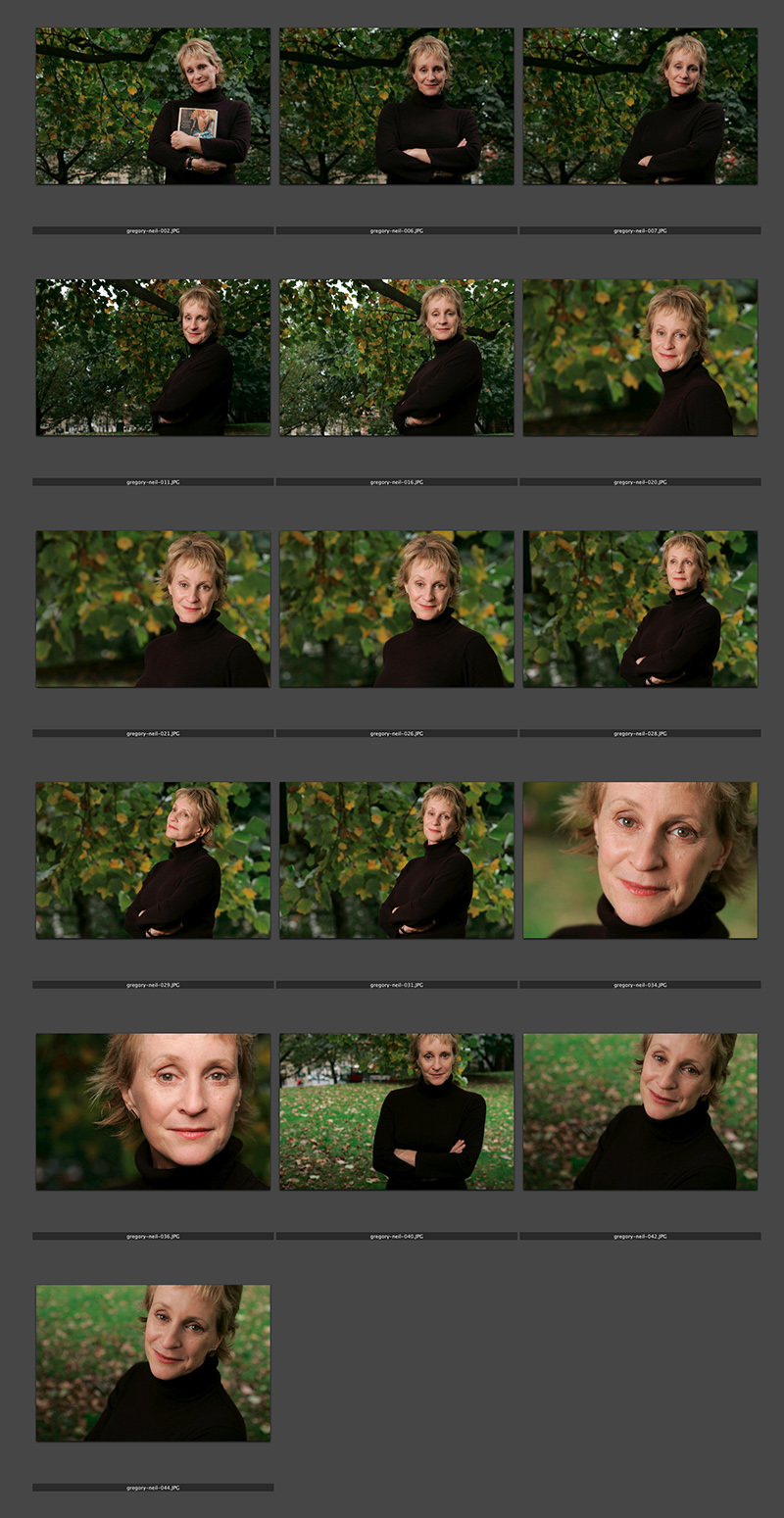
Philippa Gregory – the contact sheet

© Neil Turner/TSL. Philippa Gregory, October 2004

© Neil Turner/TSL. Philippa Gregory, October 2004

I haven’t done one of these contact sheets for a long time and I thought that this set was an interesting example. I submitted this set of sixteen pictures and they are all landscape in orientation. That’s because the slot they were shot for was across two pages and always a squarish landscape image. As I said in the previous post, the whole thing was done in ten minutes on a dull Autumn (fall) day in Hyde Park. That time included setting up and breaking down the Lumedyne light and chatting to the subject. Note that she is clutching her novel in the opening frame. I find that it’s always a good idea to do that if their publicist insists so that you can then go on to get the pictures that will actually get used.

Saving an author’s life

This is not a claim to any act of great heroism, it’s not even a particularly accurate heading but I’ve been wanting to tell more ‘stories behind the pictures’ for quite a while and I’ve decided to give them all pretty eye-catching headlines. This portrait of the author Philippa Gregory has a story behind it that I have enjoyed telling many times over the years since I took it in 2004.

©Neil Turner/TSL. Philippa Gergory, October 2004.

©Neil Turner/TSL. Philippa Gergory, October 2004.

I was shooting a lot of portraits of authors and academics at the time and I was given the job of meeting Philippa Gregory who had just written “The Other Boleyn Girl” and shooting her portrait to accompany an  interview in one of the magazines that I worked for. No problem, run of the mill? Well… yes and no. The location that I was given was rapidly becoming an issue.

Let me explain: in the three or four years leading up to this particular job I had been sent to shoot three portraits of authors at a particular hotel in central London favoured by one or two publishers as a place for them to stay if they needed a hotel or as a great place to hire a private room for interviews and photography when they were on the publicity trail promoting new books. Once again, pretty run of the mill stuff. Except. Except the three previous subjects that I had shot at this particular venue had all died within a few months of having their picture taken by me. I’m not superstitious. I live at No13 and I couldn’t care less about black cats crossing my path. I have a healthy respect for ladders and I try to avoid blindly walking under them – that’s a mixture of common sense and the fact that my Father once dropped some turpentine on me when he was painting our house when I was about six or seven years old. Superstitious I am not but I did have a 100% record of people that I photographed at this hotel being dead pretty shortly after having their picture taken.

This presented me with a few issues.

  1. I didn’t know how well I would be able to put the idea of another ex-author on my hands when shooting if I decided to ignore what was rapidly becoming a curse.
  2. If I wanted to go elsewhere, how was I going to explain that idea in mid-October to the author and her publicist?
  3. Where else could I go and how far should I be away from the hotel to avoid worrying?
  4. What would the reporter who was doing the interview think?

Driving to the location I decided to try my best to get the subject away from the hotel. Hyde Park was only a couple of hundred yards away and  it shouldn’t be too tough to get her to cross four lanes of fast moving traffic in heels just to have her picture taken under the trees. Well, I arrived nice and early and I spoke to the publicist about atmosphere and about getting a picture that nobody else was going to get. I laid on what little charm I have and we agreed that a short walk (using the underpass rather than running across the road) was going to be OK. I got in before the interview, Philippa Gregory seemed happy to get some fresh air and we had ten productive minutes under some trees shooting a pleasant set of portraits. I even delivered her safely back to the hotel-of-doom in time for the interviewer to do her bit.

Now I’m not claiming to have actually saved the author’s life as such. I don’t even believe in curses or even in extended coincidence and the real truth is that all three of the authors that died were in their late 80s and 90s when I took their pictures. I was telling this story to an author’s agent the other day and she asked me what I would do if I was sent back to the same hotel to photograph an elderly author who was, for argument’s sake, wheelchair bound and it was a day when it was bitterly cold? Tough question…

For those amongst you who always want to know about gear and settings:

  • Canon EOS1D MkII with a 70-200 f2.8L IS lens at 145mm 
  • 1/22nd of a second at f5.6 on 100 ISO
  • Lumedyne Signature Series flash kit with 32″x24″ Chimera Softbox

People in the news bringing back memories

©Neil Turner/TSL. Hilary Mantel, January 2007.

©Neil Turner/TSL. Hilary Mantel, January 2007.

I seem to have a very strong memory for where, when and why I photographed people in the past. When names come up in the news I often think “ah yeah I shot them at such and such a place”. Hilary Mantel, double Booker Prize winning author has been in the news a lot this week. She gave a lecture where she commented on the Duchess of Cambridge and in comparing her to the late Princess Diana (the Mother-in-Law she never knew) called her “precision-made, machine-made, so different from Diana whose human awkwardness and emotional incontinence showed in her every gesture.” The lecture was long and talked of many things but the reactions against Hilary Mantel’s views were both harsh and often mistaken.

This made me wonder if my view of the situation and the criticism is in any way tainted by having met her, by having admired her books and by actually listening to what she said when I watched the extended highlights of the lecture on YouTube. Of course I cannot really be sure but my memory of meeting Ms Mantel is pretty strong. I can remember her apartment and I can remember her hospitality. I can remember her reluctance to have her picture taken and having spent a lot of time chatting before ever getting a camera out of its bag. I can even remember getting to the location with a lot of time to spare and I can even remember the chat that I had with a chap walking his dog along the street where I parked up and waited in the chilly January air.

Without having much to say, I thought that I’d share my favourite frame from the job. It was shot in colour like the rest of the set but I felt the need to convert it to black and white and submitted two versions to the Picture Editor. I wasn’t surprised when they ran it in colour but I have a very strong memory of being mightily disappointed.

For the many techies who read my blog, it was shot on a Canon EOS1D MkII with a Canon 70-200 f2.8L IS lens at 1/250th of a second at f4.5 on 100 ISO. It was lit with a Lumedyne flash with a shoot-through translucent white umbrella deliberately set up to lose as much of the ambient light as possible.