black and white

Twenty-five years ago today

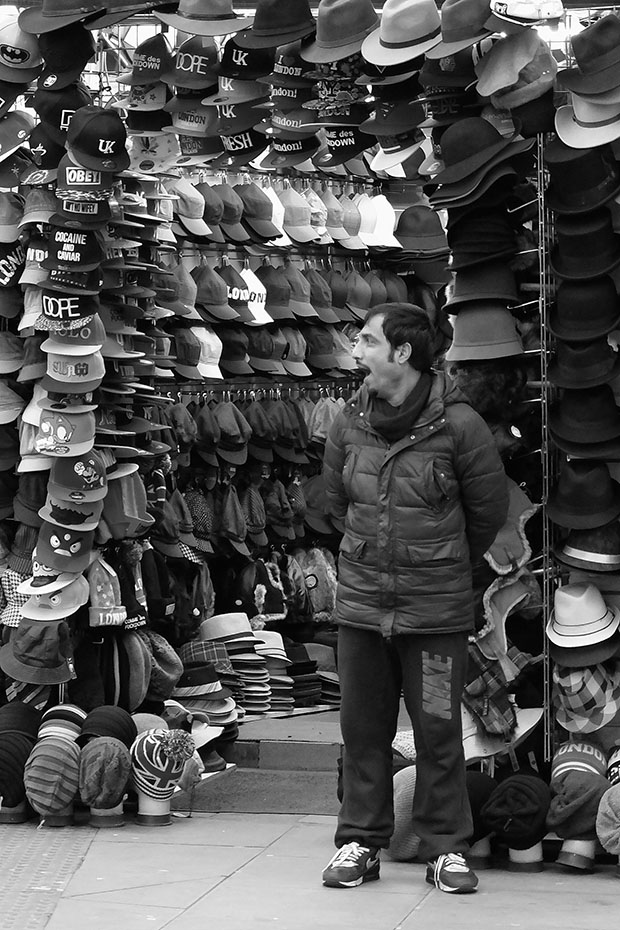
©Neil Turner, 13th February 1990. Whitecross Street Market, London EC1.

©Neil Turner, 13th February 1990. Whitecross Street Market, London EC1.

Over the last few years I’ve posted a few pictures from my own filing cabinet when they have had some relevance or when there is a specific anniversary. This picture was taken twenty-five years ago today as I went for one of my regular wanders around bits of London that were near Metro – the 24 hour laboratory where we all got our E6 transparency film processed. It was about a mile and a half from our Hoxton office (before it was trendy) and it took about twenty minutes to walk there or five minutes to drive. Sometimes there would be other photographers around and we would adjourn to a local cafe for a cup of something and a sandwich and at other times I’d take myself off for a walk around one of the many fascinating side roads and markets that made up the Clerkenwell/Farringdon/Smithfield area and take a few personal and/or stock pictures whilst the film made its hour and three quarter journey through the system and the ‘soup’ at Metro.

On this particular day I went to Whitecross Street with a couple of cameras and a couple of rolls of Kodak Tri-X film. It is amazing what you remember when you start to think about a day and a place and my memory of this day is that I was half an hour into the walk when I bumped into another photographer (there were three or four agencies close by) and we had a coffee anyway!

The man in the photograph (who said his name was Frank but I’m not sure he was being 100% honest judging by the cheeky look in his eye) had been a stall holder at the market selling books and a few magazines for many years. Trade was brisk as the workers from the many offices on the edge of the City of London were having their lunch hours and I didn’t really finish my conversation with him.

Anyway, another ‘archive’ picture that brings back happy memories and brings a smile to my face. This was, quite literally, half of my lifetime ago and I still love the photograph.

Techie stuff: Nikon FM2 camera with a 135mm f2 Nikkor, Kodak Tri-x film.
Electronic viewfinders and me

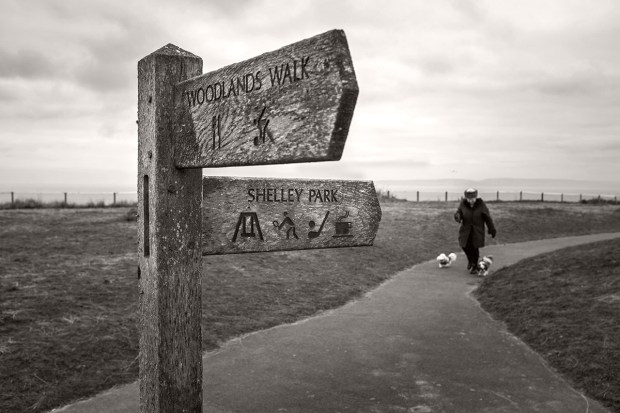
©Neil Turner, February 2015. The cliff tops at Boscombe on a dull winter's day.

©Neil Turner, February 2015. The cliff tops at Boscombe on a dull winter’s day.

A few months ago a colleague whose work I know and love said that it took him a little while to get used to electronic viewfinders and now that he has been using them for a while he cannot remember why he had been so resistant to them in the first place. Resistant to electronic viewfinders? That summed up my attitude until a couple of weeks ago too. After carrying my beloved Fujifilm X20 around with me I decided that it was time to give an X100S a run out. The lack of a zoom lens and the small jump in size and weight is compensated for by a big increase in the higher ISO quality (which isn’t to be sniffed at during the winter time) and a few more megapixels (allowing a bit of judicious cropping here and there) and so for the last few weeks I have been shooting my personal work with the X100S. The idea hit me that now I had the option of using the electronic viewfinder (to be known as the EVF from here on in) instead of the optical viewfinder (known from here as the OVF) and that’s what I started to do.

For the first few days I was getting annoyed by the EVF to the extent that I had to have a few days off from it. During that time I shot some photographs that I really liked and I had to force myself back to using the EVF with something of a heavy heart. That was just over a week ago and I am now really pleased to announce that I have got the hang of shooting using an EVF. Welcome to the twenty-teens, welcome to the world of the EVF enthusiast and welcome to a wide world of possibilities I hear some of you saying. Not quite.

The current situation is that I am perfectly capable of shooting with an EVF and that I can see why some photographers have made the switch but not me. I still prefer the OVF to the extent that I don’t want to use the electronic version and to the extent that the kind of work that I have been doing with my Fujifilm cameras isn’t as fulfilling without the old-school optical set up. If I were tempted to buy a Fujifilm XE-2 or an XT-1 I’d have to forego one of the main pleasures that I derive from using kit that, despite some huge flaws, makes me want to go and just shoot pictures.

I’m not going to tell all of the EVF enthusiasts I know that they are wrong but I am now in a position where my choice to carry on using OVFs and DSLRs is made from knowledge and not from ignorance. There, I’ve said it.

Late November afternoon in the park

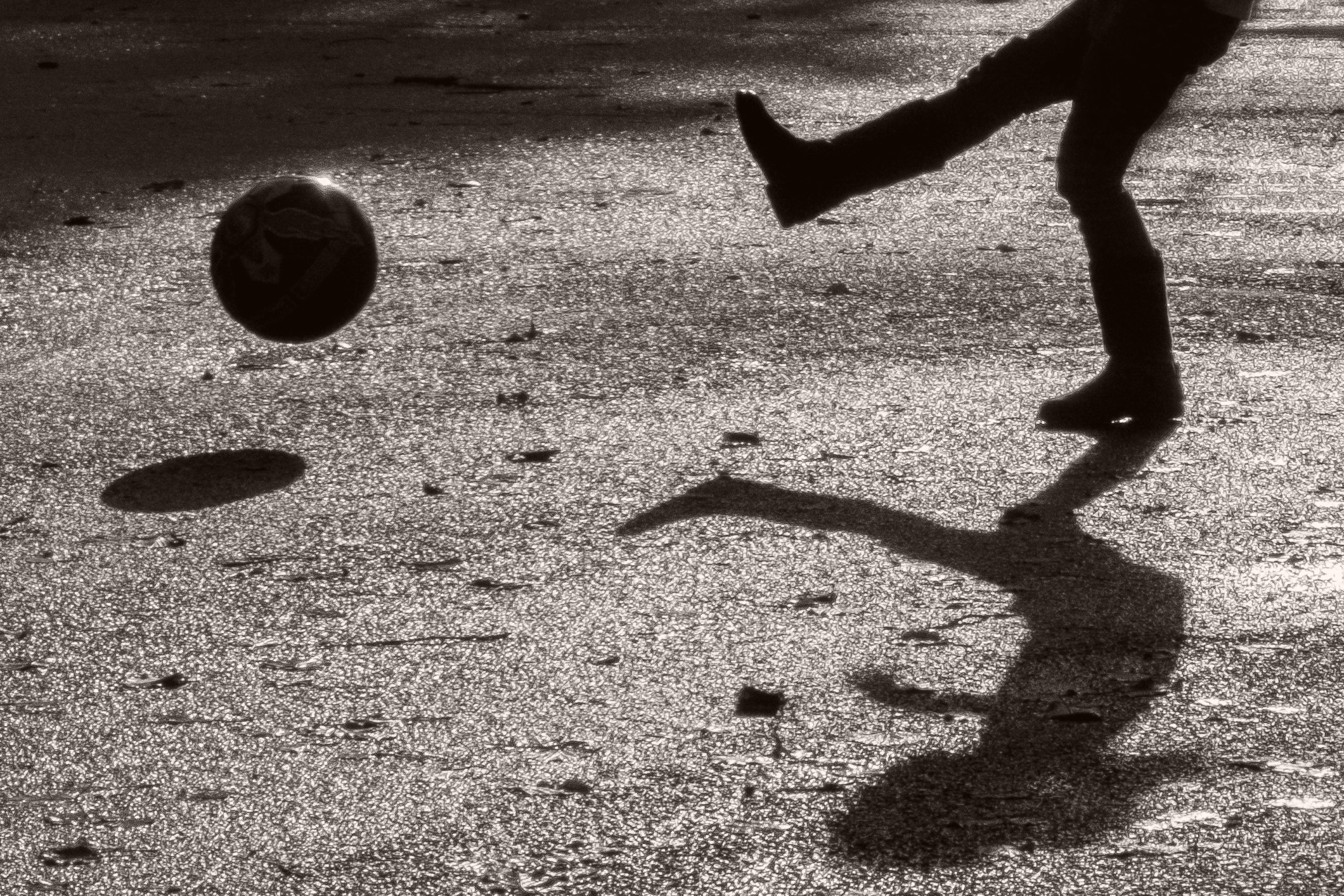
©Neil Turner, November 2014. Playing football in the  park.

©Neil Turner, November 2014. Playing football in the park.

This is just another of those “just because I like it” photographs that I have added to my personal work folio on my Pixelrights account. The family had been out to breakfast and we went to the park for the youngest members to have a run around. I had my Fujifilm X20 with me and shot a few frames including this one.

For the technically curious amongst you, the black and white conversion was done in Photoshop with a 5% red layer added to the desaturated sRGB file to give it more body and depth.

Five day black & white challenge

©Neil Turner, November 2014. A young woman jogs along the promenade near Portman Ravine in Bournemouth with a child in a pushchair.

©Neil Turner, November 2014. A young woman jogs along the promenade near Portman Ravine in Bournemouth with a child in a pushchair.

A couple of weeks ago I was nominated by another photographer to take part in a Facebook Five Day Black & White Challenge. The idea was simple: to post a new black and white photo every day for five days. I have to admit that I was a bit reticent at first and posted pictures that I’d already taken in the previous few weeks. Then someone mentioned that they found the discipline of having to go out every day and shoot something new invigorating and so I started the challenge over again and shot specifically for it every day. My second challenge ended yesterday but it wasn’t until I was out shooting again today that I remembered that the challenge was over. What to do with the pictures from day six? The answer was to post the chosen frame to Facebook anyway and then to post it here too – as another “just because I like it” frame.

Technical stuff: Canon EOS6D with a 28mm f1.8 EF lens (cropped slightly). 160 ISO and 1/1250th of a second at f11 RAW file converted and desaturated using Adobe Camera RAW CC 2014 with a 5% bronze tint added.

After the storm

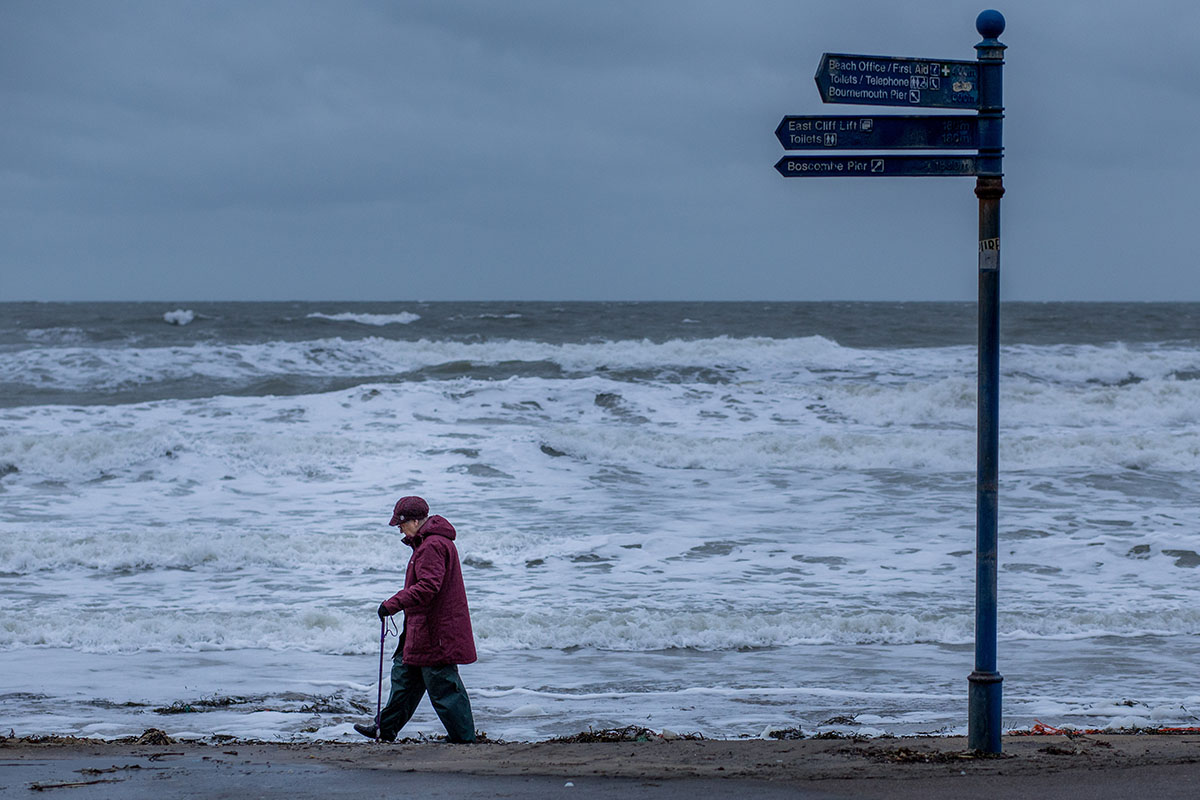
©Neil Turner, November 2014. A pensioner walks along the beach near Bournemouth Pier.

©Neil Turner, November 2014. A pensioner walks along the beach near Bournemouth Pier.

Following on from my post about zoom and prime lenses I was out with just the primes yesterday – walking along one of my favourite bits of beach in wild winds and failing light. I was just out having some photographic time before getting into the car for yet another drive up the M3 for work. This one was shot at 640 ISO at 1/1000th of a second at f4 with an 85mm f1.8 Canon EF lens on my rather lovely little Canon EOS6D – a camera that I am becoming increasingly fond of. When I’m doing personal work like this I tend to set the white balance to daylight and accept whatever colour cast I get and in this case it wasn’t far off of what the naked eye saw.

You learn something new every day

It is one of the universal truths of photography that you never stop learning. Almost every time you pick a camera up something happens that you squirrel away in your memory banks that will make a difference to how you shoot something else at some time in the future. Normally these are small things but this week I was shooting the wonderful Talvin Singh performing at an arts festival and something happened that made me scratch my head because I’d never experienced anything quite like it.

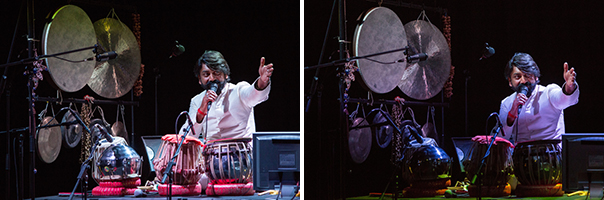
©Neil Turner, October 2104

©Neil Turner, October 2014

The two pictures above were taken within a fraction of a second of one another under ‘exactly’ the same lighting without flash and with identical settings (manual everything apart from focus) on the same camera with the same lens and have been processed through Adobe Camera RAW identically. So why are they different? The answer seems to be LED stage lighting. You might conclude that both pictures are ‘quite nice’ and move on but that’s not really an answer when you are shooting something that has a moment that you absolutely have to capture. I’ve had issues with un-balasted HMI lighting and of course strip lights but this was in another ‘issues league’ entirely.

It appears that these brand new lights installed in a state-of-the-art theatre are an absolute nightmare for stills photography. Now that I’ve experienced this, I have been reading up on it and it seems to be a known phenomenon where the lights cycle between the red, green and blue LEDs in the light at a speed that the human eye chooses not to detect but that a camera shooting at shutter speeds of 1/125th of a second or higher has a real problem with. The higher you go, the worse it gets. Of course you could shoot at 1/60th of a second and all would be reasonably well – apart from any movement being a little/lot blurred.

Being a complete anorak I decided to shoot a series of tests at an even higher shutter speed (having first racked the ISO up a way) to see what happened:

©Neil Turner, October 2014

©Neil Turner, October 2014

That makes shooting under these lights at the kind of shutter seeds you need to freeze action nigh on impossible. Once I had realised that there was an issue I dropped down to 1/100th of a second and then to 1/80th and shot lots of frames. The first five frames above were shot at 1/400th and the last one was at 1/100th – what a difference.

Most of what I have read about LED stage lights concerns white balancing – well that was the least of my worries here. It was almost as if shooting with shutter speeds in excess of the cameras maximum flash synch speed (the highest speed at which the entire chip is exposed at the same moment) was part of the problem. The LED stage lights in this theatre were effectively pulsing or flashing and the only way to get a consistent image was to work with that pulsing and use shutter speeds below the maximum flash synch. I have read something on what appeared to be a well-infomed website which implies that this only happens when the lights are dimmed – which makes some sense. I haven’t got enough experience with this to work out whether the speed thing is a coincidence or whether it is directly related but I now know how to shoot in this one venue with these lights.

Shooting with shutter speeds that are a long way below “ideal” some of my pictures were sharp and many weren’t – but the job got done. Constant reference to the screen on the back of the camera is frowned on by a lot of people but this case proves that there are times when it is exactly the right thing to do. Imagine having had to shoot this on film with no LCD…

Presumably more and more theatres and venues will use these lights and the problem will grow. Maybe there’s a solution out there already?

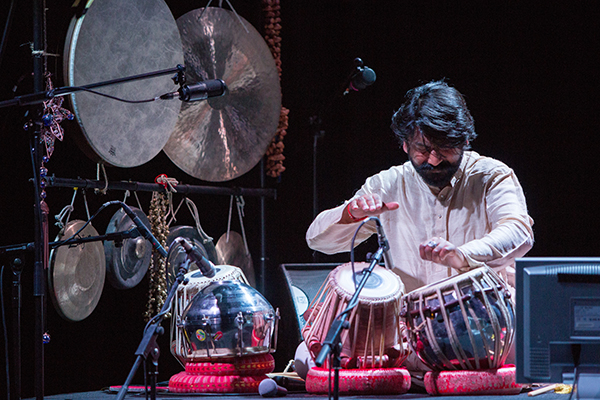
©Neil Turner, October 2014.

©Neil Turner, October 2014.

Techie stuff: Canon EOS5D MkIII with a 70-200 f2.8L IS Canon lens. 1/100th of a second at f3.2 on 2000 ISO. WB set to daylight but adjusted in Adobe Camera RAW removing quite a bit of magenta and adding a small amount of yellow.

Tonality – the black & white conversion app

Screen grab from Tonality 1.1.1

Screen grab from Tonality 1.1.1

I was intrigued by a recommendation that I read from a colleague for Tonality. I rarely go outside Adobe Camera RAW these days, even for black and white conversions, but I was tempted to have a go at something new and so I went to the Apple App Store and bought it. After a few attempts at fiddling with it I dismissed it as a very interesting application that I would master one day when I had the time. A few days ago I was asked by a client to convert a lot of images supplied to them as colour Jpegs into mono Jpegs with a slight tone over them. In the past I would have gone straight back to the RAW files and started again but I had the idea of giving Tonality a go.

Like so many of the corporate jobs I shoot, the client would rather I didn’t show they images on my personal blog and so I grabbed some other interesting pictures from my ongoing personal work and applied the same sort of presets to them. It had taken me less than five minutes to become familiar with the sliders and controls and probably another five minutes to create the ideal and very subtle split toning effect that the client had been asking for. The two versions of a photograph taken on the beach at Bournemouth that you see below were a quick test for this blog post. The colour image is a Jpeg converted from a Fujifilm X20 RAW file in Adobe Camera RAW and the black and white version underneath was converted into black and white using the “adaptive exposure” auto setting in Tonality from that Jpeg.

©Neil Turner, September 2014. Bournemouth.

©Neil Turner, September 2014. Bournemouth.

©Neil Turner, September 2014. Bournemouth.

©Neil Turner, September 2014. Bournemouth.


I don’t know what you think but I am really impressed by the job that the auto has done and, whilst I could fiddle and get it even better, I am more than happy with it. I can hear you saying that this is also easy to do in Photoshop (and quite a few other apps and plug-ins) but the point is that it was done in Tonality and it was really easy. The application is capable of a lot of good stuff as well as a lot more completely over the top special effects that I wouldn’t touch with a barge pole.

When I get more time, I’m going to get right under the skin of this application. Until then, it will be used on my personal project work. If a client asks for toned mono images again, I will definitely look as using Tonality for that too.

The UK price is £13.99 – which is a little bit dearer than most Apps that I would buy just to have a play. It’s a very simple app that achieves its goals.

Out Walking

Ever since I started using the EyeEm photo sharing site I have been trying to shoot more pictures “just for the fun of it”. The platform allows you to add your pictures to albums and one of my favourites is entitled “Out Walking”. I often shoot with my Fujifilm X20 with and Eye-Fi card in it, convert the RAW fils to Jpeg using the neat film simulation modes before uploading them to my iPhone and going through the process I described in my Eye-Fi Workflow post a week or so ago. I also vowed a while ago to get better at black and white. I’m not sure that’s going quite so well but I often combine the two. It’s great fun and even mildly addictive!

Anyway, for no other reason that I want to share them, here are some of the images.

© Neil Turner, January 2014. Man holding sign offering tattoos an tattoo removal touts for business on the pavement just outside one of main areas of Camden Market

© Neil Turner, January 2014. Man holding sign offering tattoos an tattoo removal touts for business on the pavement just outside one of main areas of Camden Market

© Neil Turner January 2014. Cold and bored stall-holder selling keep calm t-shirts at Camden Market.

© Neil Turner January 2014. Cold and bored stall-holder selling keep calm t-shirts at Camden Market.

© Neil Turner, January 2014. Bored shop keeper outside his open hat shop just outside one of main areas of Camden Market

© Neil Turner, January 2014. Bored shop keeper outside his open hat shop just outside one of main areas of Camden Market