Neil

Zooming with your…

©Neil Turner/Bupa 10,000. May 2015. A Police rider accompanies a detachments of Guards as they march back their barracks.

©Neil Turner/Bupa 10,000. May 2015.
A Police rider accompanies a detachments of Guards as they march back their barracks.

I was on a job the other day, standing next to a very young photographer in a ‘press pen’. He glanced over at the gear I was using and mentioned how much he would love to own the 135mm f2L lens that I had on one of my cameras. He said that he had never really got the hang of “zooming with his feet” in the way that so many of the photographers he admired had advised. He had also had it drummed into him by one of his tutors at college and it had left him wondering if he was doing something wrong.

Zooming with your feet is a great concept and it is one of the catchphrases in contemporary photography that appears to be beyond question. But is it? Is it actually as much a cliche as a universal truth?

There we were on a job where we couldn’t have zoomed with our feet even if either of us had the skills to do so. We couldn’t go forward – there was a metal barrier in the way. We couldn’t go backwards because there were other photographers and a couple of TV crews behind us – and behind them was another barrier. We had a tiny amount of sideways movement if we could change places with each other but, apart from that, we were in a very fixed position. (more…)

Reliance on the internet

As photographers we have got used to using a range of web-based technologies to deliver our work to our clients. Most of the time it works and nobody notices how amazing these technologies are. Over the years we have come to expect more and more in terms of bandwidth and speed and we have come to rely on getting good connections to easily accomplish what would have been regarded as time-sensitive alchemy only a few years ago.

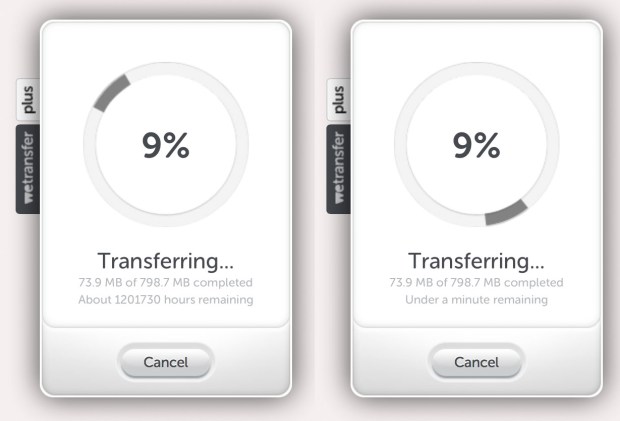
On an overseas job last week the client wanted a lot of high resolution Jpegs delivered to them very quickly and their chosen method was WeTransfer. It’s a very good and reliable system in itself but it depends on a half decent internet connection. Sadly we didn’t get that connection and out of sheer frustration I did these screen grabs:

wetransfer

Yes that’s right: one million, two hundred and one thousand, seven hundred and thirty hours to complete a transfer that should have taken about half an hour on a half decent network. In case you are interested that is fifty thousand and seventy-two days or one hundred and thirty-seven years and sixty-five days. A bit slow. The second screen grab says less than a minute but that was also wildly inaccurate as no further data moved.

In the end I had to abandon the ethernet and wifi networks that the client had arranged for us to use and head outside where I could pick up a great 4G mobile signal by tethering to my iPhone and use my roaming package to send the pictures – which took about 44 minutes (by then I had 1.2Gb of pictures). The point here is that now we have come to reply on the internet for almost all of our image delivery it has become crucial that we have multiple ways of connecting to the internet.

Quiet documentary image

©Neil Turner, January 2015. Flowers and a memorial plaque to four local surfers on Boscombe Pier.

©Neil Turner, January 2015. Flowers and a memorial plaque to four local surfers on Boscombe Pier.

The light on the beach is almost always interesting and whilst out walking this morning I shot a few frames of a small bunch of flowers tucked behind a memorial plaque to four young local surfers on Boscombe Pier. I guess that I would call this a documentary image and it is yet another different way for me to shoot a beach picture. For me the photograph is a great deal stronger for having the back of the gentleman in the frame.

Tech stuff: Fujifilm X100S, 1/170th of a second at f11 on 320 ISO. RAW file processed through Adobe Camera RAW in Photoshop CC2014.

Not the DSLR, I’m having fun

© Neil Turner, March 2014. Shadows on the pavement as a pedestrian passes along Tottenham Court Road.

© Neil Turner, March 2014. Shadows on the pavement as a pedestrian passes along Tottenham Court Road.

Question: Why are so many professional photographers using mirrorless cameras, micro 4/3rds format cameras and experimenting with pretty much anything that isn’t a DSLR?

It’s a tough question and without conducting some sort of major survey I can only give an answer based on my own experiences and those of close friends and colleagues. DSLRs have been my main cameras for over sixteen years now and they have become an extension of me when I’m working. They do what I need them to do with no real fuss, the quality has moved from “acceptable” back in 1998 to “extremely good” and they allow me to do the day job without having to worry about my gear very much. But, and there’s always a ‘but’ – they have become a little bit boring and little bit ‘too good’.

When I’m shooting pictures for the joy of it (and despite doing this for a living since 1986 I still do that) I want to feel something different. Elegant competence isn’t enough any more. (more…)

Another ‘classic’ technique posting from the old site

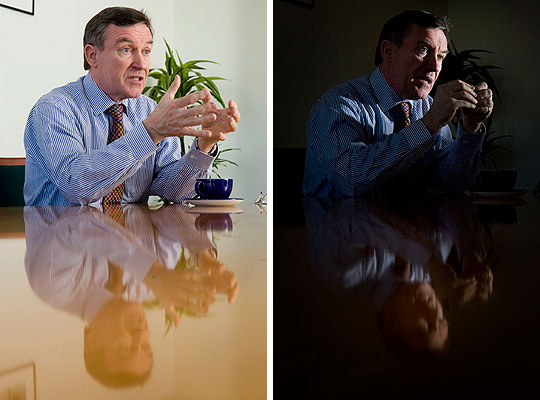
The idea here is to have two separate lighting set-ups for one interview portrait without having to constantly move around the room adjusting lights. This interview was with a senior businessman who chairs a body that decides how much teachers’ pay rises will be each year. The reporter wasn’t all that comfortable with me shooting through the interview but it was what the picture editor wanted, so that’s what I did. This job required a bit of quick thinking so that I could get two different set-ups in place.
©Neil Turner/TSL, April 2008.

©Neil Turner/TSL, April 2008.

The picture on the left was lit using a single Lumedyne head at 50 joules bounced off of a wall almost in front of the subject. The image on the right was lit by a single Canon 550ex flash gun with a Honl Photo snoot attached aimed directly at the subjects face and set further away from the camera.

Both flash units were fitted with Pocket Wizard receivers set on different channels from each other. The idea here is that by simply switching between channels on the transmitters I could switch between two very different lighting styles without moving.

The left hand image is far more evenly lit. The large expanse of off-white wall made a very good and large light source. The exposure here was 1/60th of a second at f5.6 on ISO200. There was some available light play – without flash the scene would have been two stops under exposed with that amount of flash. You can see from the diagram below how the room was laid out and the flash head was positioned at about 10 degrees above the subjects eyeline.

The right hand image is far more starkly lit. The exposure was 1/250th of a second at f13 on ISO 200. There is almost no available light in this picture and the lighting effect is dramatically different. The very narrow angle of the light offered by the Honl snoot makes it difficult to always get the subject right in the centre of the small pool of light and so you need to be careful when aiming it to centre it on where the subject is most likely to be.
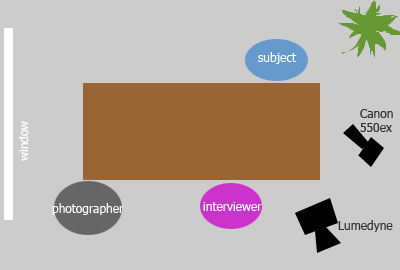
The layout of small conference room where the interview took place.

The layout of small conference room where the interview took place.

The point of this technique is that you can arrange more than one style of lighting and then switch between them at will simply by selecting a different channel on the trigger. I find that I use the Honl snoot a lot more than I had imagined that I would. It fits into a bag very easily and it is simple to use. When you are in complete control of the lighting, it’s very easy to achieve dramatic results. This style of light might not be to every picture editor’s taste and so the evenly lit alternative is a very good idea.

After the storm

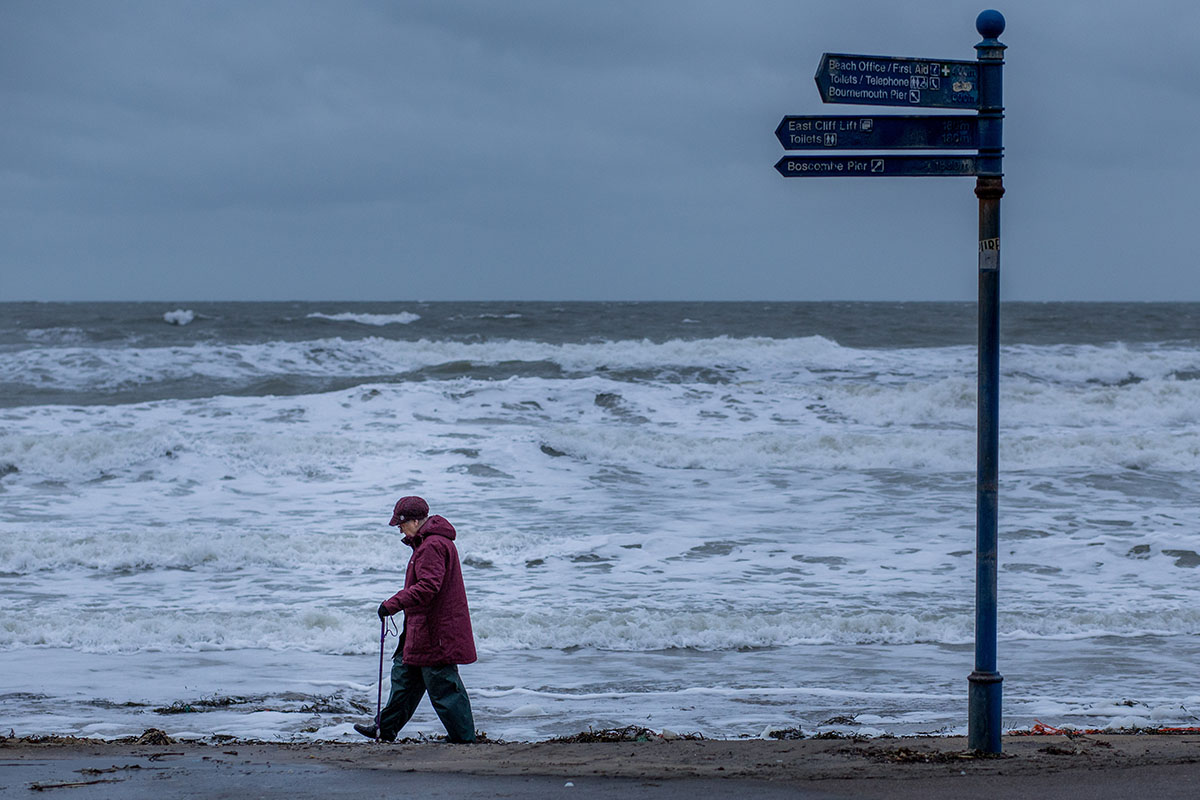
©Neil Turner, November 2014. A pensioner walks along the beach near Bournemouth Pier.

©Neil Turner, November 2014. A pensioner walks along the beach near Bournemouth Pier.

Following on from my post about zoom and prime lenses I was out with just the primes yesterday – walking along one of my favourite bits of beach in wild winds and failing light. I was just out having some photographic time before getting into the car for yet another drive up the M3 for work. This one was shot at 640 ISO at 1/1000th of a second at f4 with an 85mm f1.8 Canon EF lens on my rather lovely little Canon EOS6D – a camera that I am becoming increasingly fond of. When I’m doing personal work like this I tend to set the white balance to daylight and accept whatever colour cast I get and in this case it wasn’t far off of what the naked eye saw.

Three important things

Many, many years ago I started to post technique examples and opinions on my website. By 2002 I had about fifty articles on the site and over the last couple of years I have been recycling many of them because I still thank that they are worth reading. None of it is unique wisdom and much of it can be found in the form of YouTube videos by other people. I like to think that I was marginally ahead of the curve back then at least. Here is one of my favourites…

There are many things that help make a great photograph – a good photographer, the right equipment and luck can all play a part but there are three things that, in different proportions, are absolutely essential.

  1. Light: Possibly the most important element to making an ordinary photograph into a good one.
  2. Composition: Getting all the right elements in the right places.
  3. Subject Matter: It’s true that what you are photographing can very easily make the difference between good, very good and great pictures.

Light: You not only need the right quantity of light, but the right quality and direction of the light are vital too.

  • Too much light can be just as much of a problem as too little. A picture that relies on shallow a depth of field for it’s impact will be hard to achieve if there is too much light to work with wide open lens. Of course if there is too little light to freeze the action when that’s vital to the picture, that’s also a problem.
  • Many pictures rely on hard shadows and extreme contrast for their effect and others need even and soft light to make the photograph work.
  • What direction the light is coming from in relation to the subject matter is important. Strong backlight will be perfect for some subjects and ninety degree side light will do it for others.

Composition. Whatever else is going on in the picture, this is the element of the total package over which you have the most control.

  • What lens you use is an absolutely critical decision to take in terms of the composition. What you can see through the viewfinder is utterly controlled by this decision.
  • Where you position yourself in relation to the subject is another crucial decision.
  • Confusion is the greatest enemy of clarity! How successful you are in keeping extraneous details out of the photograph has an enormous bearing on the final result.

Subject Matter: All great photographs tell their own story, and that’s just as true for a product shot of ball bearings as it is for Pulitzer prize winning documentary images.

  • If what you are photographing tells it’s own story, then you need to strip the content down so that the story isn’t confused.
  • Some things aren’t that interesting, so you need to add content. Telling the story sometimes requires the photographer to set the context.
  • Photographs don’t always need to be great art. Sometimes subject matter is all, and nothing else matters. If there is only one picture of a vital news event and it’s out of focus and taken from video it may well qualify as a great picture.

Three elements that go together to make great pictures. Sometimes light takes the lead and other times the composition is the most important. It doesn’t matter if one element is dominant, but photographs where all three are well balanced and well done then the image is guaranteed to be a winner.

There is, however, one extra element that you can’t legislate for. Magic. Like many things in photography, you know it when you see it but you cannot measure it or define it. Well composed and lit pictures that have great subject matter are (relatively) easy to come by, but once in a while they have magic too.

Shadows

© Neil Turner, July 2014. Shadows on the south bank of the River Thames in London.

© Neil Turner, July 2014. Shadows on the south bank of the River Thames in London.

On my way to a meeting today walking along the south bank of the River Thames I was taken by the quality of the light as it formed shadows through the trees. A pair of office workers out for a stroll stopped and had a chat and we passed a very pleasant few minutes talking about light and London. The conversation was interrupted a few times as people strolled through my composition and I grabbed a frame or two. This was my favourite of maybe a dozen very similar frames.

Another picture shot on my Fujifilm X20 and added to the blog just because I liked it…