photojournalist

So here it is… merry Christmas

©Neil Turner, 2013.

©Neil Turner, 2013.

Well today is my last day at the coal face until the new year (unless there’s interesting work and money on offer). Thinking back on the way work has been in 2013, it’s been a funny old year – but I could say that about any one of the last six or seven. Yet again I don’t have any pictures worth entering into competitions but that doesn’t mean that I’m not proud of a lot of the pictures I’ve taken and it certainly doesn’t mean that I haven’t had a lot of fun in the process. There are a few 2014 pictures already in my on-line and hard copy portfolios and my corporate book has had a pretty good year.

I’ve been sticking pictures onto EyeEm and enjoying the work of others on the same platform. I’ve even started to repost some of those images on my Facebook page which is slowly getting more ‘likes’.

Apart from shooting pictures my year has had a lot of great teaching moments and I’m looking forward to returning to the chalk face for one day a week between the new year and Easter.

Blogging has been rewarding and I’ve written a few posts that have been seen by thousands right around the world as well as a few more that only myself and a few regular readers have seen. The highlight of my blogging year was when I wrote about “Photographer B” – a post that was shared and tweeted about more than any other for quite a while. I hope that it made a few people think about what is happening in the world of professional photography.

I tried to resist the temptation of handing out a few awards (no cash, no trophy, just kudos) so, in no particular order here they are:

Best new piece of kit acquired: The EyeFi Prox2 SD card – for transmitting images to my phone, iPad or computer direct from my cameras. The runner-up is the iPhone 5S and an honourable mention goes to the Lithium ion batteries on the Elinchrom Ranger Quadra.

Best piece of old kit: First place goes to my Canon 70-200 f2.8L IS lens. It is 11 years old and just as sharp as ever thanks to one of my other winners. Runner-up is the Elinchrom Ranger Quadra.

Favourite supplier: For the work they’ve done on my gear, for supplying new kit at superb prices and for being some of the nicest people I’ve ever met this award goes to Fixation. I have two runners-up – The Flash Centre and Castle Cameras both of whom treat me very well even though I hardly ever spend any money with them!

Favourite piece of software: For the tenth consecutive year, it has to be Photo Mechanic because it makes my workflow and therefore my working life better. The runner up is Photogene4 on the iOS operating system.

Favourite client: Picking one out of the bunch would be unfair – I would like to say a public ‘thank you” to everyone who has used my services this year and it is heartening to be able to say that I haven’t suffered a single problem of non-paying during 2013.

Unsung hero award: For making great kit that just does its job day after day and week after week I’d like to recognise the contribution that Timberland footwear makes to my working life. I wrote about the photographer and their uniform quite a while ago and nothing has changed.

Happily, I don’t have a crystal ball. If I owned one I’d spend far too much time looking forward and not enough time in the moment and certainly a lot less time trying to perfect the ‘decisive moment’. 2014 promises many things – new cameras, better computers, upgraded software and the ever-present pressure to create more pictures, faster and for less money. It feels as if our industry has lost far too many characters and heroes this year. The list is long and distinguished and I hope that each and every one of them rests in peace.

So that’s it… the 2013 working year is as good as over and all that’s left to say is thanks to everyone who has read and supported this blog, thank you to all of my colleagues and friends who have helped make 2013 memorable and thank you to my lovely wife for her amazing support.
Anyone remember the “old dg28”?

Starting in 1999 I posted over fifty technique samples on my website. These days, hardly a month goes by without a photographer telling me that they read them over and over again and that they learned to not fear using flash by experimenting with some of the ideas that I talked about. Those technique pages used to get some serious traffic!

I’ve been looking back through them in connection with another project that I’m working on and I picked (almost at random) one of the old pieces to post here. It was originally posted in the summer of 2001 and I find it quite interesting that agree with everything I said. I clearly remember the shoot as well; the subject was the same age as me (37 at the time) and he was retraining as a plasterer. I’m now 49 and my career has also changed. Looking at this set of pictures I wonder whether plastering worked out for him. The words are unchanged and all I’ve done is to upload a new version of the picture.

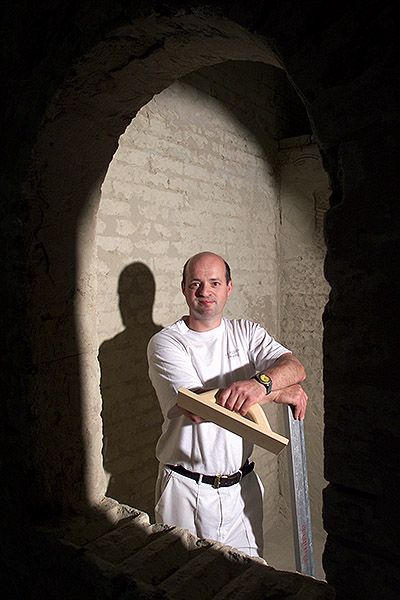
©TSL/Neil Turner. 37 year old retraining as a plasterer  in July 2001.

©TSL/Neil Turner. 37 year old retraining as a plasterer in July 2001.

When most people tai their first steps using lights they try to make the photographs shadowless. The ability to do this is very useful, but sometimes it’s better to place your own shadows exactly where you want them. Some subjects need to be given a distinct treatment.

This portrait of an award winning student was crying out for an unusual image and it was obvious that he would do pretty much anything I asked. The college where he had been studying plastering was a large space divided up into small rooms that the students then practiced their craft in. It was dark and dull coloured with no reflective surfaces so it was pretty much an ideal location for me to work in (apart from the dust).

I quickly spotted a whole series of arches and windows that would serve as a perfect frame to the photograph and set a Lumedyne light up inside the small room.The beauty of working with battery powered kit is that you don’t have to find power points, which were few and far between in the workshop area.

I first tried to shoot with a softbox on the flash unit, but the dull colours and the subjects plain T-shirt made it a pretty boring shot so I decided to shoot without any form of light modifier and removed the softbox in order to get the hard shadow.

The flash exposure was f5.6 at 200 ISO with the softbox in place, but this leapt to f13 with just the metal reflector in place. There was so little available light that everything not lit by the flash was in total darkness. This effect was perfect for the shot. The subject had turned up with few tools and the shot needed a prop or two so we borrowed some plasterers tools and got him to hold them in a way that seemed to relax him. When you are photographing people that are not used to having their picture taken professionally you often need to work as hard at relaxing them as you do in getting the technical bits right. Having some familiar props (teddy bear substitutes) to hand can make all the difference.

I worked hard with this image at getting the composition right by using the arched frame, I tried a couple of other shaped holes too, but this was the best. Getting the shadow in the right place is nothing more or less than trial and error, but using the LCD on the back of a digital SLR helps to shorten that process. I started the shoot working with a 28-70 lens but graduated to a 17-35 pretty quickly. Getting closer to the arch gave me a larger area inside the room to work with and having a six foot tall man, his shadow and some plasterers tools I needed that space.

I think that this photograph helps to demonstrate just how useful adding extra elements into a portrait can be. The props and the shadow help to tell the story as well as making the whole image that little bit more interesting. In the end the picture ran in the newspaper in black and white and the contrast provided by the shadow really helped.

©TSL/Neil Turner. July 2001

©TSL/Neil Turner. July 2001

2013 update and technical footnote:

The camera used was a Canon/Kodak DCS520 with 1.9 megapixels with a Canon 17-35 f2.8L lens. The lighting was a Lumedyne Classic flash system with a 200 w/s pack and a basic head. The DCS520 was great for certain jobs and this kind of lit work suited it down to the ground. The Kodak software was really good and it made it easy to interpolate (upsize) the images by a substantial amount – sometimes as much as 400%.

I used to shoot between 8 and 10 commissions a week and that involved driving an average of 30,000 miles a year. I had an Apple Powerbook G4 and I filed my pictures either using the ISDN line at my flat or using a PCMCIA card with a mobile phone modem built into it. The files that came out of the camera were a native 5.7Mb and generally compressed down to somewhere between 300K and 600K.

I hope to post a few more of these on the blog soon.

Back on the beach

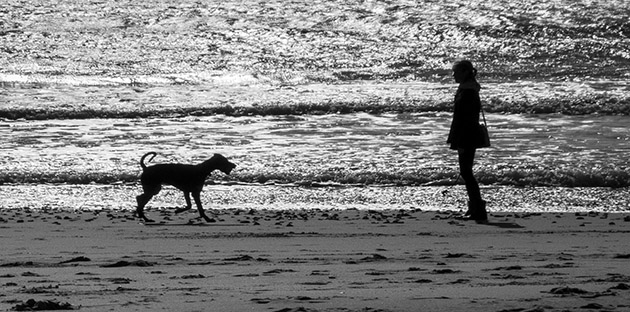
In another “just because” moment I thought that I’d post this picture I grabbed on the beach today. I’ve blogged about my near obsession with shooting dogs on the beach and today I was at my favourite part of my favourite beach when the combination of light and subject matter came together meaning that all I had to do was compose, wait and click.

©Neil Turner, October 2013. Bournemouth

©Neil Turner, October 2013. Bournemouth

I actually saw this picture as a mono image too and anyone who has been following this blog will know that this was a major step forward for me in my quest to be able to truly see in monochrome when I want to. To add the final piece to the jigsaw of this image, I love a good silhouette too.

The picture was shot on a Fujifilm X20 at the fullest extent of its 112mm equivalent zoom and it shows a dog with its owner having something of a difference of opinion about what should happen with a ball. You don’t expect to get such beautiful weather in late October – especially less than 36 hours after a massive storm had lashed this part of the English coast. Within a minute or two of shooting this picture I did a RAW conversion in the camera before using an Eye-Fi card to transfer it to my iPhone 5S where I used the Photogene 4 app to optimise and caption the image before uploading it to EyeEm (in colour). The version shown here is the more considered black and white image converted in Photoshop CC on my Mac at home.

A very old favourite portrait

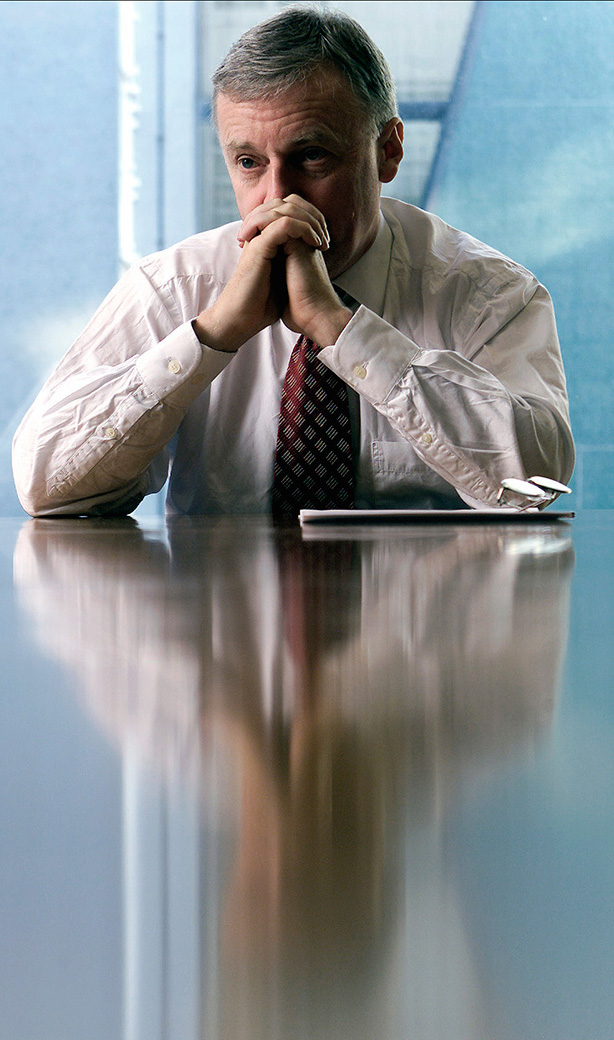
I don’t know if it happens to you when you are looking for something specific but I often search for images and, quite by accident, find something I wasn’t looking for and then that sends me off on a trip down memory lane. I’ve certainly blogged quite a few times in the past about images that meant something to me – either personally or professionally. This portrait of former General Secretary of the Trades Union Congress, John Monks (now Baron Monks of Blackley) was taken in his office at the TUC during an interview with the Times Educational Supplement about his appointment to the Government’s Learning and Skills Council in October 2000.

©Neil Turner/TSL, October 2000. John Monks, TUC General Secretary.

©Neil Turner/TSL, October 2000. John Monks, TUC General Secretary.

The reason that I like this picture is that when I shot it I was delighted to have turned a complete disaster of a shoot into a really nice image. The interview wasn’t going well and the room had a huge picture window which Mr Monks insisted was behind him. The room had dark walls, very dark furniture and no matter how hard I tried the pictures weren’t coming together. I had moved the light (I was working with a single Lumedyne battery powered pack and head with a 70cm shoot through umbrella) to the left of the interviewer and the picture was still boring. There was a decent reflection of the subject in the highly polished table but balancing the lift between the ambient coming through the window and the flash in the room was proving tricky. You need to remember that in those days we were shooting on 1.9 megapixel Kodak DCS520 cameras with tiny LCD screens and you could only get a basic idea of lighting balance.

I was limited where I could place the flash because at that time I was still using Wein optical triggers and the lights in the room had a fault which made them flicker – enough to trigger the flash every second or so. That meant reverting to the emergency back-up synch lead and all of the range restrictions that it placed on where the cable could reach and how it ran around the room.

Gradually I kept changing the shutter speed to allow more and more ambient light into the exposure. I had started at 1/125th of a second at f5.6 on 200 ISO and by the time I got to 1/15th of a second the ambient light really started to kick in and the light reflecting off of the blue tiles and glass in the courtyard outside his window magically took over and eliminated virtually all traces of the gloom and dark wood in the room. I managed to turn the main light off in the room without causing too much trouble – I had to do it because the ambient light inside the room was starting to have an effect on the exposure.

A colourless portrait of a greying man in a dull room sprang into life and I started to relax. This was one of the last frames, shot just as the interview was winding up and it was at 1/8th of a second with the camera resting on the table to try to make sure that there was as little shake as possible. I shot almost all of the interview on a Canon 70-200 f2.8L with a few frames on a Canon 28-70 f2.8L and my old 17-35 f2.8L. Apart from having overcome some difficulties to shoot the portrait, I genuinely loved the colours and I loved the placement of his spectacles. This is a gentle crop that got rid of anything that didn’t add to the overall feel and it quickly became a favourite for a few of the right reasons and many of the wrong ones. That means that it is a good picture and possibly worthy of a place in my portfolio back then but that I was too pleased with my own input to judge that properly!

Sometimes when you shoot pictures through an interview it all goes well and you listen to what’s being said because you are so relaxed. If the pictures are going badly you pick up on the mood of the interview but don’t really hear the conversation. This was definitely a case of the latter. I had no real idea that the interview had been a tough one!

Monochrome and me

I was asked by a good client of mine to have a look at a set of black and white photographs that a new photographer had shot for them. They quite liked them but couldn’t see why they weren’t enthused by them because they fitted the brief. My answer was that if they had been in colour they’d have been seriously dull but that in black and white they were elevated to mediocre because black and white has impact. I tried to find the words to say that for monochrome to work really well you needed the light to contribute to the finished picture in an even more compelling way than it has to for good colour images. That wasn’t to say that great light doesn’t make for great colour pictures – far from it – but by this time my explanation was foundering and I was starting to sound less than coherent. At that point I cut my losses and simply said “to sum up, the light isn’t very interesting and without colour all you have is light and shade”. Wow… nailed it right at the end!

I drove home thinking about my own long and chequered history with shooting black and white: from the first frames I ever shot as a young kid through the exercises in light and shade, focal length and depth of field and movement that I did as a student to the hundreds of rolls I shot as an emerging professional photographer I have never been all that pleased with my ability to consistently shoot interesting black and white images  – ones that I didn’t privately think would look better in colour.

  • Photographic heresy alert – I’m a better photographer in colour and so are 90% of my fellow photographers.
  • Photographic jealousy alert – I envy those who can just “see” in terms of black, white and shades of grey
  • Photographic honesty alert – I have decided to do something about it, 27+ years into my professional career

Thinking long and hard about monochrome and me has been an interesting experience. I’ve found myself examining the way images look through the viewfinder and asking whether the picture I’m about to take relies on colour, light, both or neither. Don’t get me wrong, I don’t have a clipboard or a mental checklist to hand – it’s just a momentary thought that pops up a few times on each job. I’m definitely making progress. I’ve been shooting a lot of events during the Bournemouth Arts By The Sea Festival over the last three weeks and on more than one occasion I knew that some of my pictures were destined to be monochrome, better in black and white.

©Neil Turner, September 2013. The vesry first frame I shot during the Bournemouth Arts By The Sea Festival 2013 - a man reading the programme a few minutes before it all started.

©Neil Turner, September 2013. The very first frame I shot during the Bournemouth Arts By The Sea Festival 2013 – a man reading the programme a few minutes before it all started.

©Neil Turner, October 2013. Mark Kermode playing bass with The Dodge Brothers at the Bournemouth Arts By The Sea Festival

©Neil Turner, October 2013. Mark Kermode playing bass with The Dodge Brothers at the Bournemouth Arts By The Sea Festival

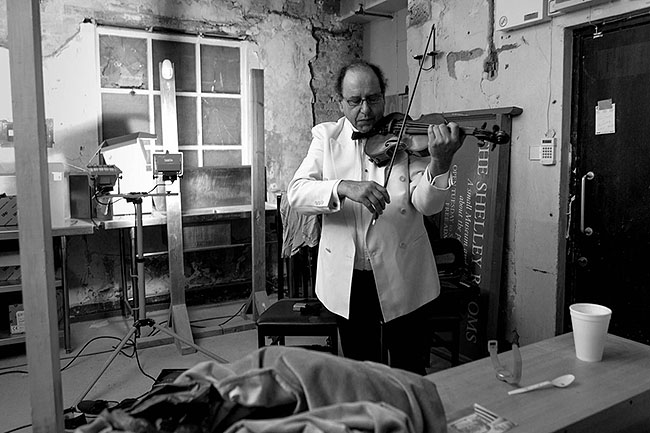
©Neil Turner, September 2013. Violinist Jack Maguire warming up in his makeshift dressing room

©Neil Turner, September 2013. Violinist Jack Maguire warming up in his makeshift dressing room

It isn’t that I’ve never shot anything good in black and white it’s just that most of the time I wasn’t ‘seeing’ without colour. The market for black and white isn’t huge right now anyway and I haven’t had to develop myself in that direction. The funny thing is that it is the explosion of social media and sites like Instagram and EyeEm that have made me experiment more and, more importantly, it has been my love affair with the Fujifilm X20 that has pushed me into shooting pictures that bear little resemblance to the suff that I do for work – often monochrome fits that bill rather well.

Monochrome and Me… it’s been a long and weird relationship. I like to think that it is maturing nicely and that it is now entering something of a golden era. There’s still no money in it but that isn’t really the point.

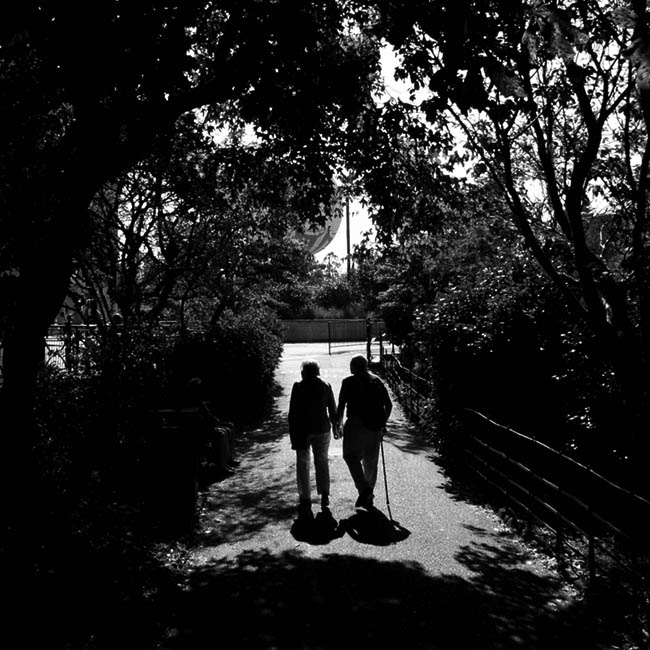
©Neil Turner, September 2013. Pensioners walking out of the Pleasure Gardens, Bournemouth

©Neil Turner, September 2013. Pensioners walking out of the Pleasure Gardens, Bournemouth

Cleaning glass

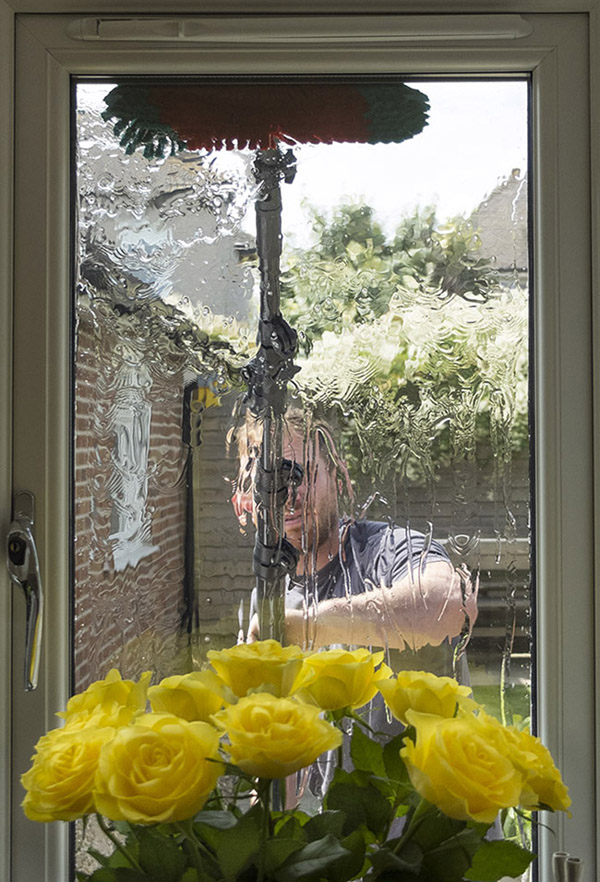
©Neil Turner, August 2013, Bournemouth.

©Neil Turner, August 2013, Bournemouth.

I was looking through a few pictures from this summer this morning when I decided to post this picture just because I liked it. The young man in the photograph is a nephew who has just started his own window cleaning business in the Bournemouth area using filtered water and a long pole instead of ladders, squeegees and chamois leathers. I hope that it takes off and I hope that he gets around to putting this on his website. It was taken with my Fujifilm X20 when I was working at the kitchen table on some pictures that I needed to get to a client and the X20 was the camera that I had to hand.

One thought this morning led, as they inevitably do, to another when I read a posting on a Facebook group by a photographer who has never cleaned their own lenses or their own digital camera chips. Cleaning lenses is too easy to go to the bother of driving to a service centre and parting with money. Obviously if you are at a major sporting event and Canon or Nikon are there you’d be a fool to not take up their offers of free cleaning and checks but beyond that you should learn to do it yourself. I say that as someone who never uses filters on a day-to-day basis as protection and as someone whose home is over 100 miles way from the nearest Canon approved service centre. I also say it as someone who used to be a staff photographer based in London with an employer who picked up the tab for pretty much everything and got quite lazy there for a while! I tend to use the Eclipse solution designed for camera chips along with either a very old quality cotton handkerchief or a soft cloth designed for spectacles. Once I’ve done the glass I usually give the outside of the lens a quick wipe down too – there’s no sense in having dirty gear.

Cleaning camera chips is a whole other matter. Getting it done professionally every once-in-a-while makes sense but at up to £50 + VAT per camera I don’t want to get my chips cleaned as often as I want to get my windows at home done. Of course the “self-cleaning” mechanisms built into today’s cameras really help. In the past it was common to get sizeable amounts of dust on the chip which needed to be removed. These days most of the loose stuff goes away with one or two cycles of the built-in cleaning option. Much of the rest can be loosened or removed using a decent air blower (the rubber bulb type) and if all else fails you can buy the right chemicals and sensor swabs to do a thorough job. If I get an offer of a free clean or I’m having a camera serviced then I always get the chip cleaned too. Canon build in a small sticky strip to catch and keep the dust shaken loose by the piezo-electric motors that do the automatic cleaning every time you turn the camera on and off. The service centre replaces that strip when you take your kit in for an overhaul or repair and it is useful to bear in mind that the strip is only truly effective if a) you have the camera with the baseplate pointing to the ground when the cleaning is in progress and b) the strip gets changed regularly.

Because of the distance I live away from the major repair and service centres I find myself cleaning camera chips using the Eclipse solution every couple of months. It definitely has an effect because I then have to re-calibrate the white balance shifts on the cameras. The end result is that I save a bit of money, a lot of time travelling to and from the service centre and an awful lot of time in post-production not having to remove dust spots. When I travel for work I always take some cleaning kit. I was in India a few years ago now and the dust in my ‘weather sealed’ EOS1D MkII cameras had to be removed on an almost daily basis. I’d hate to think how bad it would have been after a week there without having the kit to do my own cleaning.

It doesn’t have to stop with lenses and chips either. Laptop screens, computer monitors and keyboards are all easy to keep looking their best if you take ten minutes to do so. I used to throw my Domke F-series camera bags into the washing machine (which is how my beautiful grey F1X ended up salmon pink thanks to a stray pair of red socks) and these days I get the vacuum cleaner into my camera bags a couple of times a year.

Having a gutter mentality

OK so it’s a deliberately eye-catching headline and, unfortunately, this blog post is about composing photographs for use in newspapers and magazines rather than anything X-rated. In publishing the ‘gutter’ is the fold or join between the two pages across a spread. It might be pages two and three, four and five or any other combination through thirty-four and thirty-five to the end of the publication. As photographers we have to handle those spreads carefully because there is always a chance that a badly composed or laid out picture can lose a lot of its impact through an important detail disappearing into the gutter. Experienced photographers and thinking photographers always go out of their way to give designers as much flexibility as possible to use their pictures across a spread without losing those important details.

How the pictures look

Here is an example of an image and how it was used. It’s not the greatest picture that I have ever taken but it is a very good example for the purposes of teaching – something I’ve used this picture for many times. You can see where the gutter lies – halfway through and that there is a single column of text on either side of the cropped picture. The designer could easily have laid the page out with two columns of text in white on the darker background or two columns on either the left or right of the spread – they had plenty of choice. That, to a large extent, is because the photograph was shot with design in mind.

6-003

Space on either side of the image with interesting but unimportant detail makes this an ideal editorial photograph in terms of composition. It could even have been cropped to a single page vertical if the layout hd called for the. Arguably it would have been a shame, but that’s the way it sometimes goes. You’ll also notice that the designer has taken advantage of a large dark area within the image to run a headline. Purist photographers hate having their work used (and they’d argue abused) in this way but I am happy for it to happen as long as it doesn’t trample the important details that I have mentioned previously. Put simply, shooting pictures more loosely than you might otherwise do nearly always gives designers more options.

When I’m teaching editing and workflow to other photographers I often see them cropping their images to perfection. The fact that those crops rarely coincide with the shape of the page and the fact that even if they did coincide things often change is something that I spend a lot of time talking about. The only times you get to crop your images exactly how you want to see them are in a) your self-published book and b) your portfolio. Photographers that want to get used over and over again by the same clients provide options and that means a range of pictures many of which have a strong element of flexibility about them.

I absolutely love shooting for editorial clients. I also love working for corporate clients who like to use images in an editorial way. That means that I have to think about what the designers and sub-editors might want to do with my pictures every time I have the viewfinder to my eye. When I was first starting out that was one of the steeper learning curves – easily as tough as correctly exposing transparency film and focusing manual lenses. Twenty seven years on, it has become second nature.

Anniversaries

©TSL. July 2004. Nine years ago this week Canon delivered my first EOS1D MkII. I shot for the first time with it on a job where staff were using acupuncture in a Sussex school to help boys with their behaviour.

©TSL. July 2004. Nine years ago this week Canon delivered my first EOS1D MkII. I shot for the first time with it on a job where staff were using acupuncture in a Sussex school to help boys with their behaviour.

I woke up this morning to the headline news that it was Nelson Mandela’s 95th birthday. It is also my next-door-neighbour’s 50th birthday and my nephew’s partner is having her birthday celebration this evening as well. I started to think about things that had happened on (or near) this day over time in my life and I came up with a few:

  • 18th July 2012: I was working as a member of the Photo Operations team at the London 2012 Olympic and Paralympic games. I have written before about just how exciting, tiring, inspiring and memorable it was but with the first anniversary athletics event about to happen those memories are coming back as strongly as ever.
  • 18th July 2011: I was coming to the end of the very first cycle of the NCTJ Photojournalism course that I help to teach at Up To Speed in Bournemouth whilst shooting a wide range of both editorial and corporate commissions. That was also an exciting time but for very different reasons.
  • 18th July 2010: I was shooting mostly corporate photography and things were starting to go quiet for the summer months. Really quiet as it turned out.
  • 18th July 2008: I was still employed as a staff photographer at TSL and I spent the day shooting a lovely set of pictures at a school in Hertfordshire that had spent a small fortune making their new building and the grounds as environmentally friendly as possible. I was still unaware that two weeks later I’d be called into a meeting with the Editor and the HR Director to be told that they were making me redundant.
  • 18th July 2003: I had been using my Canon ESO1D cameras for over a year and I was in love. The CRW file format was something of a revaluation and I really enjoyed using it.
  • 18th July 1999: http://www.dg28.com had just been born – I started to publish samples of my work and a few bits of technique advice on my own website for the first time.
  • 18th July 1997: I was starting to experiment with borrowed and rented digital cameras before getting my own DCS520 in late October 1998.
  • 18th July 1995: A month previously I got my own scanner (Kodak RFS2035) and Mac laptop (Powerbook 160c) with Photoshop (v2.5) and began the long journey to digitisation
  • 18th July 1994: Having become a staff photographer at The Times Supplements in January 1994 I had just swapped from shooting with Nikon F4s to Canon EOS1n cameras.
  • 18th July 1993: Life was fun, fast and decidedly unpredictable. One day I would be shooting for a newspaper and the next it was a glossy magazine. On the third day it might be a PR job and you could lay money down that every week would be different from the last. I was shooting with a mixture of Nikon F4, F801 and FM2 cameras as well as having Leica M6s. Some days it would be black and white and some days it would be colour transparency. Some days I’d be using lights and others required nothing more than a fast lens.
  • 18th July 1983: I was working for Jessops when they only had five shops, offered great deals and great service and everyone knew the Jessop family. I was using Olympus OM1n cameras at the time and had acquired an awesome 35mm f2 Zuiko lens.

My career has (so far) failed to stand still for more than a couple of years. Technology changes, my employment status changes and I change. All of that adds up to excitement and that triggers a feeling of keeping it fresh. My style constantly evolves and the client base also evolves. A lot of my colleagues spend a lot of time bemoaning the disappearance of the ‘good old days’ and I am also prone to a bit of nostalgia but we are where we are and just under five years ago I wrote this line:

“It’s an exciting time to be a photographer with new challenges being presented every month and I am on record as saying that I am a very lucky man to be doing what I do.”

Today I’m shooting a nice mixture of editorial and corporate work as well as doing some teaching, writing and consultancy. I spend a lot more time on the beach and I’m constantly looking forward to the next exciting development… whatever that turns out to be!