commercial

iPad workflow part three

Welcome to the third instalment of my investigation of the best iPad workflow for the kind of work that I do. At the end of part two I came to the conclusion that adding images wirelessly to the iPad (or an iPhone) was the best way to go for me and in the few days since I made that observation I have largely moved towards using FSN Pro to get the pictures to where I need them to be.

I mentioned several times in part two that I wanted, wherever possible, to avoid storing anything in the Apple Photos app without explaining why I am so keen to avoid it. The simple answer is that my normal workflow for several clients involves keeping the original camera filenames intact so that it is possible to follow up at a later date and find them again without having to spend any time looking. Why Apple are so keen to rename every file with the clumsy “img_1234” formula is beyond me. I guess that it must make what goes on inside iOS easier for Apple – if not for photographers. By avoiding the app it is entirely possible to retain the original filename from start to finish. Don’t get me wrong; if I was rushing and getting a couple of quick edits away to a client then I’d happily rename files and/or settle for the img_xxxx option but when there are five, six or more photographs going through then renaming becomes a pain. (more…)
iPad workflow part two

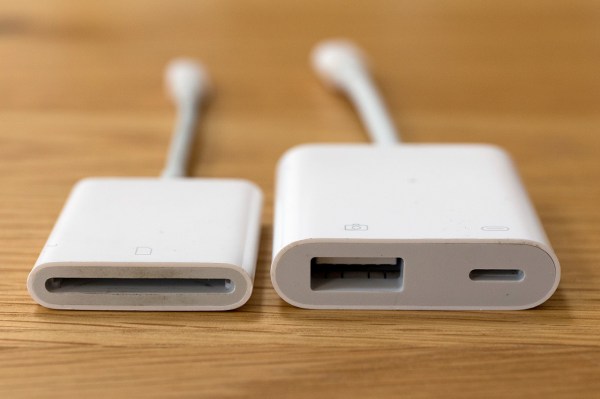
Apple’s Lightning to SD Card and USB3 to Camera adapters

A few weeks ago I promised to keep working on my iPad workflow and keep readers of this blog up-to-date with my thoughts. Lot of other things have got in the way lately but here is the second instalment. I’ve decided to break the whole process down into four parts:

  • Getting the images onto the iPad
  • Toning and captioning them
  • Getting the pictures to where they are needed
  • My conclusions and (hopefully) a settled workflow

The accessories that I’ve used to import images from memory cards onto an iPad for photo editing.Because I’m vaguely logical, I’m going to tackle them in order and so I’m going to outline the ways that I have looked at getting my pictures onto the iPad. Because this is an examination of the possibilities I’m going to consider all of my options and because I’m a Canon user I will tend to lean towards the options for EOS cameras although much of what I’m talking about is not make specific. I have experimented with several ways to get the pictures onto the iPad and I’ve tried all of them as JPEGs and RAW files too: (more…)

A freelancer’s nightmare

It all started with a twinge in the small of my back. The twinge became an ache and the ache became pain. A visit to the Doctor led to some prescription pain killers and a referral to a back-pain clinic two months into the future. Still working at full speed, I lost the feeling in the soles of my feet and had a few cramps. Every day it got a little worse and then, one Sunday morning, I couldn’t get out of bed without crying with the pain. We made our way to the accident & emergency department of the local hospital where an MRI scan confirmed that I was in trouble. They admitted me to hospital and just over a week later I had two operations on my spine.

The operations were three weeks ago today and, although I’m back home, I’m looking at several months before I can even start to think about working as a photographer. I’m on crutches, my rehabilitation is underway and it’s a struggle.

It has to be one of the worst fears of the freelancer – suffering some sort of injury or illness that keeps you from doing your work which in turn means a loss of income and knowing that your clients will have to look elsewhere for someone to provide the services that you have been providing.

All of this devastating news made me want to compose this rather different blog post and my advice comes in two parts:

  • What to do to avoid and prepare for a sudden, unplanned period of time off
  • What to do if it happens to you

The message has to be that it can happen to you. One minute you are buzzing around going from job to job and regularly burning the midnight oil to get those edits done, your cashflow is looking good and your clients keep coming back and the next you are laid up with an injury. (more…)

Shooting fish in a barrel

London. January 2011. © Neil Turner

In 2008 when I had just left my staff job at TSL I was asked by a reporter working for a photographic magazine about what I intended to do with my career. I pointed out that I had an enormous amount of experience working in schools and universities and that in my time working for the Times Educational Supplement, Times Higher Education Supplement and Nursery World Magazine I had shot pictures in over 3,000 places of learning in at least 13 countries and that it seemed like a “no-brainer” to market myself as a photographer specialising in those areas. Plenty of prospectuses and websites as well as editorial shoots later my tally of educational visits and shoots tops 3,500 and I’m still in love with the genre. The reporter asked what special skills I had that made me good at that part of the job and my response was that if you can’t get great pictures of kids then you really shouldn’t be a photographer because it was “shooting fish in a barrel“. (more…)

The third kit fetish

The Phottix 70cm collapsible beauty dish, adapted to fit an Elinchrom Ranger Quadra head.

Everyone knows about the fetish for camera bags shared by most photographers and anyone who has read this blog will know about my own personal one for card readers but there is a third one that has been exercising me of late. I have mentioned it quite a few times over the years and a particular need to have a repeatable set up has led me down this particular equipment rabbit hole once again.

I’m talking about lighting. I’m talking specifically about light modifiers. Those umbrellas, snoots, dishes, soft boxes and hybrid gadgets that you place on the fronts of your flash units in order to control and improve the light. (more…)

RGB and me

I get involved in a lot of discussions about the finer points of photography both online and in person. One of the most common this year has been the about choosing which RGB colour space we should all be working in. The truth is that there are a number of variables which, between them, should point you in one direction or another. There are plenty of RGB colour spaces but the main two are Adobe RGB and sRGB – mainly because these are the options you have when shooting with most DSLR cameras. There are a couple of others (Colormatch and ProPhoto) that offer wide gamuts and some real technical advantages but, as I hope to explain, this isn’t necessarily helpful. More isn’t just a waste, it’s a potential problem.

Ideal Worlds

In an ideal world we would have cameras, viewing and reproduction systems that gave us every tiny subtle variation in colour that the human eye can see on a good day in great light. We don’t. Yet. (more…)

Seven things to agree on before taking a commission

© Neil Turner, October 2014. Production of John Foster's Shot At Dawn in the Council Chamber at Bournemouth Town Hall.

© Neil Turner, October 2014. Production of John Foster’s Shot At Dawn in the Council Chamber at Bournemouth Town Hall.

Quite a lot the posts that I’ve uploaded to this blog in the last few months have been related to the business side of photography. For those who want more of the old dg28 – your time is coming soon. In the meantime I wanted to post my thoughts on what you should agree with your client before undertaking a commission. This is taken directly from my own outline terms and conditions which are posted on my website. I have absolutely no objection to any photographer copying and/or adapting these seven points for use in their own terms and conditions because, in my opinion, the more of us who do this the more likely it is that potential clients will be used to the concepts and it will require less pushing to get them to negotiate. (more…)

How many hours in a day?

freelance_definition
Is there anybody out there who would argue against a ‘working day’ being eight hours? Maybe eight hours spread over a nine hour period with an hour for breaks? However you think about it and whatever your opinion actually engaging in work of some sort for eight hours is a good starting point to talk about ‘a day’s work’.

Like a lot of photographers I tend to base my charges based on full or half days combined with the end use of the pictures. A half day with a fully loaded PR license costs more than a whole day for a single use in a newspaper. Half a day that makes it impossible to do any work through the rest of the day isn’t a proper half day and should be charged at a higher rate. It isn’t always easy to explain to inexperienced potential clients but, compared to other charging methods, it is as easy as I can make it. (more…)