Editorial

Anniversaries

©TSL. July 2004. Nine years ago this week Canon delivered my first EOS1D MkII. I shot for the first time with it on a job where staff were using acupuncture in a Sussex school to help boys with their behaviour.

©TSL. July 2004. Nine years ago this week Canon delivered my first EOS1D MkII. I shot for the first time with it on a job where staff were using acupuncture in a Sussex school to help boys with their behaviour.

I woke up this morning to the headline news that it was Nelson Mandela’s 95th birthday. It is also my next-door-neighbour’s 50th birthday and my nephew’s partner is having her birthday celebration this evening as well. I started to think about things that had happened on (or near) this day over time in my life and I came up with a few:

  • 18th July 2012: I was working as a member of the Photo Operations team at the London 2012 Olympic and Paralympic games. I have written before about just how exciting, tiring, inspiring and memorable it was but with the first anniversary athletics event about to happen those memories are coming back as strongly as ever.
  • 18th July 2011: I was coming to the end of the very first cycle of the NCTJ Photojournalism course that I help to teach at Up To Speed in Bournemouth whilst shooting a wide range of both editorial and corporate commissions. That was also an exciting time but for very different reasons.
  • 18th July 2010: I was shooting mostly corporate photography and things were starting to go quiet for the summer months. Really quiet as it turned out.
  • 18th July 2008: I was still employed as a staff photographer at TSL and I spent the day shooting a lovely set of pictures at a school in Hertfordshire that had spent a small fortune making their new building and the grounds as environmentally friendly as possible. I was still unaware that two weeks later I’d be called into a meeting with the Editor and the HR Director to be told that they were making me redundant.
  • 18th July 2003: I had been using my Canon ESO1D cameras for over a year and I was in love. The CRW file format was something of a revaluation and I really enjoyed using it.
  • 18th July 1999: http://www.dg28.com had just been born – I started to publish samples of my work and a few bits of technique advice on my own website for the first time.
  • 18th July 1997: I was starting to experiment with borrowed and rented digital cameras before getting my own DCS520 in late October 1998.
  • 18th July 1995: A month previously I got my own scanner (Kodak RFS2035) and Mac laptop (Powerbook 160c) with Photoshop (v2.5) and began the long journey to digitisation
  • 18th July 1994: Having become a staff photographer at The Times Supplements in January 1994 I had just swapped from shooting with Nikon F4s to Canon EOS1n cameras.
  • 18th July 1993: Life was fun, fast and decidedly unpredictable. One day I would be shooting for a newspaper and the next it was a glossy magazine. On the third day it might be a PR job and you could lay money down that every week would be different from the last. I was shooting with a mixture of Nikon F4, F801 and FM2 cameras as well as having Leica M6s. Some days it would be black and white and some days it would be colour transparency. Some days I’d be using lights and others required nothing more than a fast lens.
  • 18th July 1983: I was working for Jessops when they only had five shops, offered great deals and great service and everyone knew the Jessop family. I was using Olympus OM1n cameras at the time and had acquired an awesome 35mm f2 Zuiko lens.

My career has (so far) failed to stand still for more than a couple of years. Technology changes, my employment status changes and I change. All of that adds up to excitement and that triggers a feeling of keeping it fresh. My style constantly evolves and the client base also evolves. A lot of my colleagues spend a lot of time bemoaning the disappearance of the ‘good old days’ and I am also prone to a bit of nostalgia but we are where we are and just under five years ago I wrote this line:

“It’s an exciting time to be a photographer with new challenges being presented every month and I am on record as saying that I am a very lucky man to be doing what I do.”

Today I’m shooting a nice mixture of editorial and corporate work as well as doing some teaching, writing and consultancy. I spend a lot more time on the beach and I’m constantly looking forward to the next exciting development… whatever that turns out to be!

Some answers to your questions

A couple of weeks ago I invited people to ask me questions about anything. The idea was to generate some ideas for blog posts because some of the best ones that I have written in the past have been initiated by good questions. I have kept a couple of the most inspiring back for longer answers (and let the questioners know) and I thought that I’d give some answers to some of the other questions now. So, in no particular order, here goes:

Q: Do you do one-to-one training with other photographers and would you be happy to do that in my hometown of Oxford?

A: Yes I do and yes I’d be happy travel if the travel costs were covered. It doesn’t come particularly cheaply but I hope that people who book training with me get an awful lot out of a session. Anyone who has read my blog lately will know that we did a new small group workshop at Up To Speed in Bournemouth a couple of weeks ago. It was a wonderful day with five great people attending the session. You can get in touch with me if you are interested in one-to-one or small group sessions and we can take it from there.

Q: How has you move from London affected your work? Have you tried to hide it from London clients? Do you get any sense that you are looked down upon at all by London-based clients, or have you found benefits in being an out of town photographer?

A: I have always had a home in Dorset, even when I was working as a staff photographer in London. In that respect nothing has changed – I still have bases in both London and Bournemouth. What is different is that I have tried very hard to change the balance of the work that I do so that I can spend a lot more time at home in Bournemouth. My clients all know that I have two bases and one or two have definitely chosen not to pick up the phone for simple jobs that they perceive would involve me popping up to London for a quick portrait or a one hour PR job. The truth is that the vast majority of my photographic work comes from London clients and a big percentage of that is still in London. That’s absolutely fine: I stay up in town as and when I need to. On balance the work that comes from London is better paid, more interesting and more plentiful. The photographic market down here is a lot smaller and there is a relatively large number of photographers chasing that small pool of work. There are one or two photographers down here that will work for stupidly low fees and I am not about to get into a race to the bottom with them. All of that adds-up to the status quo where I am working all over the country for mostly London or overseas clients and less than 5% of my work is locally sourced. The benefits of living down here are self-evident: it’s a lovely place, I was born here and have lots of family and friends here. When I’m not shooting I am able to do the other stuff (like blogging) at home. The drawbacks are all about perception and I spend a lot of time on the phone trying to change negative perceptions.

Q: Best portable light modifier for location work (for the Quadras)? I’m toying with the idea of getting a Rotalux Deep Octa (100cm I think it would be) as an upgrade to my current brolley, grid or small Easybox softbox, and wondered what you have found to be the ‘best’ portable light modifier for your Quadras?

A: Quantify best… For me, it’s all about the compromise between quality of light and ease/speed of use. I have a huge soft spot for the Chimera ProII soft box that I’ve owned for well over ten years. It’s a 32″ x 24″ rectangular box with an inner diffuser that fits onto the Quadra via the Elinchrom soft box adapter and a suitable speed ring. I can assemble and attach it in under a minute (30 seconds if I’m on form) and it rotates on the speed ring allowing either portrait or landscape orientation. I also use a shoot through translucent umbrella. Many years ago I acquired a Lastolite umbrella box which is as quick as an umbrella to put up, almost as cheap as an umbrella and yet give a really nice even efficient light in the way that a soft box does. It has been in and out of my bag over the years as I get bored with doing things the same old way but I recently started to use it again and it finally broke. I have ordered a new one and when it comes I expect to get back to using the umbrella box for a while. I think that the important thing here is to have options and to know when and where to use each of them. I never, for example, use the translucent umbrella outdoors – too much loss of light. The Rotalux deep boxes are great but they are expensive and relatively cumbersome. I have never owned one but I’d like to.

Q: Hello. I own a 5D mark1, 24-105, 430ex2. I work with ambient light & tripod mostly because I’m scared of flash. This is OK for landscapes/architecture etc but not for people shots in low light. I have tried E-TTL in P & Green mode but am always disappointed. Would you have safe manual settings you could share with me for low light people shots?

A: Shooting people in low light requires quite a lot of practice to get great results and shooting direct flash whilst keeping the flash unit in the hot shoe will make getting better results really hard. The ‘secret’ to great flash photography is how you modify the light – bouncing it off of walls, reflectors or almost any surface that will direct the light onto the subject from a pleasing angle is what makes the picture. Shooting modes are a secondary issue. I know people who use E-TTL and some of the auto modes who get great results because they know how to bounce or modify the light. You should experiment with bouncing and you shouldn’t be afraid to try a wide range of surfaces. I wrote about how to approach bouncing a few months ago and that is a good starting point. As far as settings go, you need to think about how much power you have in your flash (not that much) and so you need to use apertures like f4 or f5.6 to conserve the flash power. If you are new to shooting in manual modes you might consider using aperture priority and deliberately setting the ambient exposure at -1 or -2 stops. Alternatively you can set everything manually and use the screen on the back of the camera to judge whether the exposure is a good balance or not. Introducing flash as a secondary light source is scary and you need to take some baby steps. Changing absolutely everything at once is a tough call because you will probably take longer to work out what works for you. If you have some money I’d suggest that you get a small light stand, a white umbrella and a either a Canon ST-E2 remote trigger or a pair of off-camera radio triggers so that you can get the flash out of the hot shoe and open up a world of creative options. After that, many of my old technique samples will make a lot more sense.

Q: The Enterprise and Regulatory Reform Act… How do we fight against the potential legislation this has paved the way for?

A: There are lots of things that we can all do. The first is to get into a dialogue with your Member of Parliament. Ask them to oppose the orphan works proposals as they stand and point out that the work that the Intellectual Property Office has done so far has left photographers and other creators angry and feeling as if the IPO has an agenda which doesn’t include us or our livelihoods. Your MP will almost inevitably write back quoting a generic reply from Lord Younger pointing out that the stripping of metadata is illegal (which is circumvented by so many websites terms & conditions) and that the right to attribution of your work already exists. This is a red-herring of a response and needs to be challenged if you don’t want you MP to think that they have fulfilled their obligation to you. Next, you should keep the discussion up within your professional and social circles. Don’t let the subject drift into the background. The good news is that there are plenty of people working on this as we speak. Stop43, EPUK, the NUJ, the British Photographic Council, the major agencies and The BPPA amongst others are going to meetings with people that matter and keeping up the pressure on the IPO and the legislators. The Stop 43 website is a useful one to bookmark if you want to keep up to date. Finally it is important that we all try to influence those websites (Flickr, Instagram, Twitter, Facebook etc) whose websites strip metadata to change their ways. You can avoid adding images to them or actively use their competitors who don’t strip stuff and you can try to persuade your friends to follow suit. It’s going to be a tough battle and we need as many people to join-up as possible so your efforts in helping others to get involved will be vital.

Thanks to everyone who has sent me questions so far. Please keep them coming…

Ask me anything…

©Neil Turner, June 2012. Dorset.

©Neil Turner, June 2012. Dorset.

Whilst looking back through some of my most popular blog posts in the last few years a surprising number of them were written in response to questions that other photographers and students of photography have asked me. That got me thinking about posting this simple update with a very simple request/offer:

“ASK ME ANYTHING… WELL SOMETHING… ALMOST ANYTHING…”

So not exactly ANYTHING – I’m only going to answer interesting questions about photography and my own work! Please use the contact form or reply to this blog posting. You could tweet me but I might miss that given the avalanche of stuff that goes across my desk each day. I will then pick out a couple of questions and use them to write future blog posts. Great… get other people to come up with the ideas!!!

← Back

Thank you for your response. ✨

Fujifilm X20 – a summary of my thoughts

©Neil Turner, May 2013. Mudeford Spit, Dorset

©Neil Turner, May 2013. Mudeford Spit, Dorset

Just over five weeks after taking delivery of my Fujifilm X20 I’m sitting here trying to gather my thoughts and opinions about this intriguing little camera. It is far from perfect and it doesn’t fulfil all of the requirements that I thought that I had when I bought it. In several areas its performance is below par and working with the RAW files is not as easy as it could or should be. All of that having been said, it has become my constant companion almost everywhere I go and I still find myself adoring using it.

Put simply, there’s something about this camera that you’d struggle to put your finger on but that makes taking pictures with it an absolute pleasure. A couple of weeks ago I posted my first update about the X20 and my experiences using it. I tried to summarise the good and the bad points of the camera. You probably won’t be surprised to find out that my opinions have barely changed:

  • The video is still a pain to use and a bigger pain to import and edit.
  • The high ISO performance is still no better than any other camera with a small chip – awful.
  • The RAW file format .raf is not particularly easy to work with and the screen resolution previews in Adobe Camera RAW are worse than slow to generate.
  • The battery life has graduated to awful from appalling now that I have the menus set up better. I have twice got through two batteries in a single day.
  • The build quality of the battery clip is still suspect.

In fact I could have just cut and paste what I wrote back in April with the slight change that the battery life is marginally less awful than first thought. So those are the negatives. What about the positives? You’ll probably have guessed that they have barely changed either. Colours, tonal range, handling and the sheer joy of using it are all very positive comments that I made before and would support still.

©Neil Turner, May 2013. Mudeford Spit, Dorset

©Neil Turner, May 2013. Mudeford Spit, Dorset

I guess that I will never make it as a camera reviewer. The thought of shooting test charts and ISO range comparisons fill me with dread. In a digital world where figures and absolute measurements are the lifeblood of so many websites you should definitely go to DPReview if you want the numbers laid out and explained.

As someone who owns and uses some of the finest DSLR cameras ever made on a daily basis I want something very different from my compact ‘walkabout’ camera. I make the vast majority of my income from taking pictures and I make the rest from teaching, writing and consulting about photography. For me to want to go out and just take pictures for the joy of it, the camera has to be fun to use. And it is on that simple point that Fujifilm are getting it so completely right with their x-series range. The X100 was a great start and the X10 was a brilliant companion. Since then we’ve had the X Pro1, the XE1, X100s and this X20 to enjoy. The single factor that unites all of these cameras is the pleasure you can take from using them when you spend so much time using other (better?) cameras.

That brings me to the next point. There’s no way that I’d use the X20 instead of a Canon EOS5D MkII or MkIII for a normal assignment but on my own time, taking pictures for pleasure and for the family the Fujifilm X20 is wonderful. It will be beaten at some point and it remains true that it isn’t the best compact  in terms of image quality, speed, flexibility or any of a dozen other quantifiable factors. I propose to introduce a new scale based on the likelihood that you’ll actually bother to take the camera out and use it willingly and with a smile on your face. On that measure, and that measure alone, the Fujifilm gets a perfect ten. Right now, I’m off to the shops to get my morning paper; on foot and with my X20 over my shoulder…

©Neil Turner, May 2013. Stourhead, Somerset.

©Neil Turner, May 2013. Stourhead, Somerset.

Final footnote… I was disappointed with the built-in flash and so I decided to buy a small hot-shoe unit to supplement it. I found that one online retailer was selling the Fujifilm EF20 flash that was designed for the X series cameras at under £90.00 and so I bought it. Not a bad investment; I’ve used it quite a bit and it makes a lot of sense to have it because it fits into a pocket without too much difficulty and even has a limited bounce facility. I’ll try to post something cool shot with it soon.

Editorial portraits folio

Like most photographers I’m always looking at new ways of showing my portfolio. I’ve saved the presentation version of my editorial portraits folio as a QuickTime movie and posted it here. Please let me know what you think. If you look at it without going for the full-sized version the captions are a bit small but, apart from that, I quite like it!

Headteachers or whatever you want to call them…

Almost everyone remembers their head teacher. If they don’t then they will probably remember the Principal, Headmistress, Headmaster, High Master, High Mistress, Direktor or whatever other title the person who led their schools went by. Since 1986 I have photographed hundreds of these people and I have made the journey from being a little bit scared of them through accepting them to being impressed by the work that they do and the huge difference that their being good at their job makes to children and young adults.

I decided to put together a slideshow of some of the headteacher portraits that I have done. Most of the portraits date back to my time at The Times Educational Supplement. I also made the decision to keep them anonymous – I just wanted to show how different they are yet how much they have in common. Some of the Heads featured in this selection are famous in the world of education and one or two have been made Knights or Dames for their services to education. A few have since retired but that doesn’t matter. I don’t want to suggest that the person in charge is the only reason that some schools are better than others but I have yet to visit a successful school that doesn’t have first rate leadership.


The constant software update dilemma

Back in the day we used to occasionally try out new chemicals and different printing papers. We used to experiment with new film stock when it hit the market and, on the whole, it was a welcome distraction from the day-to-day work. In the digital era we have to get new cameras a bit more often and we need to keep our IT current but the biggest battle and the largest dilemma is software. Because I teach a bit and because I am a complete anorak** I always have a look at new software packages as they become available.

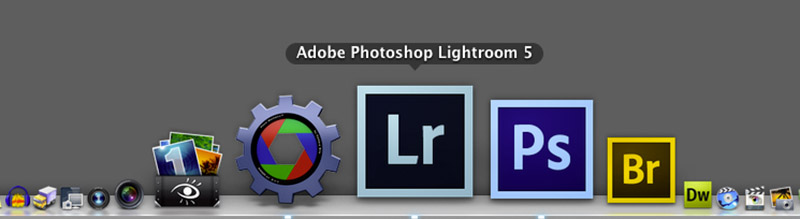
menu_bar_screen_grab

Keeping up to date is not cheap. Upgrades are often necessary – especially when none of the software companies make their RAW converters backwards compatible when new cameras and new lenses hit the market. The move by Adobe towards the monthly or annual subscription model is very interesting and brings into very sharp focus the real cost of having the latest software. I have written before about making the business case for buying new gear and the same formula should apply to upgrading software. Every time I talk or write about these kinds of financial decisions, the same piece of music pops into my head… Bruce Springsteen’s song “Cautious Man” where there is a line that says:

“When something caught his eye he’d measure his need
And then very carefully he’d proceed”

lightroom_5_screen_shot

This week, to misquote the wonderful Fast Show, “I are mostly been playing with Lightroom”. To be more precise I have been looking at the new Lightroom 5 beta that Adobe have made available. This comes against a background of having experimented with pretty much every version of Lightroom since it hit the shops back in 2007 and found that I wasn’t entirely sold on the application despite seeing why others love it so much. And that is a huge part of the software conundrum – there are lots of options that achieve pretty much the same end result but get there via very different routes. If, like me, you shoot RAW pictures you need to have a way of editing, captioning, renaming, converting, saving, delivering and archiving your work. This can be achieved using a single application or you can use three , four or five different ones – it really doesn’t matter as long as your workflow is repeatable, flexible, efficient and accurate.

I will write a lot more about Lightroom 5 when I have really used it properly but I have to say that it seems a lot quicker than the previous version and the interface for Adobe RAW Converter is even closer to to the version that I use in Photoshop CS6 than ever – making using Lightroom a lot easier for me. I have also realised that Adobe’s efforts to create a programme for photographers to edit their work in are bearing fruit. The time has definitely arrived when I could easily do without Photoshop altogether and run pretty much everything from Lightroom. Of course that doesn’t mean that I want to… yet.

Lighting gels… the best in VFM?

Almost all photographers spend money on accessories, gizmos, gadgets and photo-related odds and sods. Sometimes we waste our money but I wanted to put in a brief plug for the things that constantly amaze me by the amount of “bang for the buck” I get from them. I’m talking about lighting gels. They cost a few pounds each and they last for years if you look after them even reasonably well.

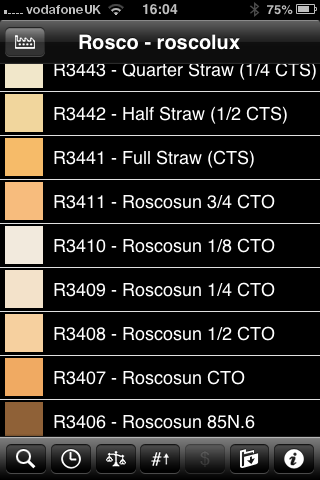
Screen grab from Swatch App

Screen grab from Swatch App

The reason that I am writing this today is that last week I was shooting a job and was slightly embarrassed that the pieces of gel in my lighting kit were looking a bit tatty. I realised that some of them were bought as shared sheets (ie I only had half of a 52 x 61 cm sheet of each) when I was at college in the mid 1980s. I might have added a few more colours and strengths since then but even the newest gel in my bag is five years old. The beauty is that you don’t need to look after them that well really – even a scrunched and screwed up gel is still the same colour and will work. Of course they don’t like extreme heat and they aren’t partial to liquid damage either but at under the boiling point of water and kept dry they are very durable.

When I decided that I needed some new gels I phoned The Flash Centre and they arranged for Rosco to send me some. I have been playing with the iPhone Swatch app for about eighteen months now and it made ordering the new gels rather easy. They arrived rapidly in a strong cardboard tube and all I had to do was cut them down into the right sized pieces to fit into a pocket in my Think Tank rolling case.

This time around I ordered various grades of CTS – that’s Colour Temperature Straw, the gel that changes the light coming out of my flash units to varying degrees of Tungsten right up to the Full CTS which does a very good job of making the Elinchrom Ranger Quadra flash tube into a Tungsten light that very closely matches the Tungsten setting on a Canon EOS DSLR. I also got some ND (Neutral Density) gels and a sheet of a diffuser called ‘tough spun’. I didn’t need to get any effects gels – the purple, orange, red, blue and green gels that I have in the case are fine even if they are old enough to buy alcohol by now.

Comparing the cost of this big batch of new gels to some of the money that I have literally thrown away on rubbish gizmos over the last 30 years I feel very smug. I know that after one single use I will have justified the (tiny) expense and that after the 50th use it will get embarrassing how smug I feel about the VFM (value for money) that you get from quality lighting gels.