photography

Photography compared to…

160408-fairground-074

BOURNEMOUTH, DORSET. 08 April 2016. A fairground on Redhill Common. © Photo Neil Turner – Freelance photographer.

When you try to explain concepts in photography to someone who isn’t deeply embedded in the art/craft/science/passion it makes sense to find something else top compare it to. My favourite comparisons are driving, cooking and sport.

Driving is something most of us do and, on the whole, we do it without having to think too much about the basics. I’ve talked about it before so I’ll quickly recap my thoughts:

Changing gear, using the indicators, knowing when to use windscreen wipers and headlights are all pretty much done on auto-pilot whilst we think more consciously about road awareness, speeds, traffic, navigation and much else besides. The comparison to photography is an easy one to make because there are basic controls that we like to think are second nature; exposure, focusing, making sure we have memory cards and batteries whilst composition and anticipating things happening in front of your camera (and often off to the side and behind you) are things that require more conscious thought.

Tempting though it is to continue stretching the analogy I want to move onto cooking. (more…)
Thinking on your feet

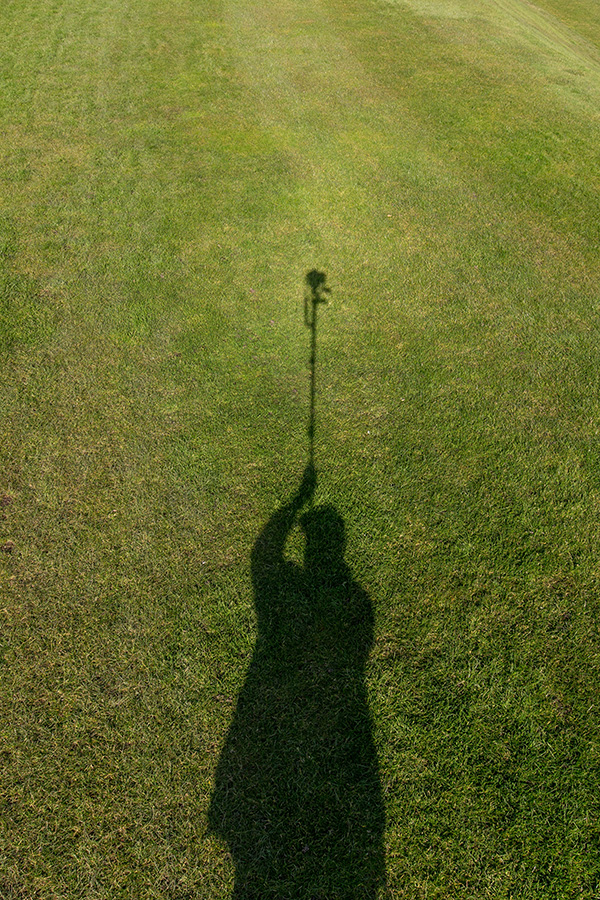
My shadow using a monopod to get a high angle picture. March 2016 ©Neil Turner

My shadow using a monopod to get a high angle picture. March 2016 ©Neil Turner

I was out shooting a job yesterday and needed to get quite a bit of extra height. The best place to shoot the picture from was on the side of a grassy hill which was very wet and the client’s health and safety policies meant that it wasn’t going to be easy to use a step ladder – whilst building a tower was outside the budget. In an ideal world a proper pole-cam or even a drone would have been the best option but the light was right and I needed to improvise.

Having used the Canon EOS6D as a remote via their iPhone app once before I was reasonably confident that my idea would work but the app has been replaced/updated and it meant learning the new one on the job. I had a basic monopod, a tripod head and a Manfrotto Super Clamp in the car but no proper way to attach the phone to the monopod to use as a viewfinder and remote release. With a proper pole-cam you rest the base of the pole on the ground and it is pretty stable. You also have a cradle for the phone or even a tablet if you want to go bigger. I had to tuck the foot of the monopod into my belt to get enough height but I had about an hour so I went into full “1970s Blue Peter” improvisation mode.

The cradle that holds my iPhone in my car was pressed into service and that attached very easily to the Manfrotto Super Clamp. Having extended the monopod to its full height I then attached the clamp to the second stage of the monopod (about eye-level when the whole thing was in use I guessed). Then I stuck the tripod head onto the monopod tilting down a little and put the EOS6D with a Canon 16-35 f4L IS lens on it. Whilst all of this was being done I was downloading the latest Canon Camera Connect app from the Apple App Store.

After a few minutes messing with settings I had the system working. I could use the phone as a viewfinder and a remote release for the Canon DSLR and I set about shooting the pictures without leaving the ground myself. After a minute or two I decided that I needed more height to look down on the subject a bit more and so I tilted the tripod head down a little and when I put the camera back into the air the foot of the monopod was resting on my chest. Even with a camera as light as the 6D I couldn’t hold it up for more than a minute at a time but we got the shot and I only got pointed at (and laughed at) by a small handful of passers-by. I wouldn’t want to have to work this way very often but, having just edited and uploaded the pictures, I know that I have a “Blue Peter”** solution that works.

** Blue Peter was required viewing as a child growing up in the 1970s. They always showed you how to make useful things from odds and ends lying around the house.

The story behind a picture #2

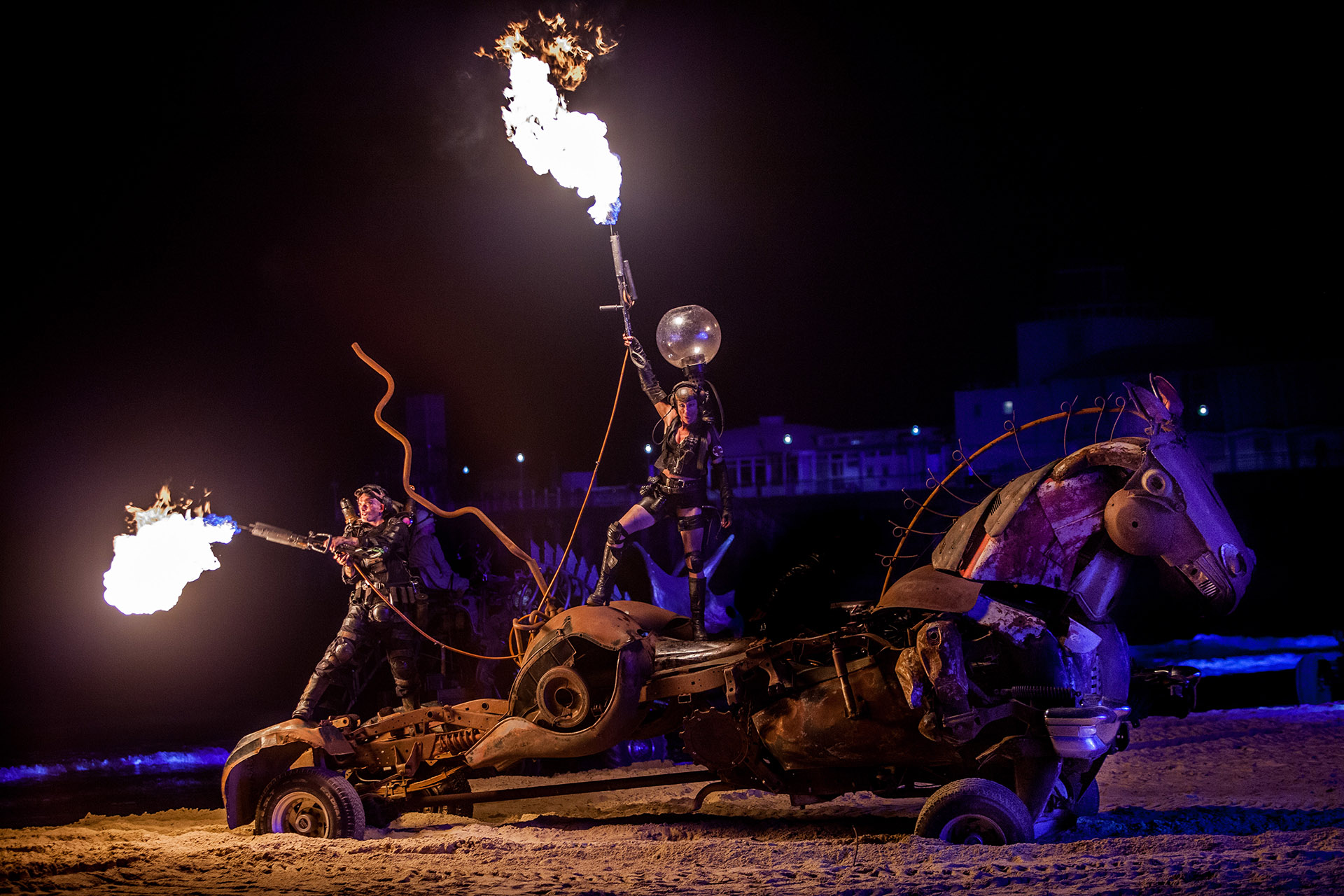
© Neil Turner. Joe Rush and the Mutoid Waste Company stage a spectacular demonstration of their vehicles on the beach next to Bournemouth Pier.

© Neil Turner. Joe Rush and the Mutoid Waste Company stage a spectacular demonstration of their vehicles on the beach next to Bournemouth Pier.

Back in 2013 the Bournemouth Arts By The Sea Festival was getting bigger and better and I was asked to come along and shoot some of the events. The climax of day two was to be a spectacular show on the beach next to Bournemouth Pier by Joe Rush and The Mutoid Waste Company who build and drive fantastic vehicles made from scrap. The organisers had penned off a large area of beach, put up a large public address system and once night had fallen the vehicles and their crews came onto the beach.

I had been there earlier in the festival when some of the vehicles had driven through the town and so I knew roughly what to expect. I got there reasonably early and staked out what I thought would be a good position with the sea and the pier in the background. I had two cameras with me – one with a 70-200 f2.8 and the other with a 24-70 f2.8 zoom lens. I had a couple of Canon speed lights and a high-voltage battery pack, plenty of memory cards and then waited for darkness and the start of the show.

Half a dozen vehicles sped onto the sand and I started shooting away without flash. It was pretty dark, despite the arc lights that had been positioned at various points around the perimeter. These vehicles weigh several tons and one or two of them got caught in the soft sand but that made for great pictures because the people who ‘crew’ them are artists and showmen and they gave the most amazing static display whilst waiting to be hauled free.

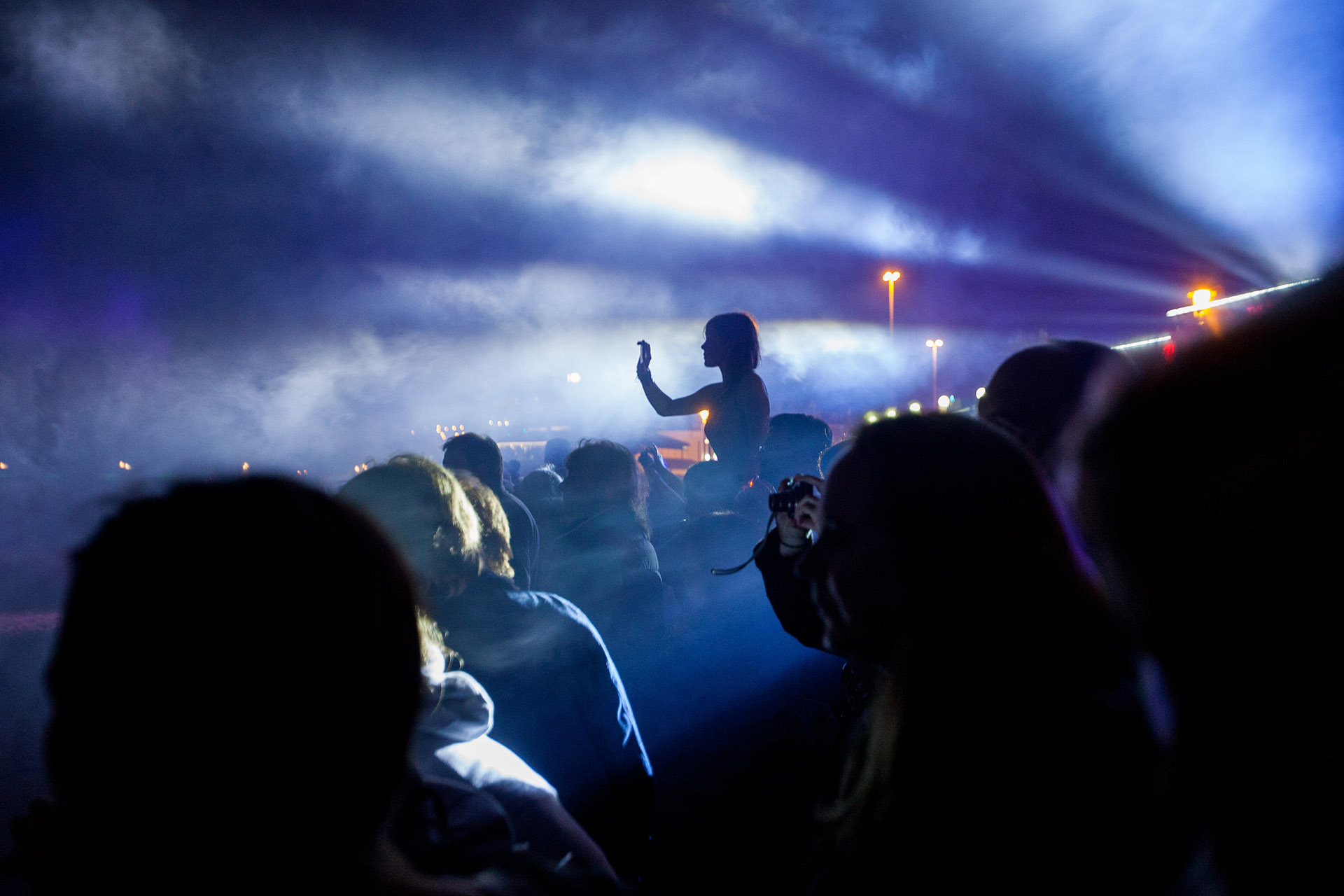
© Neil Turner. Audiences watching Joe Rush and the Mutoid Waste Company  on the beach next to Bournemouth Pier to close day two of the third annual festival.  Photo: © Neil Turner

© Neil Turner. Audiences watching Joe Rush and the Mutoid Waste Company on the beach next to Bournemouth Pier to close day two of the third annual festival.

The edit of the pictures was done in rapid time and sent to the client ready for the next day’s papers and any number of websites and social media platforms and accounts.

The 2015 festival takes place in October and I’m looking forward to seeing some of it up close.

Technical stuff: Canon EOS5D MkII cameras with Canon EF 70-200 f2.8L IS and 24-70 f2.8L lenses. Top picture 1/100th of a second at f2.8 on 2000 ISO with white balance corrected in Adobe Camera RAW. Bottom picture 1/25th of a second at f3.2 on 2000 ISO.

Getting pictures away quickly

Getting photographs to the client has always been one of the less glamorous aspects of being a professional photographer. From sticking a pile of prints into an envelope and handing them to a courier to scanning negatives before using clunky slow modems to deliver them right up until today’s relatively painless methods nobody in their right mind would list this part of the process as either satisfying or easy.

The arrival of social media and the realisation amongst better clients that using our work rather than their own smartphone snaps has meant that we have had to speed things up a lot. I’ve always liked Eye-Fi cards but more recently I have been working with clients and with projects where something even more reliable and configurable is required. The worst part of it is that there isn’t actually one simple solution or workflow that will satisfy all of them in all circumstances. For a lot of jobs transferring the pictures from the camera to a smartphone or tablet before captioning and shifting them to the client is quick enough and I’ve written about that workflow before. New software appears all of the time and I am always looking at ways to make things smarter and quicker by introducing some automation and cutting steps out.

Live Ingest window from Photo Mechanic 5.

Live Ingest window from Photo Mechanic 5.

(more…)

F4 and be there…

06 August 2015. Bournemouth, Dorset. Close up of part of a Canon 70-200 F4L IS lens. Hillcrest Road

06 August 2015. Bournemouth, Dorset. Close up of part of a Canon 70-200 F4L IS lens.

I’ve discussed zooms versus primes far too many times in far too many blog posts to rehearse the old arguments again and at the end of my recent post about zooming with your feet I mentioned investing in some new gear with a promise to follow it up with a blog post – so here it is.

The great New York press photographer Weegee is supposed to have said “F8 and be there” when asked how he got such great pictures. I’m not remotely interested in the debate about whether or not he actually said it but I am interested in the idea of apertures and, more importantly, maximum apertures.

For as many years as I’ve been shooting with zooms I’ve owned and used lenses pretty much exclusively with f2.8 maximum apertures. (more…)

Zooming with your…

©Neil Turner/Bupa 10,000. May 2015. A Police rider accompanies a detachments of Guards as they march back their barracks.

©Neil Turner/Bupa 10,000. May 2015.
A Police rider accompanies a detachments of Guards as they march back their barracks.

I was on a job the other day, standing next to a very young photographer in a ‘press pen’. He glanced over at the gear I was using and mentioned how much he would love to own the 135mm f2L lens that I had on one of my cameras. He said that he had never really got the hang of “zooming with his feet” in the way that so many of the photographers he admired had advised. He had also had it drummed into him by one of his tutors at college and it had left him wondering if he was doing something wrong.

Zooming with your feet is a great concept and it is one of the catchphrases in contemporary photography that appears to be beyond question. But is it? Is it actually as much a cliche as a universal truth?

There we were on a job where we couldn’t have zoomed with our feet even if either of us had the skills to do so. We couldn’t go forward – there was a metal barrier in the way. We couldn’t go backwards because there were other photographers and a couple of TV crews behind us – and behind them was another barrier. We had a tiny amount of sideways movement if we could change places with each other but, apart from that, we were in a very fixed position. (more…)

Having read “Annie Leibovitz At Work”

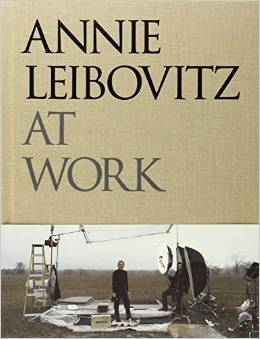
liebovitz_coverI doubt that you’ll be surprised to hear that the vast majority of the books sitting on my shelves at home are collections of photographs. I have books by most of the greatest photographers who ever lived and I find them to be a constant source of inspiration as well as a great help in keeping my feet on the ground. Every time that I need ideas I see what they did and every time I think I’ve done something great I realise that many other people did it before me and often better than me.

One of the biggest sections is the one devoted to Annie Leibovitz. I admire her and I admire her work. I don’t necessarily want to be the kind of photographer that she has become and I definitely don’t want to do the kind of work that she is most famous for but there is a great deal of inspiration there.

For my birthday a few months ago I was given a 2011 copy of her 2008 book “Annie Leibovitz At Work”. It is partly a biography, partly a summary of her professional life and an interesting insight into how she feels about the job that she has done since leaving college. There are also copies of many of her greatest pictures in it – although it’s the words that I want to talk about here.

When I read it a month or so ago I did so immediately after reading Roger Allen’s excellent “The Darkroom Boy 40 Years on Fleet Street” which is a funny and honest look at the life and career of one of the greatest exponents of the newspaper photographer’s craft. (more…)

Photography word of the day

For the past couple of months I have been posting a ‘word of the day’ using the hashtag #PWOTD on Twitter. Some of the words are merely triggers to allow myself to say something about photography and others pretty much sum up what I want to say in a single word. A few have links to other websites and quite a few link to old blog posts on here in the hope that some of the 250+ postings on here reach a few extra people.

After two months it is getting harder and harder to come up with a word every day (OK so I schedule the tweets up to three or four days in advance using Tweetdeck) and I was wondering whether anyone else had any suggestions?

Up until Tuesday 16th December 2014 the words so far:

advice   ambient   backup   bad habits   balance   bounce flash   byline   chimping   clients   colour management   compromise   confidence   consistency   contrast   criticism   default   destination   dusk   editing   empathy   experimentation   family   focus   genre   gutter   inspiration   interaction   juxtaposition   limits   manipulation   metadata   middle ground   mindset   monochrome   obsession   patience   people skills   personal   perspiration   photocalls   portfolio   preparedness   prime lenses   prioritise   professionalism  reaction   research   rules   self criticism   sensitivity   shadows   silhouette   simplicity   social media   teamwork   tripod   uniform   viewpoint   vision   workflow
If you’d like to see them then search the hashtag #PWOTD or have a look through my Twitter feed @dg28com . I’m probably going to take a break from doing the word of the day over Christmas – partly because I hope that everyone is going to be having a break from social media but mainly because I really hope that I am!