London

Having a gutter mentality

OK so it’s a deliberately eye-catching headline and, unfortunately, this blog post is about composing photographs for use in newspapers and magazines rather than anything X-rated. In publishing the ‘gutter’ is the fold or join between the two pages across a spread. It might be pages two and three, four and five or any other combination through thirty-four and thirty-five to the end of the publication. As photographers we have to handle those spreads carefully because there is always a chance that a badly composed or laid out picture can lose a lot of its impact through an important detail disappearing into the gutter. Experienced photographers and thinking photographers always go out of their way to give designers as much flexibility as possible to use their pictures across a spread without losing those important details.

How the pictures look

Here is an example of an image and how it was used. It’s not the greatest picture that I have ever taken but it is a very good example for the purposes of teaching – something I’ve used this picture for many times. You can see where the gutter lies – halfway through and that there is a single column of text on either side of the cropped picture. The designer could easily have laid the page out with two columns of text in white on the darker background or two columns on either the left or right of the spread – they had plenty of choice. That, to a large extent, is because the photograph was shot with design in mind.

6-003

Space on either side of the image with interesting but unimportant detail makes this an ideal editorial photograph in terms of composition. It could even have been cropped to a single page vertical if the layout hd called for the. Arguably it would have been a shame, but that’s the way it sometimes goes. You’ll also notice that the designer has taken advantage of a large dark area within the image to run a headline. Purist photographers hate having their work used (and they’d argue abused) in this way but I am happy for it to happen as long as it doesn’t trample the important details that I have mentioned previously. Put simply, shooting pictures more loosely than you might otherwise do nearly always gives designers more options.

When I’m teaching editing and workflow to other photographers I often see them cropping their images to perfection. The fact that those crops rarely coincide with the shape of the page and the fact that even if they did coincide things often change is something that I spend a lot of time talking about. The only times you get to crop your images exactly how you want to see them are in a) your self-published book and b) your portfolio. Photographers that want to get used over and over again by the same clients provide options and that means a range of pictures many of which have a strong element of flexibility about them.

I absolutely love shooting for editorial clients. I also love working for corporate clients who like to use images in an editorial way. That means that I have to think about what the designers and sub-editors might want to do with my pictures every time I have the viewfinder to my eye. When I was first starting out that was one of the steeper learning curves – easily as tough as correctly exposing transparency film and focusing manual lenses. Twenty seven years on, it has become second nature.

Social media … is it working yet?

A little over two years ago I wrote a blog post about social networking where I asked largely rhetorical questions about whether there was a point to it, which platforms were the right ones and whether or not it made any difference. About three weeks ago I wrote on Twitter that I’d spent half a day integrating my social media – getting my Tweets to show up on LinkedIn and getting my photos posted on EyeEm to show up on Facebook and then getting every single platform to react to one another when I wanted them to. Not only did I set all of that up on the desktop and laptop computers but I also did it on the iPad and the iPhone. Boy, am I ever integrated now!

This morning I added a post on a LinkedIn group about explaining to reluctant businesses why they should be using social media:

“The simplest way to explain it to the doubters is to point to the utter stupidity of NOT using social media in the world in which we currently live. You didn’t need it ten years ago and theres’ a chance it might be past it’s best in ten years time but right here, right now it is the method chosen by a massive proportion of the population for making choices, doing research and engaging with business.”

So… is social media working yet? You wouldn’t expect me to give a clear and unequivocal answer to a direct question that I posed myself would you? Of course not – except there is an answer that I have given a few times when talking about this:

“It isn’t not working”.

How do I explain that? I’d be worried if social media was having a negative effect on my business and career but I have been really careful to avoid the stupidity of posting banal, overly-personal or critical observations on any platform unless they were going to have a positive effect – which is almost never. On a few closed Facebook groups I might be a little less guarded and in private messages I might use the odd bit of cussing but on the whole my social media profiles have been kept clean. That has meant very little controversy, relatively few spikes in activity and a lower profile than I might have gained had I been happy to upset a number of people. That’s all OK but why would I imply that all wasn’t well with social media? Well, the hours spent plugging away haven’t been directly rewarded with more business and it would be hard to quantify the actual benefits of getting out there in the worlds of social media. So in the two years since I first blogged about this I have got a lot better at doing it, gained a few jobs here and there and generally promoted myself positively. I’m going to keep on doing it because I genuinely believe that to avoid social media is a very bad thing.

The irony is that this blog is the one thing that I want people to see, read and interact with. That’s my strategy and that’s why I wanted to get the integration going – the other platforms are there to boost the blog and the blog is there to raise my profile. Whether or not that circle is vicious or virtuous is something only others can decide upon.

©Neil Turner, May 2013. First seen on EyeEm - there are so many ways to promote your business these days!

©Neil Turner, May 2013. First seen on EyeEm – there are so many ways to promote your business these days!

New work – an answer

A few weeks ago now I posted an open invitation for anyone to ask me a question. I received a few and saved some of them until I was ready to answer them. This one has been playing on my mind for quite a while:

“Why don’t you post new pictures on your blog in the way that you used to when dg28.com was the first website I looked at every week?”

That is what I call a question! There are so many parts to the answer that I have decided to list them as bullet-points:

  • I don’t shoot as much editorial work as I used to and a lot of corporate clients don’t want me to post the images shot for them.
  • I don’t have quite as much time to work on websites as I used to.
  • One of the main reasons that I stopped posting new work was that much of it stopped looking ‘new’ and I wrote about that on this blog.
  • Another reason that I stopped was the number of times people asked me to take pictures down.

Now that I am a freelance photographer I need to be very careful about what I post. Social media, blogs and websites are very public forums for thoughts and ideas and it is far too easy to do or say something that harms your business and freelancing as a photographer is very much a business. There’s also an element of protecting ideas. I published fifty technique examples in the period between 1999 and 2008 and I get emails from photographers all over the world saying that some of those lessons changed their practice. I still meet photographers who tell me that they read those pages over and over again when they were trying to develop their own techniques for using portable flash and that is gratifying but now I’m playing a few of my cards a bit closer to my chest because I have developed a few new ways of working that I’m not ready to share outside of my portfolio.

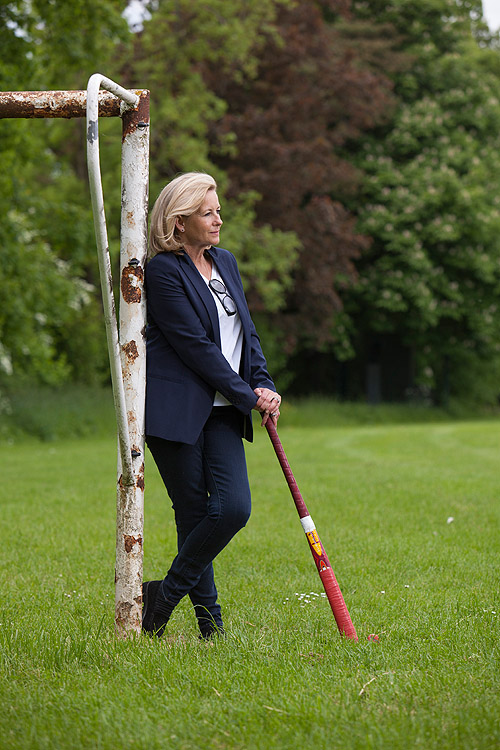
Like I said – there’s no single reason why I stopped posting and I certainly don’t rule out posting some more ‘new’ work over time. As a response to the question that was asked I have decided to post one new portrait that I made a couple of months ago for a women’s magazine. Te story was about three women who had written very personally about their time at school and how that had influenced their later lives. One of the women was journalist and author Gill Hornby and I was asked to photograph her with her dislike of school and team sports in mind. We had a few minutes at a playing field on a less than sunny day and this is the photograph that I liked most:

©Neil Turner. 07 June 2013. Gill Hornby is the author of The Hive (Little Brown).

©Neil Turner. June 2013. Gill Hornby is the author of The Hive (Little Brown).

Anniversaries

©TSL. July 2004. Nine years ago this week Canon delivered my first EOS1D MkII. I shot for the first time with it on a job where staff were using acupuncture in a Sussex school to help boys with their behaviour.

©TSL. July 2004. Nine years ago this week Canon delivered my first EOS1D MkII. I shot for the first time with it on a job where staff were using acupuncture in a Sussex school to help boys with their behaviour.

I woke up this morning to the headline news that it was Nelson Mandela’s 95th birthday. It is also my next-door-neighbour’s 50th birthday and my nephew’s partner is having her birthday celebration this evening as well. I started to think about things that had happened on (or near) this day over time in my life and I came up with a few:

  • 18th July 2012: I was working as a member of the Photo Operations team at the London 2012 Olympic and Paralympic games. I have written before about just how exciting, tiring, inspiring and memorable it was but with the first anniversary athletics event about to happen those memories are coming back as strongly as ever.
  • 18th July 2011: I was coming to the end of the very first cycle of the NCTJ Photojournalism course that I help to teach at Up To Speed in Bournemouth whilst shooting a wide range of both editorial and corporate commissions. That was also an exciting time but for very different reasons.
  • 18th July 2010: I was shooting mostly corporate photography and things were starting to go quiet for the summer months. Really quiet as it turned out.
  • 18th July 2008: I was still employed as a staff photographer at TSL and I spent the day shooting a lovely set of pictures at a school in Hertfordshire that had spent a small fortune making their new building and the grounds as environmentally friendly as possible. I was still unaware that two weeks later I’d be called into a meeting with the Editor and the HR Director to be told that they were making me redundant.
  • 18th July 2003: I had been using my Canon ESO1D cameras for over a year and I was in love. The CRW file format was something of a revaluation and I really enjoyed using it.
  • 18th July 1999: http://www.dg28.com had just been born – I started to publish samples of my work and a few bits of technique advice on my own website for the first time.
  • 18th July 1997: I was starting to experiment with borrowed and rented digital cameras before getting my own DCS520 in late October 1998.
  • 18th July 1995: A month previously I got my own scanner (Kodak RFS2035) and Mac laptop (Powerbook 160c) with Photoshop (v2.5) and began the long journey to digitisation
  • 18th July 1994: Having become a staff photographer at The Times Supplements in January 1994 I had just swapped from shooting with Nikon F4s to Canon EOS1n cameras.
  • 18th July 1993: Life was fun, fast and decidedly unpredictable. One day I would be shooting for a newspaper and the next it was a glossy magazine. On the third day it might be a PR job and you could lay money down that every week would be different from the last. I was shooting with a mixture of Nikon F4, F801 and FM2 cameras as well as having Leica M6s. Some days it would be black and white and some days it would be colour transparency. Some days I’d be using lights and others required nothing more than a fast lens.
  • 18th July 1983: I was working for Jessops when they only had five shops, offered great deals and great service and everyone knew the Jessop family. I was using Olympus OM1n cameras at the time and had acquired an awesome 35mm f2 Zuiko lens.

My career has (so far) failed to stand still for more than a couple of years. Technology changes, my employment status changes and I change. All of that adds up to excitement and that triggers a feeling of keeping it fresh. My style constantly evolves and the client base also evolves. A lot of my colleagues spend a lot of time bemoaning the disappearance of the ‘good old days’ and I am also prone to a bit of nostalgia but we are where we are and just under five years ago I wrote this line:

“It’s an exciting time to be a photographer with new challenges being presented every month and I am on record as saying that I am a very lucky man to be doing what I do.”

Today I’m shooting a nice mixture of editorial and corporate work as well as doing some teaching, writing and consultancy. I spend a lot more time on the beach and I’m constantly looking forward to the next exciting development… whatever that turns out to be!

Some answers to your questions

A couple of weeks ago I invited people to ask me questions about anything. The idea was to generate some ideas for blog posts because some of the best ones that I have written in the past have been initiated by good questions. I have kept a couple of the most inspiring back for longer answers (and let the questioners know) and I thought that I’d give some answers to some of the other questions now. So, in no particular order, here goes:

Q: Do you do one-to-one training with other photographers and would you be happy to do that in my hometown of Oxford?

A: Yes I do and yes I’d be happy travel if the travel costs were covered. It doesn’t come particularly cheaply but I hope that people who book training with me get an awful lot out of a session. Anyone who has read my blog lately will know that we did a new small group workshop at Up To Speed in Bournemouth a couple of weeks ago. It was a wonderful day with five great people attending the session. You can get in touch with me if you are interested in one-to-one or small group sessions and we can take it from there.

Q: How has you move from London affected your work? Have you tried to hide it from London clients? Do you get any sense that you are looked down upon at all by London-based clients, or have you found benefits in being an out of town photographer?

A: I have always had a home in Dorset, even when I was working as a staff photographer in London. In that respect nothing has changed – I still have bases in both London and Bournemouth. What is different is that I have tried very hard to change the balance of the work that I do so that I can spend a lot more time at home in Bournemouth. My clients all know that I have two bases and one or two have definitely chosen not to pick up the phone for simple jobs that they perceive would involve me popping up to London for a quick portrait or a one hour PR job. The truth is that the vast majority of my photographic work comes from London clients and a big percentage of that is still in London. That’s absolutely fine: I stay up in town as and when I need to. On balance the work that comes from London is better paid, more interesting and more plentiful. The photographic market down here is a lot smaller and there is a relatively large number of photographers chasing that small pool of work. There are one or two photographers down here that will work for stupidly low fees and I am not about to get into a race to the bottom with them. All of that adds-up to the status quo where I am working all over the country for mostly London or overseas clients and less than 5% of my work is locally sourced. The benefits of living down here are self-evident: it’s a lovely place, I was born here and have lots of family and friends here. When I’m not shooting I am able to do the other stuff (like blogging) at home. The drawbacks are all about perception and I spend a lot of time on the phone trying to change negative perceptions.

Q: Best portable light modifier for location work (for the Quadras)? I’m toying with the idea of getting a Rotalux Deep Octa (100cm I think it would be) as an upgrade to my current brolley, grid or small Easybox softbox, and wondered what you have found to be the ‘best’ portable light modifier for your Quadras?

A: Quantify best… For me, it’s all about the compromise between quality of light and ease/speed of use. I have a huge soft spot for the Chimera ProII soft box that I’ve owned for well over ten years. It’s a 32″ x 24″ rectangular box with an inner diffuser that fits onto the Quadra via the Elinchrom soft box adapter and a suitable speed ring. I can assemble and attach it in under a minute (30 seconds if I’m on form) and it rotates on the speed ring allowing either portrait or landscape orientation. I also use a shoot through translucent umbrella. Many years ago I acquired a Lastolite umbrella box which is as quick as an umbrella to put up, almost as cheap as an umbrella and yet give a really nice even efficient light in the way that a soft box does. It has been in and out of my bag over the years as I get bored with doing things the same old way but I recently started to use it again and it finally broke. I have ordered a new one and when it comes I expect to get back to using the umbrella box for a while. I think that the important thing here is to have options and to know when and where to use each of them. I never, for example, use the translucent umbrella outdoors – too much loss of light. The Rotalux deep boxes are great but they are expensive and relatively cumbersome. I have never owned one but I’d like to.

Q: Hello. I own a 5D mark1, 24-105, 430ex2. I work with ambient light & tripod mostly because I’m scared of flash. This is OK for landscapes/architecture etc but not for people shots in low light. I have tried E-TTL in P & Green mode but am always disappointed. Would you have safe manual settings you could share with me for low light people shots?

A: Shooting people in low light requires quite a lot of practice to get great results and shooting direct flash whilst keeping the flash unit in the hot shoe will make getting better results really hard. The ‘secret’ to great flash photography is how you modify the light – bouncing it off of walls, reflectors or almost any surface that will direct the light onto the subject from a pleasing angle is what makes the picture. Shooting modes are a secondary issue. I know people who use E-TTL and some of the auto modes who get great results because they know how to bounce or modify the light. You should experiment with bouncing and you shouldn’t be afraid to try a wide range of surfaces. I wrote about how to approach bouncing a few months ago and that is a good starting point. As far as settings go, you need to think about how much power you have in your flash (not that much) and so you need to use apertures like f4 or f5.6 to conserve the flash power. If you are new to shooting in manual modes you might consider using aperture priority and deliberately setting the ambient exposure at -1 or -2 stops. Alternatively you can set everything manually and use the screen on the back of the camera to judge whether the exposure is a good balance or not. Introducing flash as a secondary light source is scary and you need to take some baby steps. Changing absolutely everything at once is a tough call because you will probably take longer to work out what works for you. If you have some money I’d suggest that you get a small light stand, a white umbrella and a either a Canon ST-E2 remote trigger or a pair of off-camera radio triggers so that you can get the flash out of the hot shoe and open up a world of creative options. After that, many of my old technique samples will make a lot more sense.

Q: The Enterprise and Regulatory Reform Act… How do we fight against the potential legislation this has paved the way for?

A: There are lots of things that we can all do. The first is to get into a dialogue with your Member of Parliament. Ask them to oppose the orphan works proposals as they stand and point out that the work that the Intellectual Property Office has done so far has left photographers and other creators angry and feeling as if the IPO has an agenda which doesn’t include us or our livelihoods. Your MP will almost inevitably write back quoting a generic reply from Lord Younger pointing out that the stripping of metadata is illegal (which is circumvented by so many websites terms & conditions) and that the right to attribution of your work already exists. This is a red-herring of a response and needs to be challenged if you don’t want you MP to think that they have fulfilled their obligation to you. Next, you should keep the discussion up within your professional and social circles. Don’t let the subject drift into the background. The good news is that there are plenty of people working on this as we speak. Stop43, EPUK, the NUJ, the British Photographic Council, the major agencies and The BPPA amongst others are going to meetings with people that matter and keeping up the pressure on the IPO and the legislators. The Stop 43 website is a useful one to bookmark if you want to keep up to date. Finally it is important that we all try to influence those websites (Flickr, Instagram, Twitter, Facebook etc) whose websites strip metadata to change their ways. You can avoid adding images to them or actively use their competitors who don’t strip stuff and you can try to persuade your friends to follow suit. It’s going to be a tough battle and we need as many people to join-up as possible so your efforts in helping others to get involved will be vital.

Thanks to everyone who has sent me questions so far. Please keep them coming…

The Press Photographer’s Year

ppy_2013_grab

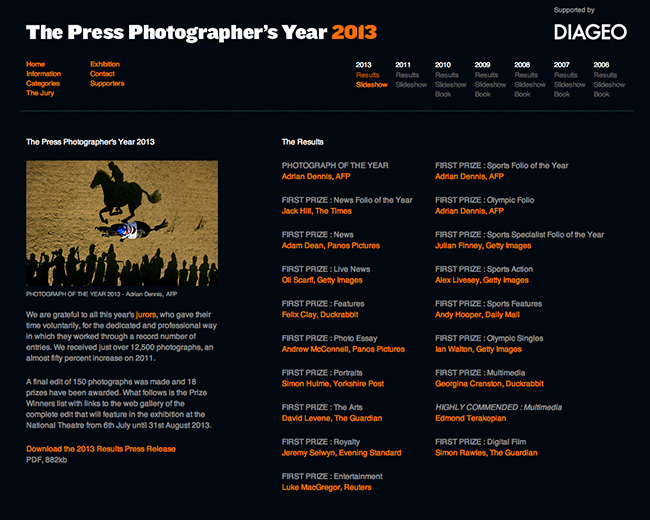
I always have a look at who has won various competitions and I’m always interested to see what the judges go for. Most competitions leave me a little cold but The Press Photographer’s Year is different. Well thought out categories, independently judged (I have to say that, I’ve been on the Jury twice myself) and backed by The BPPA I have always been part jealous and part proud of the winners. Jealous because I never seem to win anything and proud because I can call most of the winners my colleagues and friends

Press photography has a tough time in the UK. It’s undervalued by the publishers and misunderstood by a lot of the public. This year’s batch of winning and selected images will go on show at The Royal National Theatre next Saturday the 6th of July for seven weeks where it will be seen by a huge number of people who wouldn’t necessarily go to a photography exhibition. Please take some time to look at the winners’ slide show on The PPY website and please try to make some time to go to the exhibition and see for yourself just how good the work that these guys produce on a daily basis is.

So, congratulations to Adrian Dennis of AFP, Jack Hill of The Times and all of the other winners and thank you to Diageo for supporting this great project. Maybe next year I’ll actually enter!

Editorial portraits folio

Like most photographers I’m always looking at new ways of showing my portfolio. I’ve saved the presentation version of my editorial portraits folio as a QuickTime movie and posted it here. Please let me know what you think. If you look at it without going for the full-sized version the captions are a bit small but, apart from that, I quite like it!

No such thing as professional?

yahoo_screen

Yahoo’s CEO Marissa Meyer made a stupid remark yesterday whilst announcing a complete overhaul of their Flickr photo-sharing website service. She actually said was that “…there’s really no such thing as professional photographers anymore”. Like many people who used to think that they were professional photographers I became very angry.

What I’d love to happen next is to get commissioned to shoot her portrait for a major newspaper or magazine and to prove her wrong. That’s unlikely to happen, which is a shame. Within a few hours of hearing what she had said I had deleted my Flickr account and let my Twitter followers know that I had done it and why I had done it.

Did Ms Meyer really mean to upset hundreds of thousands of hard-working professionals? Does she really think that our profession has ceased to exist? I suspect that what actually happened is that she made her remark with the subtlest of hints of humour in her voice in order to promote her company’s new-look product. I doubt that it has done too much harm but why do corporates continually keep doing this kind of thing? Gerald Ratner famously compared his company’s gold jewellery to  a prawn sandwich wiping millions of pounds off of its share value and ultimately leading to his downfall. Time after time people at the top who believe their own hype and who think that they can be funny in order to sell their products make this same mistake.

Flickr’s owners won’t apologise. They have sought to make light of her remark because it was ‘light-hearted’ – or at least it was light-hearted in her mind. At a time when the value of photography is, in many ways, at an all-time low the owner of one of the biggest sites based on photography has unwittingly reinforced that perception. Stupid and un-thinking throw-away remarks do damage in ways that only become apparent over time

My business model isn’t based on Flickr. I had about thirty folio images up there simply because it probably pays to have a presence on all of the social media sites. I have probably shot myself in the foot by deleting my account but anger leads to gesture and the biggest gesture that I could make was to leave Flickr.

The point that I really want to make here is that photography does have value. Good photography is, in fact, invaluable. Maybe if the Board of Yahoo realised that they’d actually get their CEO to apologise.