work

Work in progress – an iPad workflow

Whilst I’m not able to be out shooting I have decided to take a serious look at the workflow options using an iPad or even an iPhone and to see whether they really can replace a lightweight laptop in my working life. I have even bought a new iPad Mini 4 (already upgraded to iOS11) because I’m sure that I will be using the tablet for some form of mobile editing. Should you be seeking wisdom and a fully-formed solution I’m prepared to stick a plot-spoiler in here and tell you that it is still very much a ‘work in progress’ and that I don’t have an answer for you. Yet.

My starting point for this is having used my phone as an occasional method of getting pictures away quickly – mostly for clients to be able to use my pictures in their social media and on their websites instead of their own pictures taken with their phones and tablets. If you are prepared to work with JPEG files then this isn’t too tricky, but what if you want to base everything on a RAW workflow? Not so simple?

I know that a lot of photographers have worked out their own workflows for using iPads as their principal location editing devices. I have been trawling blogs and YouTube videos trying to get my head around how and why they have decided to go down this route and the fact that several photographers that I respect and even admire have gone this way means that it has to be a serious option for professional editorial and corporate photography. A lot of the same people, driven by a desire to reduce the weight of their kit, have also gone to mirrorless camera systems.

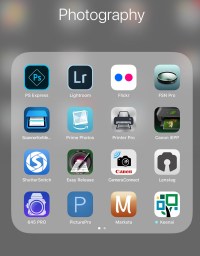
As part of my search I’ve used a LOT of different apps. Amongst others, and in no particular order: Lightroom, FSN Pro, Shuttersnitch, Marksta, PS Express, PicturePro, Transmit, Affinity and the sadly no-longer-supported Photogene4. These range from Lightroom being free with the right Adobe CC subscription to a chunky £49.99 for PicturePro.

So here is what I do know: (more…)

Using the Canon W-E1 wifi adapter

When Canon announced the W-E1 wifi adapter for the EOS7D MkII and the EOS5S and 5SR I was decidedly underwhelmed for two reasons;

  • The first was that it was not backwards compatible with the two EOS5D MkIII bodies that I had at the time.
  • The second was that it took away the ability to record to two cards when it was in use.

At the time I couldn’t see any advantage over any of the SD based transmitters from Eye-Fi or Toshiba amongst others. I didn’t buy one and I couldn’t see myself buying one either.

Fast forward ten months and my need to use remote cameras controlled by an iOS devices has grown and I only had one – the wonderfully simple Canon EOS6D. I didn’t want to use either of the EOS5D MkIV bodies as a remote and so I bought the W-E1 adapter to use in my EOS7D MkII. (more…)

Setting up FTP from a Canon EOS 5D MkIV

A couple of weeks ago I spent a couple of days helping to teach other photographers to send pictures direct from their Canon EOS 5D MkIVs. Over the last couple of years I have taught dozens of people how to do this and set up a huge number of cameras; mostly Canons ranging from the 5D MkII, MkIII and MkIV to the various EOS1D series models as well as various Nikon D4, D4S and D5 models. It’s not rocket science but it is something that takes a lot of practice before it becomes part of your toolkit.

I use this technology all of the time myself and it was suggested to me that I might like to try my hand at making an instructional video. I have a face for radio and so my two thumbs are making a welcome return to the media (last seen holding a power tool in the 1985 Argos catalogue). You might like to check out this old blog post about why I need to get pictures away quickly too.

Here’s a link to the 1080p version on Vimeo
There’s also a 720p option on YouTube.

I’m always happy to answer questions and even happier to get feedback. This is my first real attempt at a “how to” video so be gentle with me!

For those who are interested it was all filmed using a Canon EOS7D MkII and a Canon 24-70 f4L IS lens before being edited in Apple iMovie with some help from Apple Keynote.

Shooting fish in a barrel

London. January 2011. © Neil Turner

In 2008 when I had just left my staff job at TSL I was asked by a reporter working for a photographic magazine about what I intended to do with my career. I pointed out that I had an enormous amount of experience working in schools and universities and that in my time working for the Times Educational Supplement, Times Higher Education Supplement and Nursery World Magazine I had shot pictures in over 3,000 places of learning in at least 13 countries and that it seemed like a “no-brainer” to market myself as a photographer specialising in those areas. Plenty of prospectuses and websites as well as editorial shoots later my tally of educational visits and shoots tops 3,500 and I’m still in love with the genre. The reporter asked what special skills I had that made me good at that part of the job and my response was that if you can’t get great pictures of kids then you really shouldn’t be a photographer because it was “shooting fish in a barrel“. (more…)

RGB and me

I get involved in a lot of discussions about the finer points of photography both online and in person. One of the most common this year has been the about choosing which RGB colour space we should all be working in. The truth is that there are a number of variables which, between them, should point you in one direction or another. There are plenty of RGB colour spaces but the main two are Adobe RGB and sRGB – mainly because these are the options you have when shooting with most DSLR cameras. There are a couple of others (Colormatch and ProPhoto) that offer wide gamuts and some real technical advantages but, as I hope to explain, this isn’t necessarily helpful. More isn’t just a waste, it’s a potential problem.

Ideal Worlds

In an ideal world we would have cameras, viewing and reproduction systems that gave us every tiny subtle variation in colour that the human eye can see on a good day in great light. We don’t. Yet. (more…)

Seven things to agree on before taking a commission

© Neil Turner, October 2014. Production of John Foster's Shot At Dawn in the Council Chamber at Bournemouth Town Hall.

© Neil Turner, October 2014. Production of John Foster’s Shot At Dawn in the Council Chamber at Bournemouth Town Hall.

Quite a lot the posts that I’ve uploaded to this blog in the last few months have been related to the business side of photography. For those who want more of the old dg28 – your time is coming soon. In the meantime I wanted to post my thoughts on what you should agree with your client before undertaking a commission. This is taken directly from my own outline terms and conditions which are posted on my website. I have absolutely no objection to any photographer copying and/or adapting these seven points for use in their own terms and conditions because, in my opinion, the more of us who do this the more likely it is that potential clients will be used to the concepts and it will require less pushing to get them to negotiate. (more…)

How many hours in a day?

freelance_definition
Is there anybody out there who would argue against a ‘working day’ being eight hours? Maybe eight hours spread over a nine hour period with an hour for breaks? However you think about it and whatever your opinion actually engaging in work of some sort for eight hours is a good starting point to talk about ‘a day’s work’.

Like a lot of photographers I tend to base my charges based on full or half days combined with the end use of the pictures. A half day with a fully loaded PR license costs more than a whole day for a single use in a newspaper. Half a day that makes it impossible to do any work through the rest of the day isn’t a proper half day and should be charged at a higher rate. It isn’t always easy to explain to inexperienced potential clients but, compared to other charging methods, it is as easy as I can make it. (more…)

The Photographers’ Summit 2017

screen-shot-2017-02-06-at-11-11-01

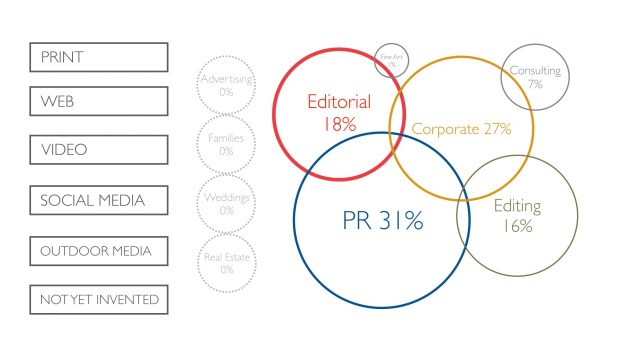
A graphical breakdown of the types of work that I do these days and where the images end up.

I do quite a few talks and lectures throughout the year and I don’t normally discuss the specifics here on the blog because they are rarely open to a general paying audience. This one is different. The National Union of Journalists here in the United Kingdom invited me to run a couple of one hour workshops at a very interesting event they are running in London this Saturday. Titled “The Photographers’ Summit 2017” the day includes the following:

  • Improve your videography skills.
  • Rights & restrictions: how privacy and property laws affect photographers & videographers.
  • Using copyright law to make sure you don’t get ripped off.
  • Moving from staff to freelance photographer.
  • Innovations in photography — 360degree filming and other developments.
  • New models and ways to make money.

The good news is that you don’t have to be a member of the NUJ to attend and it looks likely to be an interesting day. (more…)