pr

How many hours in a day?

freelance_definition
Is there anybody out there who would argue against a ‘working day’ being eight hours? Maybe eight hours spread over a nine hour period with an hour for breaks? However you think about it and whatever your opinion actually engaging in work of some sort for eight hours is a good starting point to talk about ‘a day’s work’.

Like a lot of photographers I tend to base my charges based on full or half days combined with the end use of the pictures. A half day with a fully loaded PR license costs more than a whole day for a single use in a newspaper. Half a day that makes it impossible to do any work through the rest of the day isn’t a proper half day and should be charged at a higher rate. It isn’t always easy to explain to inexperienced potential clients but, compared to other charging methods, it is as easy as I can make it. (more…)

The Photographers’ Summit 2017

screen-shot-2017-02-06-at-11-11-01

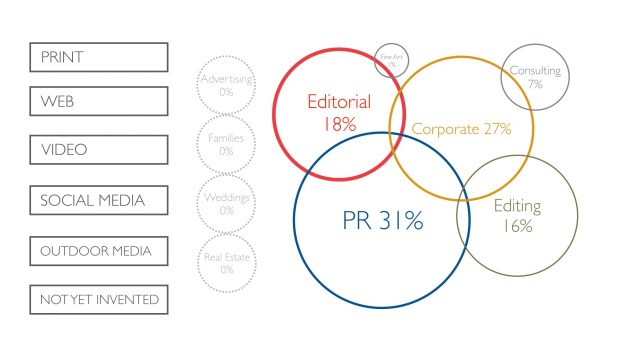
A graphical breakdown of the types of work that I do these days and where the images end up.

I do quite a few talks and lectures throughout the year and I don’t normally discuss the specifics here on the blog because they are rarely open to a general paying audience. This one is different. The National Union of Journalists here in the United Kingdom invited me to run a couple of one hour workshops at a very interesting event they are running in London this Saturday. Titled “The Photographers’ Summit 2017” the day includes the following:

  • Improve your videography skills.
  • Rights & restrictions: how privacy and property laws affect photographers & videographers.
  • Using copyright law to make sure you don’t get ripped off.
  • Moving from staff to freelance photographer.
  • Innovations in photography — 360degree filming and other developments.
  • New models and ways to make money.

The good news is that you don’t have to be a member of the NUJ to attend and it looks likely to be an interesting day. (more…)

Hands and portraits

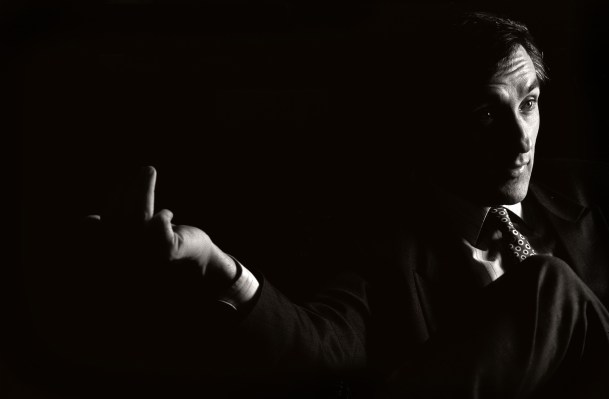
John Redwood MP, photographed during an interview in January 1994. © Neil Turner/Insight.

John Redwood MP, photographed during an interview in January 1994. © Neil Turner/Insight.

It’s January 2017 and like most photographers I am looking forward to the year with a mix of excitement and trepidation. What kinds of challenging and interesting projects are going to come my way in the next eleven and a half months? How is my work going to develop? Am I going to get enough work to pay the bills? Big questions that add to the roller-coaster of emotions that being freelance brings out.

One of the things that I always try to do is look back at some of last year’s work and compare it to older stuff and try to come up with some thoughts that help me to understand my own style better and to make sure that I don’t get tripped up by the same old mistakes. There’s a question that pops into my head about this time every year and it is one that I think that I am finally happy to answer: (more…)

Think Tank Logistics Manager 30

31 May 2016. Bournemouth, Dorset. Think Tank Logistics Manager 30. Hillcrest Road

Think Tank Logistics Manager 30.

A few weeks ago I bought some more Elinchrom Ranger Quadra kit and after a short while lugging my gear around in multiple bags and cases I decided that it was time to get myself one big case to take most or all of my Quadra gear. My rationale was that I am pulling one bag on wheels and carrying two or three others so why not make it one on wheels with the lighting and one smaller bag with cameras and lenses riding on top of it or over my shoulder as required? There’s quite a bit of choice on the market but all of my experience with Think Tank bags told me to start my search there. They make lots of rolling bags but only three specifically designed to lug large amounts of kit. My benchmark was that I had to be able to get at least two of my Manfrotto 156 stands plus a couple of Manfrotto 001s in there along with two or three packs, three or four heads, spare batteries, cables, light modifiers and plenty of accessories.

I had previously seen a colleagues Location Manager 40 case and so I wanted to check out the Logistics Manager 30 because on paper it appeared to be just about perfect. The internal dimensions were listed at 70cm length. (more…)

Thinking on your feet

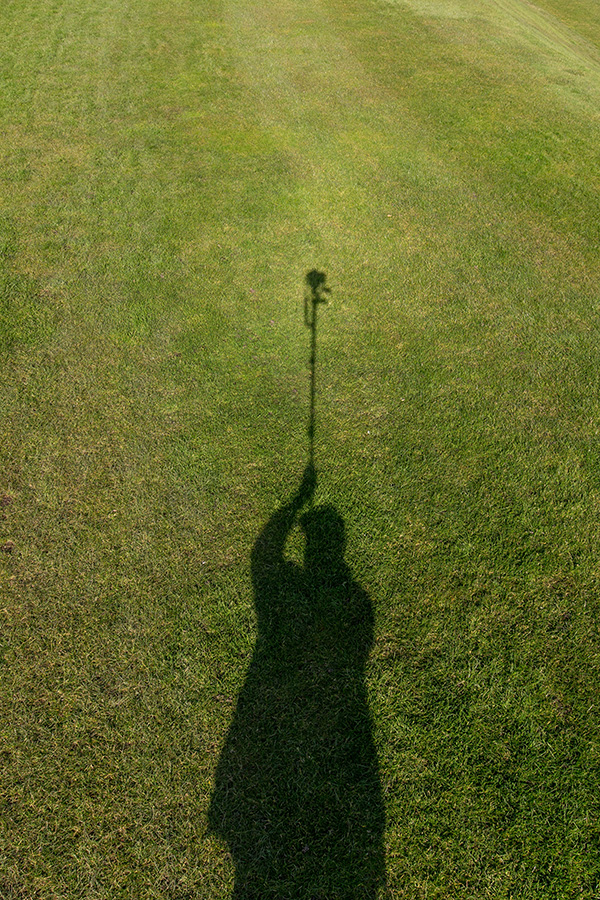
My shadow using a monopod to get a high angle picture. March 2016 ©Neil Turner

My shadow using a monopod to get a high angle picture. March 2016 ©Neil Turner

I was out shooting a job yesterday and needed to get quite a bit of extra height. The best place to shoot the picture from was on the side of a grassy hill which was very wet and the client’s health and safety policies meant that it wasn’t going to be easy to use a step ladder – whilst building a tower was outside the budget. In an ideal world a proper pole-cam or even a drone would have been the best option but the light was right and I needed to improvise.

Having used the Canon EOS6D as a remote via their iPhone app once before I was reasonably confident that my idea would work but the app has been replaced/updated and it meant learning the new one on the job. I had a basic monopod, a tripod head and a Manfrotto Super Clamp in the car but no proper way to attach the phone to the monopod to use as a viewfinder and remote release. With a proper pole-cam you rest the base of the pole on the ground and it is pretty stable. You also have a cradle for the phone or even a tablet if you want to go bigger. I had to tuck the foot of the monopod into my belt to get enough height but I had about an hour so I went into full “1970s Blue Peter” improvisation mode.

The cradle that holds my iPhone in my car was pressed into service and that attached very easily to the Manfrotto Super Clamp. Having extended the monopod to its full height I then attached the clamp to the second stage of the monopod (about eye-level when the whole thing was in use I guessed). Then I stuck the tripod head onto the monopod tilting down a little and put the EOS6D with a Canon 16-35 f4L IS lens on it. Whilst all of this was being done I was downloading the latest Canon Camera Connect app from the Apple App Store.

After a few minutes messing with settings I had the system working. I could use the phone as a viewfinder and a remote release for the Canon DSLR and I set about shooting the pictures without leaving the ground myself. After a minute or two I decided that I needed more height to look down on the subject a bit more and so I tilted the tripod head down a little and when I put the camera back into the air the foot of the monopod was resting on my chest. Even with a camera as light as the 6D I couldn’t hold it up for more than a minute at a time but we got the shot and I only got pointed at (and laughed at) by a small handful of passers-by. I wouldn’t want to have to work this way very often but, having just edited and uploaded the pictures, I know that I have a “Blue Peter”** solution that works.

** Blue Peter was required viewing as a child growing up in the 1970s. They always showed you how to make useful things from odds and ends lying around the house.

Getting pictures away quickly

Getting photographs to the client has always been one of the less glamorous aspects of being a professional photographer. From sticking a pile of prints into an envelope and handing them to a courier to scanning negatives before using clunky slow modems to deliver them right up until today’s relatively painless methods nobody in their right mind would list this part of the process as either satisfying or easy.

The arrival of social media and the realisation amongst better clients that using our work rather than their own smartphone snaps has meant that we have had to speed things up a lot. I’ve always liked Eye-Fi cards but more recently I have been working with clients and with projects where something even more reliable and configurable is required. The worst part of it is that there isn’t actually one simple solution or workflow that will satisfy all of them in all circumstances. For a lot of jobs transferring the pictures from the camera to a smartphone or tablet before captioning and shifting them to the client is quick enough and I’ve written about that workflow before. New software appears all of the time and I am always looking at ways to make things smarter and quicker by introducing some automation and cutting steps out.

Live Ingest window from Photo Mechanic 5.

Live Ingest window from Photo Mechanic 5.

(more…)

Performing the ritual of “The Selfie”

For as long as I can remember I have shot pictures of my wife and I on holiday with a compact camera at arm’s length. I have examples in the family album dating back to 1984 and, whilst I’m not claiming to have invented “The Selfie”, it really isn’t anything new in our house. We started doing those pictures just because there was never anyone else around to take the picture for us and so it was very much a second best picture. Slowly and over the many holidays that we have enjoyed together it became something of a tradition to do at least one of those arm’s length couple pictures but we always liked to get a passer-by to do the picture if we could. It is a phenomenon that I am fascinated by and I often shoot pictures of people as they perform the Ritual of the Selfie.
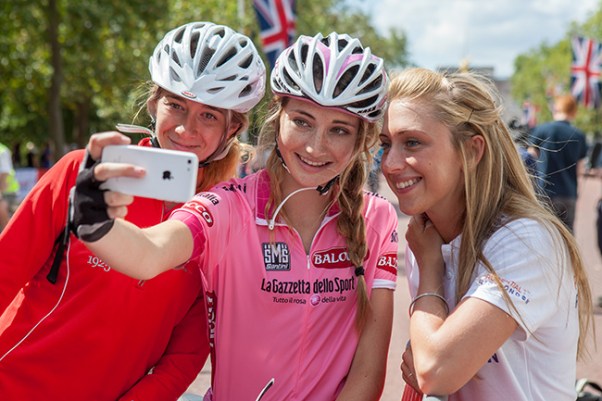
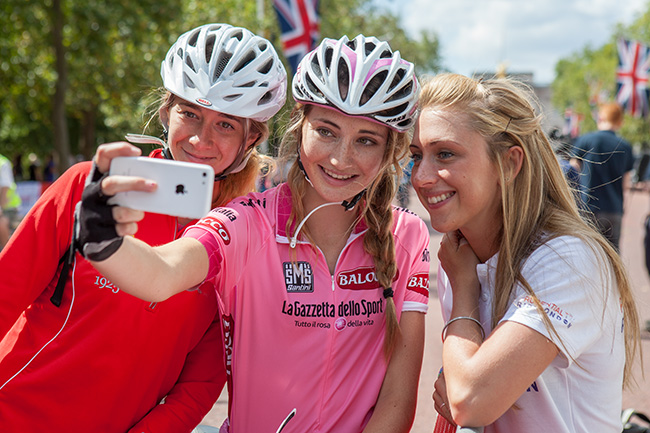
Olympic and Commonwealth Gold medallist Laura Trott posing with riders on The Mall in a break between media interviews during the Freecycle event - part of Prudential RideLondon. 9th August 2014.

Olympic and Commonwealth Gold medallist Laura Trott posing with riders on The Mall in a break between media interviews during the Prudential RideLondon Freecycle event. ©Neil Turner, 9th August 2014.

I was prompted to compose this blog post because I suddenly realised why it works so well. One of the media team working with Prudential RideLondon had offered to take the picture and the three young women dutifully posed but their faces didn’t come alive until they rescued the phone and performed the ritual of the selfie. There seems to be a confidence and a joy in taking your own picture of yourself and your friends or, in this case, you, your friend and an Olympic and Commonwealth champion. Is it because these days that can see themselves in the screen and only shoot when they are happy with what they see? I believe that there’s an element of that in it but the sense of self-reliance is just as important as far as I can see. There is a joy in The Selfie that is missing from a perfectly well taken group photo. Time after time we all saw people enjoying taking self portraits during the event and that’s the case almost everywhere almost every day.

Where I depart from the celebration of The Selfie is where media outlets and PR companies encourage people to do it and post them as part of marketing campaigns. For me the innocence and joy of the ritual gets lost when it is prompted like that. Where I also have an worries about it is when people do it dozens or even hundreds of times a day. I had a link request on EyeEm the other day from a guy who have over 6,000 images on his account and, from what I could see, they were all of himself.

I don’t object to The Selfie at all. In fact I indulge in the ritual myself from time to time. All I’d ask is that marketing people without another great idea stop trying to make something from them that isn’t really there. Photography is about a lot of things and fun is right up there as one of the most important.
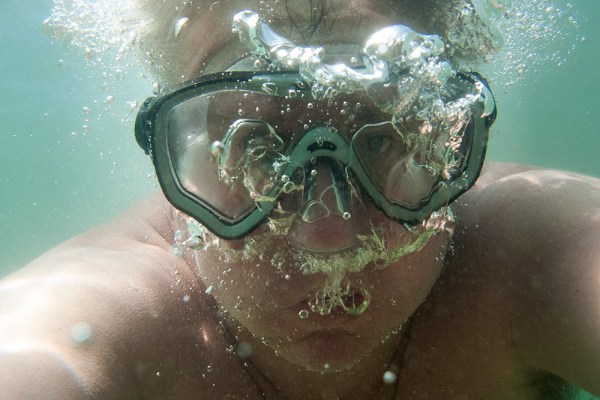
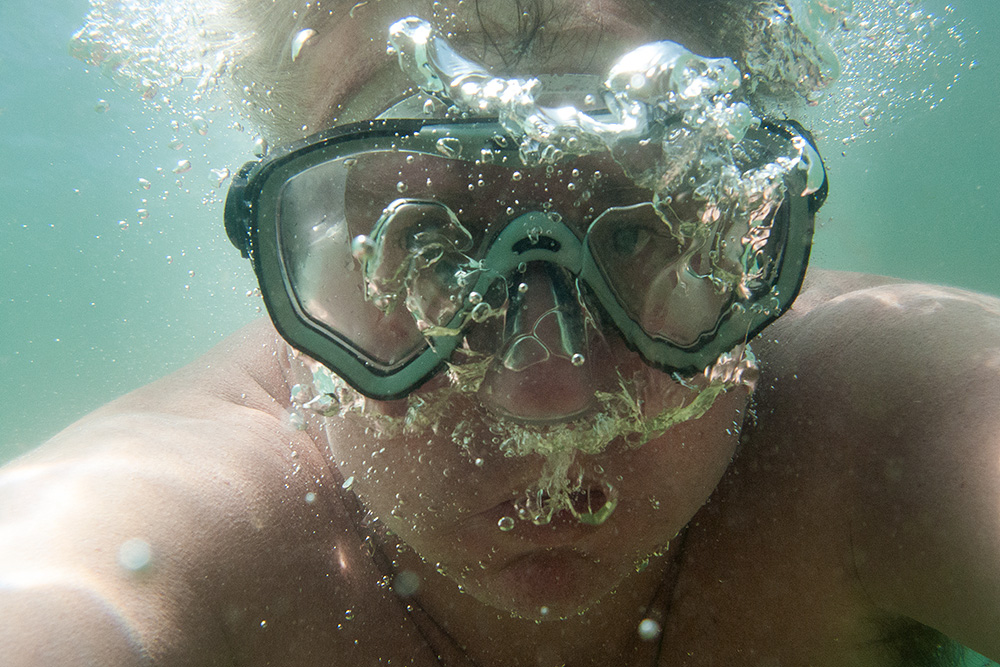
The one "selfie" that I do like of mine - under water at the beach in Bournemouth in the summer of 2013. ©Neil Turner.

The one “selfie” that I do like of mine – under water at the beach in Bournemouth in the summer of 2013. ©Neil Turner.